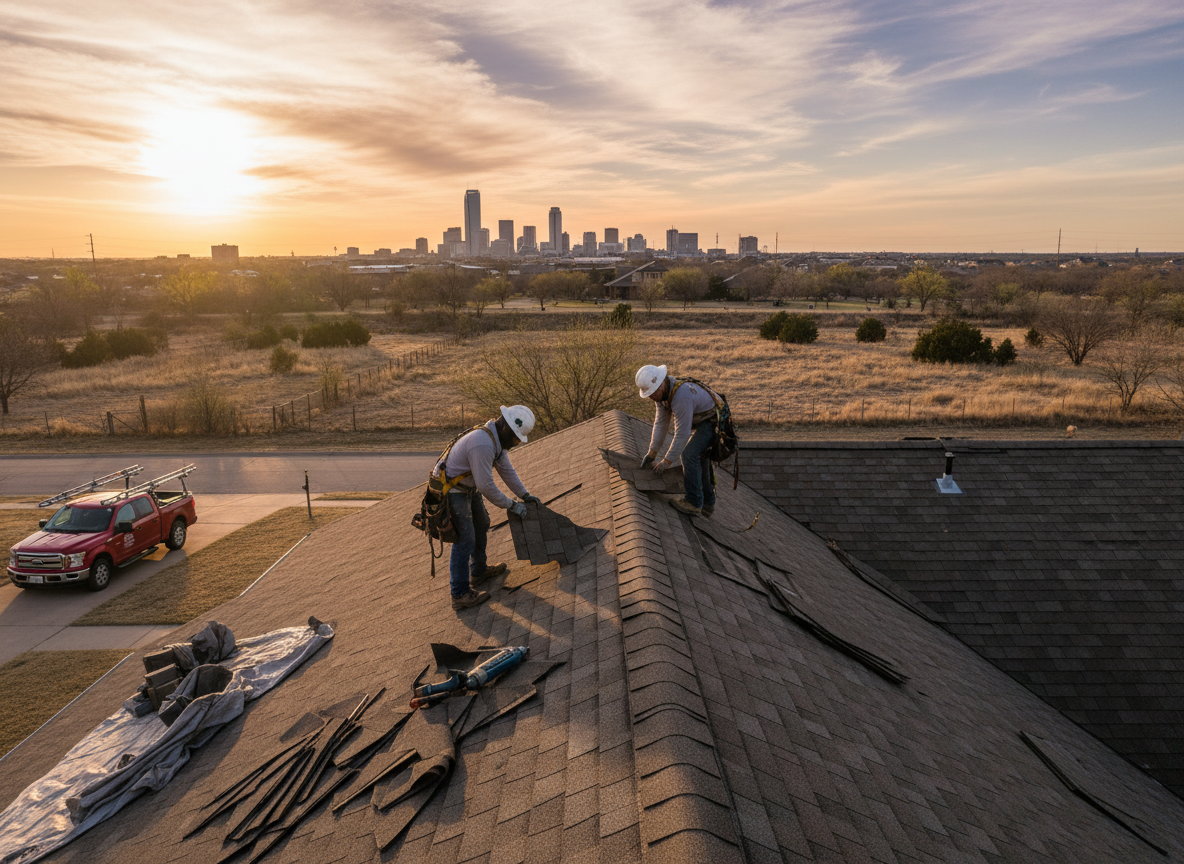
The Midwest is the region where a roof is judged by what it carries rather than by what hits it. Snow sits on it for weeks, melts and refreezes at the eaves, and the water that gets in arrives quietly during a thaw rather than dramatically during a storm. Eight states share that pattern, and the repairs that follow are about weight, ice, ventilation and freeze-thaw rather than about impact.
Eight states built for snow
- Illinois — lake-effect influence in the north-east, humid summers, and a large stock of older masonry buildings with low-slope roofs.
- Ohio — snow, ice and tornadoes in the same year, with a dense older housing stock.
- Indiana — flat terrain, uninterrupted wind, and a mix of rural and industrial roofing.
- Michigan — lake-effect snow belts that can produce very high accumulations in a short distance.
- Wisconsin — long winters, deep frost and snow loads that stay in place for months.
- Minnesota — some of the most severe snow and cold in the country, with a design snow load that reflects it.
- Iowa — open plains, wind, hail and heavy winter snow.
- Kentucky — a milder southern edge, with ice storms and spring hail.
Where we work in the Midwest
- Illinois: Chicago, Aurora, Naperville, Rockford, Springfield
- Ohio: Columbus, Cleveland, Cincinnati, Toledo, Akron, Dayton
- Indiana: Indianapolis, Fort Wayne, Evansville, South Bend
- Michigan: Detroit, Grand Rapids, Lansing, Ann Arbor, Flint
- Wisconsin: Milwaukee, Madison, Green Bay, Eau Claire
- Minnesota: Minneapolis, St. Paul, Duluth, Rochester, St. Cloud
- Iowa: Des Moines, Cedar Rapids, Davenport, Sioux City
- Kentucky: Louisville, Lexington, Bowling Green, Owensboro
Snow load, ice dams and freeze-thaw
Snow load
Snow is weight. A roof is designed for a ground snow load that varies with location and elevation, and the load on the roof depends on the snow's density, its depth and whether it has been rained on and refrozen. A wet snow event can load a roof far beyond what the same depth of dry snow would.
Where the load exceeds what the structure was built for, the first signs are deflection, cracking in the ceiling below and doors that stop closing. That is a structural problem, not a roofing one, and it needs to be treated as such.
Ice dams
An ice dam forms when heat escaping through the roof melts snow on the upper slopes, the meltwater runs to the cold eave and refreezes, and the resulting ice ridge backs water up under the courses. The water then enters the roof assembly and appears as a stain on a ceiling near an exterior wall.
Ice dams are a ventilation and insulation problem expressed as a roofing problem. Clearing the ice helps temporarily; keeping the deck cold and the eave clear is what stops it recurring.
Freeze-thaw
Water enters a joint, freezes, expands and opens the joint further. Repeat that once a year for twenty years and a small defect becomes a structural one. Fascia, soffit, valley metal, flashings and the mortar at chimneys all suffer, and the damage is cumulative rather than sudden.
Wind, hail and tornadoes
Spring brings the other half of the region's weather. Straight-line wind, hail and tornadoes do the same damage here as they do in the plains, and in a year with both a hailstorm and a hard winter a roof can take damage from two directions.
Summer heat and humidity
Midwestern summers are hot and humid, which ages asphalt from above while attic heat ages it from below. In Illinois, Ohio and Indiana the combination produces a shorter shingle life than the same product would achieve in a drier climate.
Shingle country, with ice barrier at the eaves
Architectural asphalt shingle covers the great majority of houses, and the region's roofing economy is built around it. Ice barrier membranes at the eaves are standard practice rather than an upgrade, and ventilation is not optional.
Metal roofing is common on rural and agricultural buildings across Iowa, Indiana, Minnesota and Wisconsin, and it is increasingly chosen for homes where snow shedding is an advantage. Snow guards are fitted where sliding snow would land on a walkway, a doorway or a lower roof.
Low-slope and flat roofs are widespread on commercial buildings and on older urban housing: Chicago's two-flat and three-flat buildings, Cleveland's and Detroit's older stock, and the flat-roofed additions common throughout the region. These roofs deal with ponding, freeze-thaw at seams and blocked drains.
Slate remains on some older buildings in Illinois, Ohio and Michigan, and its repair is a specialist trade requiring salvaged material and a knowledge of how the roof was originally fixed.
Wood shake appears on some older and rural properties, and it is expensive to maintain and to insure in an increasing number of markets.
How winter changes the work
In Minnesota, Wisconsin and northern Michigan, the snow load and the length of the winter dominate every roofing decision. Ice barrier at the eaves, ventilation sized for a house that will be heated for six months, and a structural check before installing a heavier covering are the basics of any replacement.
The lake-effect belts in Michigan, Wisconsin and northern Indiana have a different problem from the rest of the region: snow can arrive in very large amounts in a short distance, and the depth on a roof a few miles inland can be double the depth at the lakeshore. Roofs there are designed accordingly, and drifting against walls, dormers and valleys is a real load case.
In Illinois, Ohio and Indiana, freeze-thaw at the eaves and at the chimney is the recurring repair. Mortar joints open, step flashings lift, and the ceiling stain appears in February rather than in a storm. Repairs there are about renewing details rather than about covering damage.
In the urban cores, low-slope roofs over two-flats and commercial buildings need drainage more than anything else. A blocked scupper in a Chicago February turns into an ice load and a leak, and the repair is usually a drain and a seam rather than a new membrane.
In Kentucky and the southern edges of the region, the weather is closer to the national pattern: ice storms, spring hail and humid summers, with less sustained snow.
Details worth having to hand
The state and city, the covering type and age, and whether the problem appears during snow melt or during rain. Whether the roof has been re-roofed over an existing layer, since that affects both weight and inspectability. Whether ice has been visible at the eaves.
Call (833) 406-0167 and describe what the roof is doing. In this region the first question is usually whether the water is arriving from above or backing up from the eave.