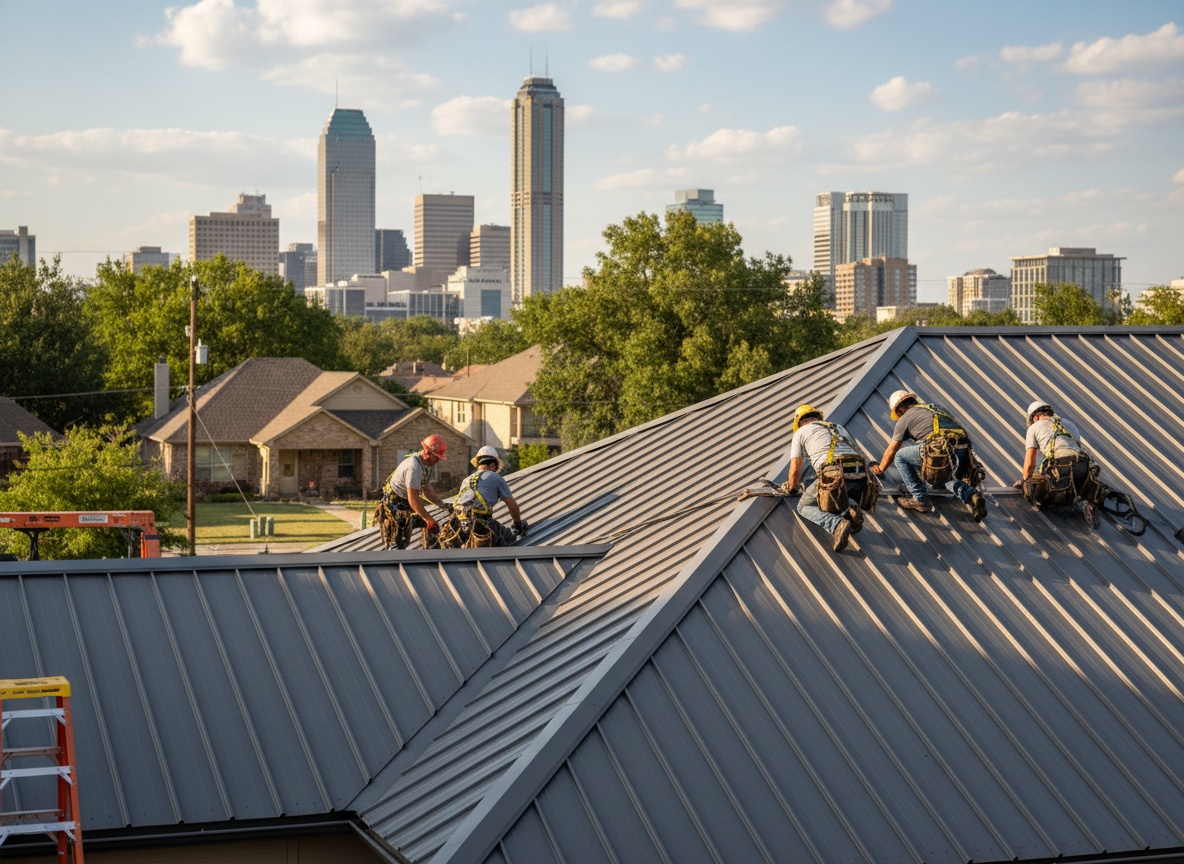
The Northeast is where the age of the housing stock matters as much as the weather. Eight states hold some of the oldest roofs in the country: slate that has been up for a century, built-in box gutters lined in metal, dormers cut into roofs a hundred and fifty years ago, and parapet walls that were never designed for the water they now receive. Add nor'easters, ice dams and a coastal wind exposure, and the work here is less about standard systems than about reading what is already on the building.
Nor'easters and the driven-rain elevations
Nor'easters
A nor'easter combines wind, rain or snow, and a long duration. The wind comes from the northeast, which means the elevations that face it take the driven rain, and the duration means water has hours to find every weak flashing rather than minutes. Roofs here fail at wall junctions, dormer cheeks and the junctions between roof planes as often as in the field.
Ice dams
The Northeast's ice dam season is long and well documented. Snow on an upper slope melts from heat loss, runs to a cold eave, refreezes and backs water under the covering. In older houses with limited insulation and complex roof geometry, the dam forms at dormers, valleys and the base of chimneys, and the resulting water often enters at the wall rather than the ceiling.
Snow load
Ground snow loads in the northern parts of the region are significant, and older structures were not always built with the same margins as modern ones. A heavy, wet snowfall on an old roof is a load event, and the signs of overloading are the same everywhere: deflection, cracking and doors that no longer close.
Freeze-thaw and masonry
Older masonry buildings have parapets, chimneys and copings that hold water and then freeze. The freeze opens the joints, the next rain enters, and the cycle repeats. Roofing repairs on these buildings are as much about masonry and flashing as about the covering.
Coastal wind and salt
Along the coast, salt accelerates corrosion of every metal component: fasteners, flashings, edge metal and vents. A roof that would last inland can fail at its fixings within a decade of salt exposure.
Eight states, from Long Island to the Great Lakes
- New York — coastal exposure on Long Island and in New York City, severe snow upstate, and a vast stock of flat and low-slope urban roofs.
- Pennsylvania — old masonry housing, box gutters and slate, with ice in the west.
- New Jersey — coastal wind and flooding, plus dense older suburban housing.
- Massachusetts — nor'easters, snow, and some of the oldest roofing in the country on Cape Cod and in Boston.
- Connecticut — a similar coastal and inland split in a small area.
- Virginia — a milder south, with hurricane remnants and heavy summer storms.
- West Virginia — mountain snow, steep pitches and rural housing.
- Maryland — coastal exposure on the bay and the Atlantic, and dense older city housing.
Slate, box gutters and urban flat roofs
Slate is the region's signature covering, and it is found on churches, institutional buildings, and a significant number of houses from the late nineteenth and early twentieth centuries. Slate that is sound will outlive its flashings several times over, which is why a slate roof is repaired rather than replaced, and why the repair depends on finding salvaged material of the same size and thickness.
Asphalt shingle covers most of the twentieth-century housing, and its failure here is driven by freeze-thaw and ice rather than by heat. Ice barrier at the eaves and ventilation are the details that decide how long it lasts.
Low-slope and flat roofs cover urban housing and commercial buildings: built-up roofing, modified bitumen and single-ply membranes. In New York, Philadelphia and Baltimore, these roofs are everywhere, and they are where parapets, scuppers and box gutters meet.
Built-in or box gutters are a particular feature of older cities. They are lined channels formed into the roof structure, and when the lining fails, water goes directly into the building rather than over the edge. Repairing them is specialist work, and it is one of the most common sources of ceiling damage in older housing.
Metal roofs appear on rural buildings, on some Victorian houses and on churches, and standing seam is increasingly used on modern homes where snow shedding matters.
Wood shingle and shake survive on Cape Cod and parts of New England, and they need specific maintenance and, in some markets, specific insurance arrangements.
The cities we cover
- New York: New York City, Buffalo, Rochester, Syracuse, Albany, Yonkers
- Pennsylvania: Philadelphia, Pittsburgh, Allentown, Erie, Harrisburg
- New Jersey: Newark, Jersey City, Trenton, Atlantic City, Paterson
- Massachusetts: Boston, Worcester, Springfield, Cambridge, Cape Cod towns
- Connecticut: Hartford, New Haven, Stamford, Bridgeport
- Virginia: Richmond, Virginia Beach, Norfolk, Arlington, Roanoke
- West Virginia: Charleston, Huntington, Morgantown, Parkersburg
- Maryland: Baltimore, Annapolis, Frederick, Rockville, Ocean City
Dense urban cores versus upstate
In New York City and the dense urban cores, the roofing conversation is about flat roofs and parapets. Built-up and modified bitumen membranes, scuppers, leaders and the flashing where a roof meets a neighbouring building are the recurring items, and access is usually the constraint: a roof reachable only through a hatch, with no space to stage material.
In upstate New York and western Pennsylvania, snow and ice dominate. Ice dams at dormers and valleys, freeze-thaw at chimneys and box gutter linings that have reached the end of their life are the common repairs, and the buildings are often old enough that the details are bespoke.
On Cape Cod, Long Island and the New Jersey shore, wind and salt are the drivers. Fasteners, edge metal and flashings corrode faster than inland, and a nor'easter-driven rain finds wall junctions and dormer cheeks first.
In Virginia and Maryland, the weather is milder but the exposure is not trivial: hurricane remnants bring intense rainfall, the bay coast has its own wind exposure, and older city housing in Baltimore and Richmond has the same box gutter and parapet issues as Philadelphia.
In West Virginia, steep pitches, mountain snow and rural access define the work. A roof that would be a straightforward repair in a suburb becomes a logistics exercise on a slope with no vehicle access.
What to have ready before you call
The state and city, the covering type if you know it, the age of the building rather than only the roof, and whether the problem appears during snow melt, during rain, or after wind. Whether the building has box gutters, since that changes the diagnosis entirely.
Call (833) 406-0167 and describe what you are seeing. In this region the first question is often what the building already had before the roof that is on it now.