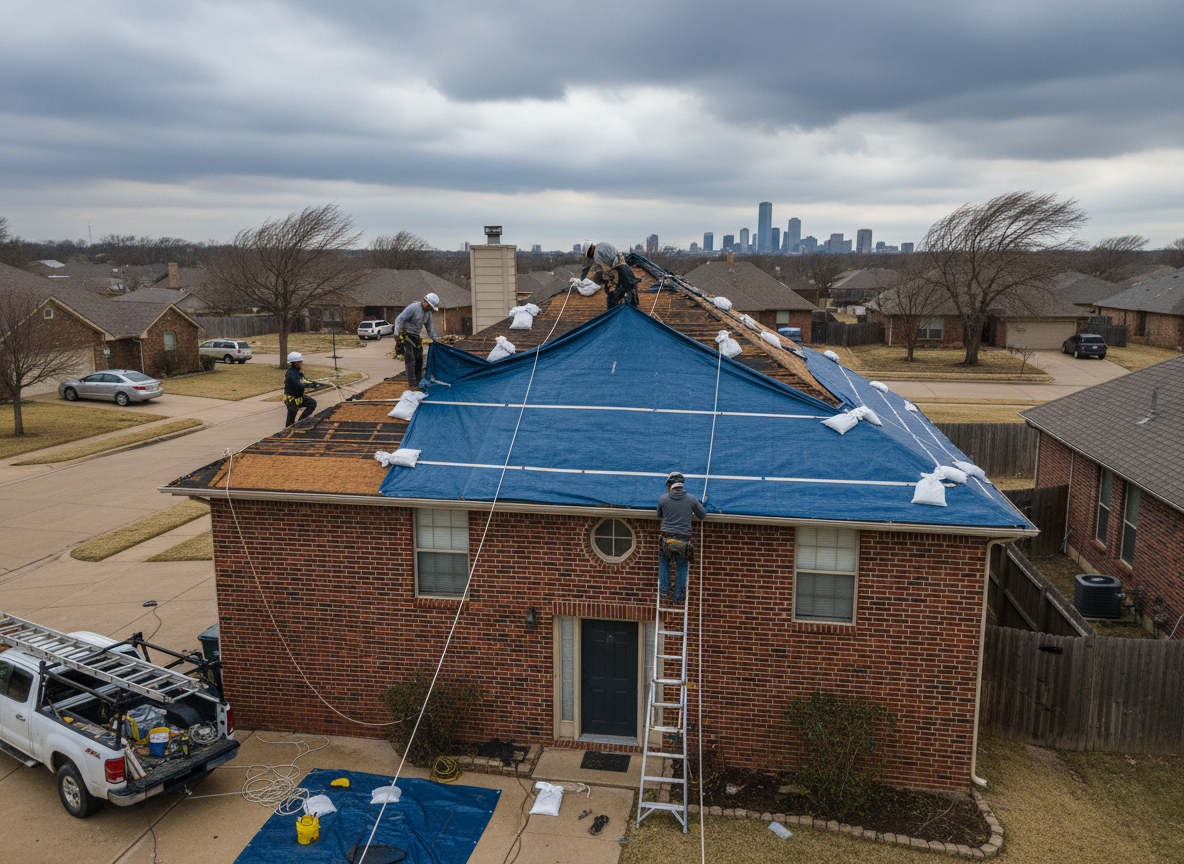
A tarp is the least glamorous object on a roofing website and one of the few that earns its place. When a covering has been opened by wind, punctured by a falling limb or left exposed by a repair that cannot be finished in the weather, a properly installed temporary cover is what keeps the difference between a damaged roof and a damaged building. Emergency roof tarping is a measured job: the cover has to be the right size, pitched so water leaves it, fixed so it does not become a sail, and recorded so the permanent work knows what it is repairing. Across the forty states covered here, from the hail belt to the hurricane coast, that principle does not change. What changes is what the tarp is fighting: impact, uplift, snow, or sun.
What a Temporary Cover Is For, and What It Is Not
A tarp does three things. It sheds water away from an opening. It stops wind from working at a loose edge and lifting more of the covering. And it gives the building a window in which the permanent repair can be scheduled without the interior taking on more water every time the sky darkens.
It does not do four things that homeowners often expect. It does not repair the roof. It does not restore insulation or a ceiling that has already been soaked. It does not make a structural problem safe. And it does not last indefinitely: a woven polyethylene cover left in place through a summer of ultraviolet light will degrade, and the fastenings will work loose as the material slackens.
That is why a cover is always described with a duration in mind. A cover installed before a storm front arrives has days of useful life. A cover installed because a replacement is scheduled in a fortnight has weeks. A cover installed on a building that is being sold or left empty needs to be checked, not assumed.
Choosing the Cover
Three properties decide whether a cover is fit for the job: weight, reinforcement and size.
Weight is usually expressed in thickness for polyethylene sheeting. A light sheet sold for painting drop cloths will shred in the first gust. A reinforced cover with a woven scrim holds its shape and resists tearing at the fastening points.
Reinforcement matters because a tarp fails at its fixings long before it fails in the field. Eyelets, hemmed edges and a scrim embedded in the plastic all spread the load. So does the method: a cover is fixed to the structure, never to the covering alone, and never in a way that creates new holes through a membrane that was previously watertight.
Size is the part that gets underestimated. The cover should extend well past the damaged area on every side and, on a pitched roof, run far enough down the slope that water leaving it lands in the gutter rather than on the sheathing. A cover that stops halfway down a slope pours water onto the deck beneath it. A cover that stops short of the ridge lets wind get under the leading edge.
Fixing It Without Making the Damage Worse
On a pitched roof with an exposed deck, the usual approach is an over-the-top cover: one piece of material running from below the damaged area to over the ridge, with timber battens fixed along the line of the rafters above the cover and the covering, so the fastenings grip structure rather than sheathing alone.
On a tile or slate roof the approach changes. Tiles are brittle, they are laid to overlap, and they are not a surface to walk or fix through. A cover usually runs from the ridge down over the tile field, held by battens fixed at the eaves and ridge rather than punched through individual units, and the entry point is addressed as a detail rather than a hole.
On a low-slope membrane roof, ballast or mechanical fixing is used, and the cover is laid with the laps running with the fall of the roof so water does not stand in a fold. Anything laid on a flat roof has to be checked for ponding, because a cover that holds water is heavier than one that sheds it and will pull at its own edges.
On metal, fasteners are placed through the ribs and never through the pan, and care is taken not to trap water in the corrugation. On a standing seam roof, clamps that grip the seam without penetrating it are used where they are available, because every hole in a metal panel is a future leak.
Wind, Snow and Sun: Three Different Problems
A tarp is a sail. On the Gulf and Atlantic coasts, and anywhere a convective storm can produce a gust front, the wind load on a loose cover is the main risk: it can lift the material, tear it at the eyelets and, worst of all, pull at the very edge that was already vulnerable. Covers in these conditions are fixed at closer centres, with the windward edge turned under.
In the snow-load north, a cover has a different enemy. Snow sitting on a tarp adds weight to a roof that may already be carrying more than its design load, and meltwater refreezing at the eaves can back water under the cover. Here the cover is kept as free of ponding and drift as possible, and the eaves are watched for ice rather than only for tears.
In the desert Southwest and the interior mountain states, ultraviolet exposure is what kills a temporary cover. A sheet that would last a winter in Ohio can embrittle in a summer in Arizona, and the fastenings can loosen as the material shrinks and hardens. Covers there are checked sooner, and are treated as a short bridge to permanent work rather than a seasonal solution.
How the Visit Runs
The first step is an assessment rather than an installation. What opened, how large is the opening, what is underneath it, and what is the weather expected to do in the next few days? A cover that would be adequate before a dry week is not adequate before a front.
The second step is access and safety. Wet roofs, storm conditions, steep pitches and skylights are reasons to work from ladders and edges rather than from the field. Nothing about a temporary cover justifies a fall.
The third is the cover itself, installed as described above, with the windward edge secured first and the laps running with the fall.
The fourth is the record: photographs of the opening before the cover, of the cover in place, of the fastenings, and a written note of the material used, the area covered and the date. That note is what tells the next roofer what is under the tarp and how long it has been there.
What the Cover Cannot Tell You
A tarp hides the damage it protects. That is the point, but it has a consequence: nobody can assess the deck, the underlayment or the extent of the water damage from above while a cover is in place. Any scope agreed while a roof is covered is provisional, and should say so.
The interior evidence is what carries the assessment forward. Staining that stops spreading suggests the cover is holding. Staining that keeps growing, or damp that moves along a wall, suggests water is still arriving somewhere the cover does not reach, most often at a wall junction or a penetration rather than at the opening itself.
When a Cover Is the Wrong Answer
There are situations where covering a roof is not the right response, and saying so is part of the job.
If the deck has lost structural integrity, a cover is not a repair to the structure and the area should be made safe and kept clear. If water is entering at a wall rather than through the roof, a roof cover does nothing at all and the elevation has to be addressed. If the damage is a single failed flashing that can be renewed the same day, covering the whole slope is unnecessary work. And if the building is unsafe to access, no temporary work should be attempted from the roof at all.
After the Cover Comes the Scope
The useful output of a tarping visit is not the tarp. It is the information that lets the permanent repair be specified properly: what was exposed, how long it was exposed, what the interior showed, and which details were already failing before the storm arrived.
That scope should list materials, quantities and labour as separate lines, with the permit position stated for the state and county the building sits in. Whether a permit is needed depends on the jurisdiction and the scope, and it is always easier to establish before the work than after it.
If a roof is currently open, call (833) 406-0167 and describe what is exposed. Say what state and city the building is in, and whether the opening is at a slope, a ridge, a valley or a wall: the answer to each is a different cover.
What the Cover Includes
A tarping visit covers more than the sheet itself. It covers the measurement of the opening, the choice of fixing method for that covering, the installation from the windward edge, and the photographs that show the damage before the cover went on. It also covers the honest statement of what the cover does not protect: a wall junction, a second opening, a penetration outside the covered area. The written note lists the material, the area covered and the date, so the next person on the roof knows what is underneath.
How it works
- 1
Assess the opening
What failed, how large it is, what sits beneath it and what the weather is going to do next.
- 2
Agree the cover and the access
Material, size and fixing method chosen for the covering, the pitch and the wind exposure.
- 3
Install from the windward edge
Battens or clamps onto structure, laps with the fall, nothing punched through a sound membrane.
- 4
Record what is underneath
Photographs and a written note, because the cover will hide the damage it is protecting.
- 5
Set the permanent scope
A written repair scope with materials, labour and the permit position for your jurisdiction.