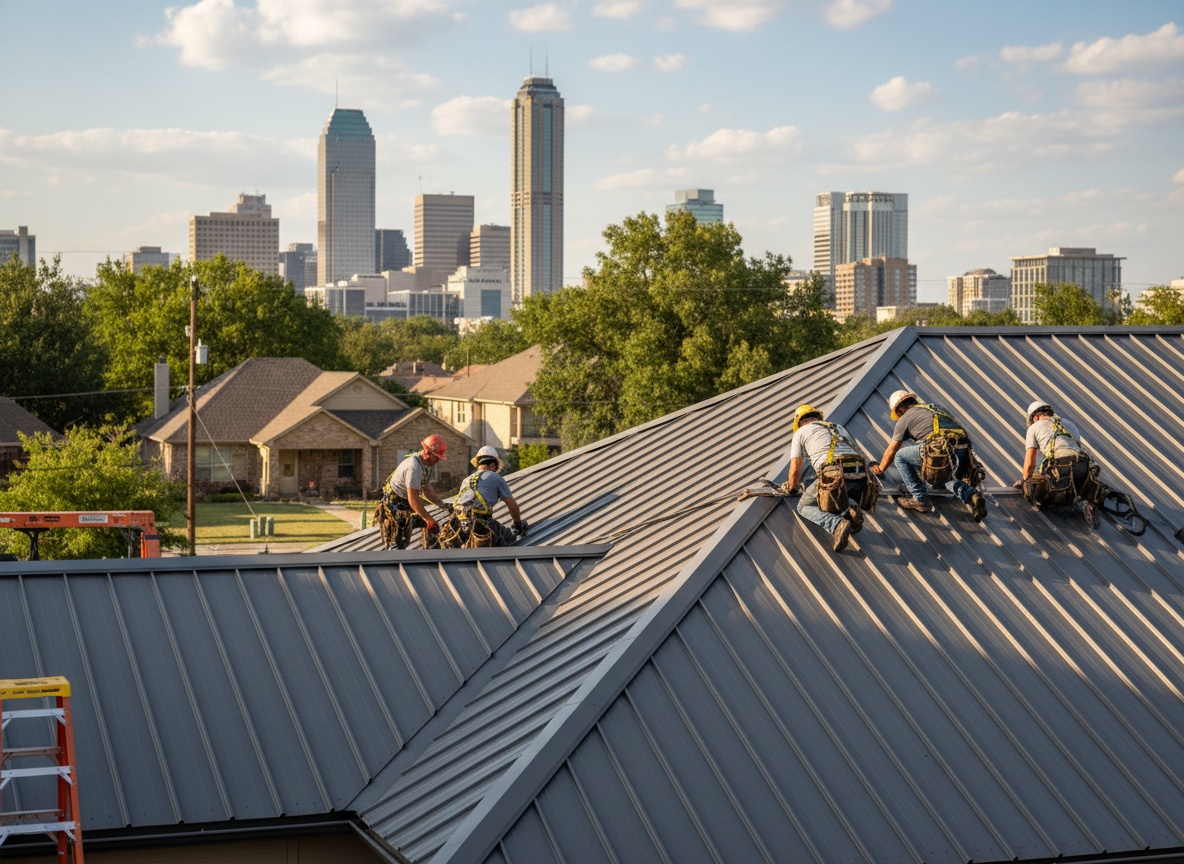
Metal is chosen for a reason, and the reason differs by state. On the hurricane coast it is chosen for uplift resistance and for a surface that does not tear. In the mountain west and the northern tier it is chosen to shed snow and to survive freeze-thaw. In the desert it is chosen for reflectivity and for a lifespan measured in decades rather than in granule loss. On farms and rural buildings across the Midwest it is chosen because a through-fastened panel is cheap, repairable and walkable. The material is the same family; the system is not, and the details that decide performance change with the climate.
The Three Families of Metal Roof
Standing seam is the system most people picture. Panels are formed with raised seams and fixed with concealed clips, so the fasteners do not penetrate the weather surface. The seam allows the panel to move thermally while the clip holds it to the deck. It is the most weather-tight of the metal options and the most expensive to install, because the seams have to be formed or crimped on site and the details are all bespoke.
Exposed fastener panels are screwed through the face of the sheet into purlins or battens, with a sealing washer under each head. They are quick, inexpensive and very common on agricultural and commercial buildings. Their weakness is the fastener: the washer compresses, the screw backs out or the hole elongates as the panel moves, and each of those becomes a leak.
Metal shingle and stamped panel products imitate slate, tile or shake. They give a metal roof the appearance of another material, with the fixings usually concealed behind the course above. They perform well where the substrate and the pitch suit them, and their details are manufacturer-specific.
Thermal Movement and Why It Matters
Metal expands and contracts more than any other common roofing material, and a fifty-foot panel can move a noticeable amount between a cold night and a hot afternoon. Every detail on a metal roof has to accommodate that movement: clips that slide, fasteners in slotted holes, ridge and eave closures that allow the panel to travel, and flashings that are not rigidly fixed at both ends.
Where movement is restrained, the panel fights the fixing. The result is oil canning, elongated fastener holes, opened laps and, eventually, a leak at a seam. Almost every premature metal roof failure is a fixing design problem rather than a material problem.
Condensation and the Underside
Metal is a vapour barrier. Water vapour that reaches the underside of a steel or aluminium panel condenses there, and in a cold climate that condensate drips onto insulation and ceiling structure. This is why metal roofs are usually installed over an underlayment or a warm-roof build-up with a ventilated cavity, and why a metal roof fitted directly to a bare deck in a heated building can produce damp that looks like a leak.
The solution is a separation layer and ventilation, or an insulated panel system. Retrofitting either after the roof is on is expensive, so the build-up belongs in the specification.
Snow, Ice and Snow Guards
In the northern tier and the mountain states, a metal roof does what it is chosen to do: it sheds snow. That is an advantage for load and a hazard for people and property below. Snow sliding off a roof can take a gutter with it, bury a doorway, or land on a parked car, and snow guards or snow fences are fitted to hold the slab until it melts or breaks up.
Ice dams behave differently on metal than on shingle. The smooth surface means water can back up under the panel edge if the eave detail allows it, so the closure at the eave and the underlayment beneath the panel matter as much as they do on any other roof.
Hail and Impact
Hail dents metal, and whether that matters depends on the metal and the panel. A soft aluminium or copper panel can be dented by modest hail without any loss of watertightness. Steel panels resist denting better, and heavier gauges better still. Standing seam panels can sometimes be dented at a seam in a way that interferes with the seam's interlock, which is a functional problem rather than a cosmetic one.
The honest assessment after a hail event separates cosmetic denting from damage that affects the seam, the fasteners or the panel's connection to the structure. Those are different outcomes with different answers, and a photograph of each seam is worth more than a general impression of the roof.
Wind and Uplift
Metal performs well in wind when it is fixed correctly, and badly when it is not. Uplift acts on the edges and corners first, and a metal roof's edge details — the eave closure, the rake trim, the ridge cap — are what hold the system together under load. Panels that are clipped at wide centres, or trim fixed with the wrong fasteners, lift at the perimeter and peel from the edge inward.
On the Gulf and Atlantic coasts, the fixing pattern and the panel engagement are specified rather than assumed, and in Florida the covering is an approved product system. A metal roof installed to a specification performs; the same panels installed to a habit do not.
Repairing Metal
Metal repairs fall into three groups: fasteners, panels and details.
Fastener repair is the most common on exposed-fastener roofs. Screws are replaced with the correct length and a new washer, and any hole that has elongated is sealed with a proper closure rather than a blob of sealant. On a roof with dozens of backing-out screws the answer is a systematic replacement, not a patch.
Panel repair covers a punctured or torn sheet, a panel that has been creased by impact, or a section that has failed at a lap. Small punctures can be closed with a proper patch system; a torn panel is replaced.
Detail repair covers the flashings, closures and trim, which is where most leaks begin. A ridge cap that has lost its closure, a valley that has been sealed rather than formed, or a wall flashing fixed rigidly at both ends will all leak regardless of the condition of the panels.
Metal in the Desert and on the Coast
In Arizona, Nevada and the interior west, a metal roof is chosen for reflectivity and for its indifference to ultraviolet light. The failure mode there is thermal: fasteners that have worked loose through thousands of daily cycles, sealants that have hardened, and panels that have oil-canned where the fixing pattern restrained them.
On the West Coast, marine air is the driver. Salt accelerates corrosion at cut edges and at fastener heads, and the specification needs to reflect it: appropriate coatings, compatible fasteners and careful detailing at every cut.
What to Ask Before the Work Starts
Which system is being installed, and what its fixing method is. What the substrate and underlayment are. How thermal movement is accommodated at the eaves, the ridge and any long run. What the panel's coating and warranty terms cover, since coastal and industrial environments are often excluded. And how the details at valleys, walls and penetrations will be formed.
Call (833) 406-0167 with the state, the panel type and the age of the roof. On metal, the details decide the outcome long before the material does.
Corrosion and the Coating
Metal roofing fails by corrosion at its edges long before it fails in the middle of a panel. Cut edges, drilled holes, scratches from a ladder and the heads of fasteners are where the protective coating is interrupted, and that is where rust begins. On a coastal roof, salt accelerates the process enough that a specification suited to inland use can fail within a decade.
The practical protection is in the details: cut edges treated or folded so they are not exposed, fasteners matched to the panel metal so the two do not corrode each other, and touch-up applied where the coating has been damaged during installation. On a through-fastened roof, the washers and screws are the most exposed components and the first to need replacing.
Coatings vary widely, from a basic polyester on agricultural panels to fluoropolymer finishes on architectural systems. The difference shows up in colour retention and chalk resistance, and in a coastal or high-UV environment it is worth knowing which one is on the roof.
Walking and Maintaining It
A metal roof is walkable, with care. Standing seam panels are walked on the flat of the pan rather than on the seam, with soft-soled shoes, and concentrated loads are avoided. Through-fastened panels are walked between the ribs. Metal shingle and stamped products are walked where the manufacturer allows, which is not everywhere.
Maintenance is mostly inspection: fasteners, sealant joints at flashings, debris in valleys, and the condition of the closures at eaves and ridges. A metal roof collects leaves in valleys exactly as any other roof does, and a dammed valley on a metal roof sends water sideways under the panel rather than over it.
Retrofit Over an Existing Roof
Fitting metal over an existing covering is common and can be a good solution, but it is a rebuild of the roof's outer layers rather than a cover-up. Battens create the ventilated cavity, the existing covering is inspected and any wet or failed material removed, and every edge, valley and penetration is rebuilt because the new surface sits higher than the old one.
Where that rebuilding is skipped, the result is a metal roof whose details belong to the roof underneath it, and those details were not designed for the new plane. The visible surface looks new; the junctions are inherited.
What the Finished Roof Should Show
Straight panel lines, consistent seam height, closures fitted at every eave and ridge, fasteners in line and correctly seated, valleys formed rather than sealed, and trims that allow the panels to move. Photographs taken along the seams from a low angle show more about workmanship than any description.
Call (833) 406-0167 with the state, the panel type and what the roof is doing. Metal rewards a specification conversation before the first panel is ordered.
What a Metal Job Includes
The job includes the system rather than only the panels: the substrate and separation layer, the clips or fasteners specified for the wind zone, the closures at eave and ridge, and the flashings formed at valleys, walls and penetrations. It includes the allowance for thermal movement at long runs, the snow guards where sliding snow is a hazard, and the panel specification with its gauge, coating and fixing pattern. Condensation control is part of it, because it cannot be added afterwards.
How it works
- 1
Identify the system
Standing seam, through-fastened or stamped, because each fails in a different place.
- 2
Check the fixings and seams
Clips, screws and washers, and whether thermal movement has been allowed for.
- 3
Assess the details
Eave closures, ridge caps, valleys, wall flashings and every penetration.
- 4
Repair or replace in kind
Fasteners renewed, panels patched or replaced, trim rebuilt as formed details.
- 5
Record the specification
Panel type, gauge, coating, fixing pattern and the photographs that show them.