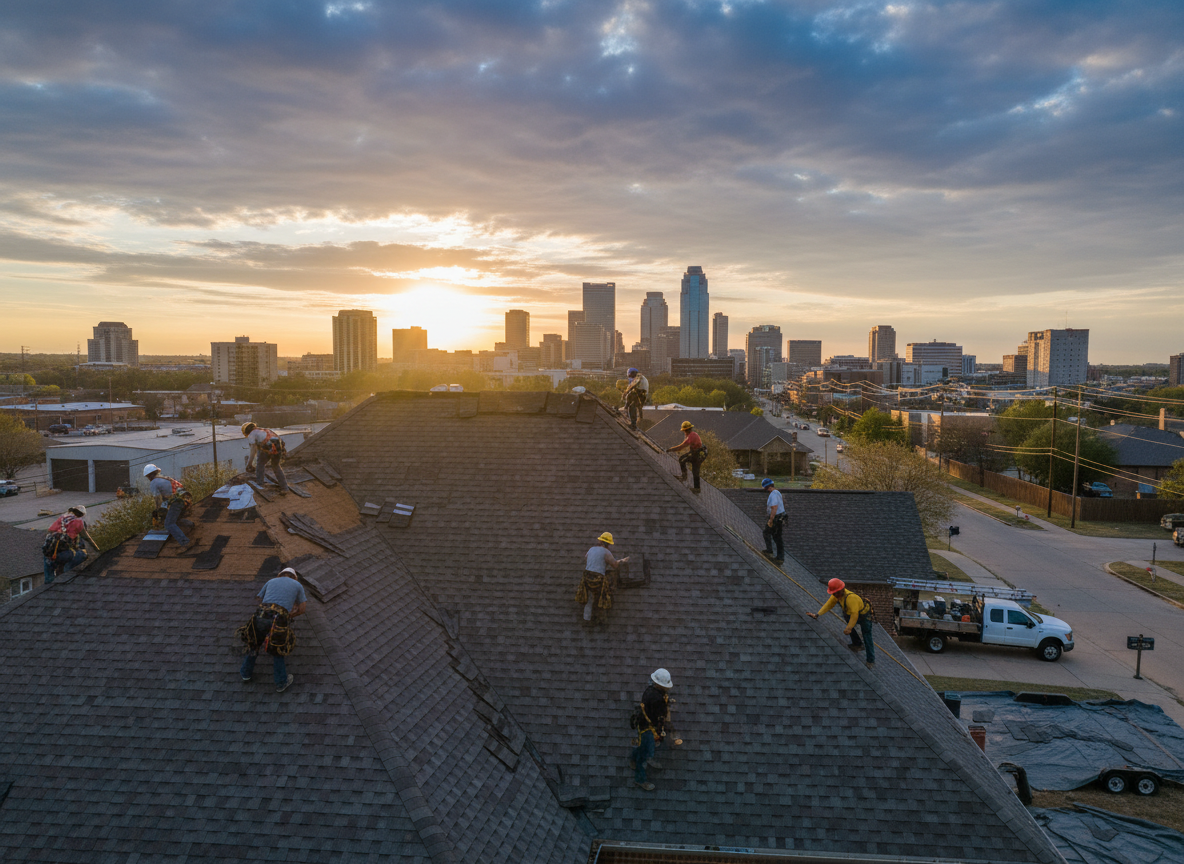
A roof replacement is often described as a new roof. It is more accurate to call it a rebuild of the roof assembly, because everything above the ceiling structure is being renewed: the covering, the underlayment beneath it, the flashings at every interruption, the edge metal, the ventilation, and whatever decking is found to be unsound when the old surface comes off. That distinction is what separates a replacement that lasts a full service life from a covering laid over the failures of the previous one.
Why the Assembly Matters More Than the Covering
A covering sheds water. The underlayment is the second line, and it is the one that actually keeps a building dry when the covering is breached by wind, hail or age. Flashings close the places where the covering cannot shed water on its own. Ventilation keeps the deck dry from below by letting moisture escape, and it controls the temperature that ages the covering from the underside.
A replacement that renews only the covering leaves every one of those systems at its previous age. It looks new from the street and behaves like the roof it replaced. It is also the most common way money is wasted on a roof, because the second replacement has to undo the first.
The Order of Work
Tear-off
The existing covering is removed rather than covered over. A second layer adds weight, traps the old underlayment and hides the deck, and in hail or wind regions it can change the performance of the assembly. Where a second layer is permitted at all, it is rarely the better option.
Deck inspection and repair
With the deck exposed, sheathing is checked for rot, delamination, deflection and inadequate fastening. Soft sheets are replaced, and any area where the deck has lost its plane is corrected. This is the stage where the surprises appear, and a written scope should say how discovered work is handled.
Underlayment
Underlayment is the water-shedding layer beneath the covering, and its specification follows the climate and the covering. Tile and metal need high-temperature or slip-resistant underlayment suited to their fixings. Where snow and ice are expected, an ice-barrier membrane at the eaves is standard practice, because it is the only layer that resists water backing up under the courses.
Flashings and edge metal
Every interruption is re-flashed rather than reused: valleys, chimneys, walls, skylights, vents and the junctions between planes. Drip edge is installed at the eaves and rakes, and the metal is specified to suit the assembly rather than fitted as an afterthought.
Ventilation
Intake at the eaves and exhaust at or near the ridge are balanced so that air moves under the deck. In snow country this is also what reduces ice damming; in hot climates it reduces the heat load on the shingles. Ventilation is corrected during a replacement because it cannot be corrected afterwards without opening the roof again.
Covering
Only now does the covering go on, chosen for the climate, the pitch, the structure's capacity and the code. Its fastening pattern is specified rather than improvised, because fastening is where wind performance is decided.
Choosing a Covering for the Climate
In the South Central hail belt, impact resistance is a legitimate specification criterion, and asphalt shingles carry a four-class impact rating system. Where hail is frequent, a higher impact class is worth considering on the field, while the details are where damage usually concentrates.
On the Southeast and Gulf coasts, wind uplift and water shedding dominate. Covering systems are approved products in some states, and within the High-Velocity Hurricane Zone in Miami-Dade and Broward the requirements are stricter and the approval process is specific. Fastening patterns and edge details are part of the approval, not a matter of preference.
Across the snow-load north, the structure's capacity governs what can be installed. A heavier covering may need structural verification, an ice barrier at the eaves is standard, and snow-shedding behaviour matters: a smooth metal surface sheds where an asphalt one holds, which affects what happens above a doorway or a path.
In the Mountain West and the arid interior, thermal performance and UV resistance matter most. Tile and metal both work well where the pitch and structure allow, and reflective or cool-rated products can matter both for comfort and, in California, for compliance.
On the West Coast, the choice is driven by rain, moss and, increasingly, wildfire. Ember-resistant detailing at valleys, vents and edges is part of the conversation in fire-prone areas, and cool-roof requirements apply to many replacements in California.
What You Should See During the Work
A replacement is a sequence of visible stages, and a homeowner should be able to see each one: the tear-off, the bare deck, the underlayment, the flashings, the edge metal and the covering. Photographs of each stage are the record.
The details that are the easiest to skip are also the easiest to check. Is the ice barrier present where it is required? Is the underlayment lapped in the direction the water runs? Are the step flashings interleaved with the courses rather than surface-mounted? Does the drip edge sit under the underlayment. Each of those can be photographed before it is covered.
What a Replacement Does Not Fix
A new roof does not fix a leaking wall. Wind-driven rain at a window head or a cladding joint enters below the roof line and will do so again.
A new roof does not fix condensation caused by household moisture and poor ventilation inside the building, though correcting roof ventilation helps.
A new roof does not fix structural movement in the building beneath it, and a covering that is heavier than the structure was designed for is a different conversation.
A new roof does not make a claim history disappear, and it does not change the fact that a storm-damaged roof may be an insurance matter rather than a maintenance one.
Regional Scheduling
Roofing is weather-dependent everywhere, and the practical seasons differ. In the north, replacements are scheduled between the freeze and the snow. In the desert Southwest, crews work around the monsoon and the worst of the summer heat. On the Gulf and Atlantic coasts, the hurricane season shapes both scheduling and risk, and an open roof during a named storm is a serious exposure. In the hail belt, spring storms can interrupt a project midway.
A written programme that names the sequence, the weather contingency and what happens if the roof is left open overnight is more useful than a date.
Before You Commit
Ask what is being removed and what is being renewed beneath it. Ask for the underlayment specification, the flashing details and the ventilation calculation. Ask which permit applies and who is arranging the inspection. Ask how discovered deck work is handled and how it is photographed.
Call (833) 406-0167 with the state, the covering type and the age of the roof, and the conversation can start from what the assembly needs rather than from a product brochure.
What Living Through a Replacement Is Actually Like
A replacement is a construction site above the house for several days. There is noise from tear-off, dust falling through the attic, and debris in the garden that is collected by magnetic sweep at the end rather than by eye. Vehicles need somewhere to stand that is not over a drain field or a shared driveway, and materials need to be lifted rather than carried through the house wherever the site allows it.
The parts worth agreeing in advance are the ones that annoy people afterwards: where the skip sits, what happens to plants and gutters against the wall, whether the crew uses the household power, what time work starts, and how the roof is protected overnight if the weather turns. None of this is technical, and all of it is the difference between a project that feels organised and one that does not.
Internally, the attic becomes accessible and often dusty. Anything stored directly under the deck should be covered or moved, and any loose insulation should be expected to shift. If the house has recessed lights close to the ceiling plane, their surroundings are worth checking before and after, because the tear-off vibrates everything above them.
Reading the Scope Before You Sign It
A replacement scope should let a second company price the same job without asking a single question. That means it names the covering and its impact or uplift rating where relevant, the underlayment and whether an ice barrier is included, the edge metal, the flashing details and how many of each, the ventilation figures, the deck allowance and how additional sheets are handled, and the permit and inspection arrangements.
It should also say what is excluded, because exclusions are where disputes begin: chimney repointing, skylight replacement, gutter replacement, fascia repair, saturating the lawn, and the removal of satellite dishes or solar equipment.
Two scopes that can be read side by side will show where the difference in cost actually sits. Two scopes written as a single figure cannot, which is why the itemised version is worth insisting on even when it takes longer to produce.
The Stage Record
Ask for photographs at six moments: the stripped deck before any repair, the repaired deck, the underlayment laid with its laps visible, the flashings installed at each interruption, the edge metal and ventilation in place, and the finished covering from each elevation. Those six images are what make a replacement verifiable years later, when a leak appears at a valley and the question is whether the valley lining was renewed or reused.
The record belongs to the building, not to the contractor. Keep it with the permit reference and the product details, because a future buyer, an insurer or a surveyor will ask for exactly that set and nothing else will substitute for it.
What the Replacement Includes
A replacement includes everything above the ceiling structure, and the scope should say so line by line: the tear-off, the deck allowance, the underlayment specification, the ice barrier where the climate requires one, the edge metal, each flashing detail, the ventilation figures and the covering itself with its ratings. It includes the permit and the inspections, the photographs at each stage before the work is covered, and the written record handed over at the end.
How it works
- 1
Assess the assembly
Deck condition, attic ventilation, pitch, structure and the climate the roof has to survive.
- 2
Specify, then price
Covering, underlayment, edge metal, ice barrier and flashing details written as separate lines.
- 3
Tear off and inspect
The old covering comes off, the deck is checked, and anything unsound is photographed before it is replaced.
- 4
Build from the deck out
Deck repair, underlayment, ice barrier, flashings, edge metal, ventilation, then the covering.
- 5
Inspect and hand over
Permit inspection where required, stage photographs, and a written record of what was installed.