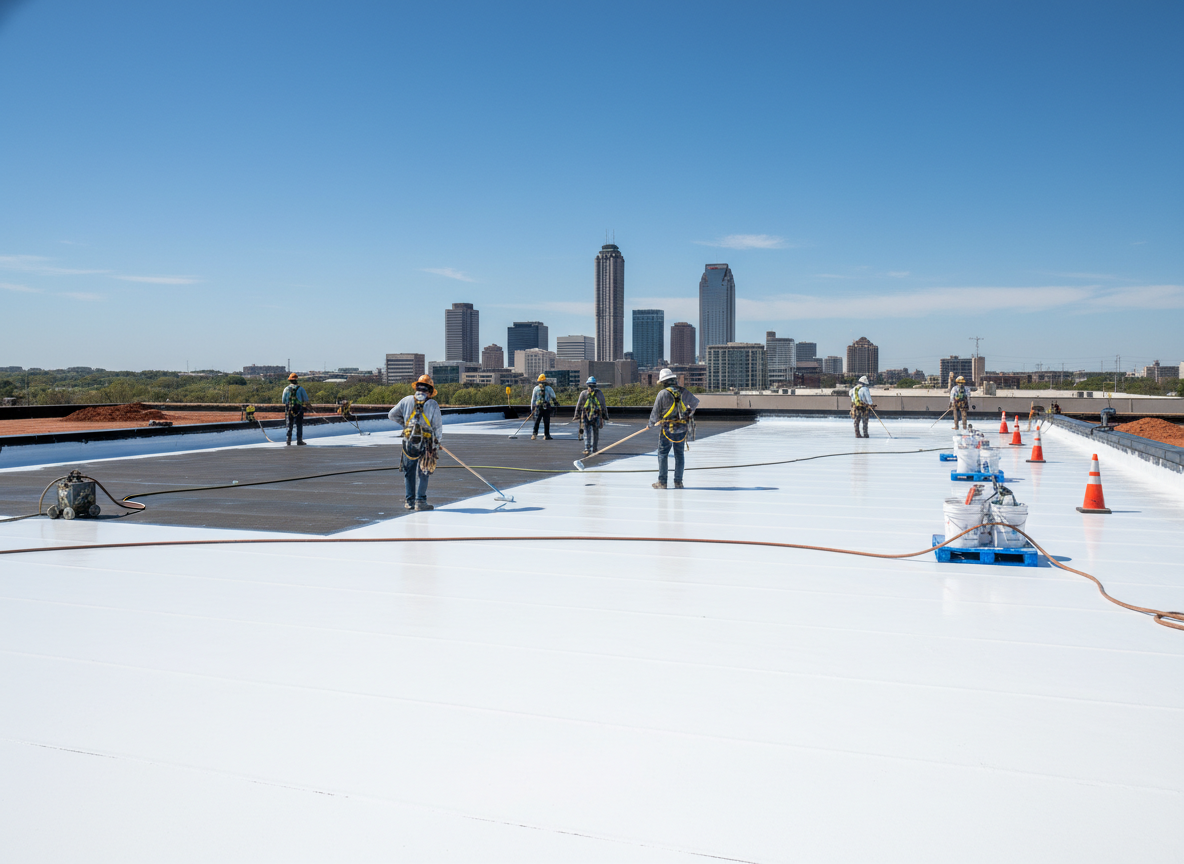
A roof coating is the most misunderstood product in roofing. It is sold as a way to extend the life of a roof, cool a building, seal a leak and avoid a replacement, and only the first of those is reliably true. A coating is a maintenance decision applied to a membrane that is still sound: it adds a protective and often reflective layer, slows the weathering of the surface beneath, and can reduce the heat a building absorbs. It is not a repair, and it cannot make a failed roof watertight.
What a Coating Actually Does
The first function is protection. Ultraviolet light breaks down the top layer of almost every roofing material, and a coating absorbs that exposure in place of the membrane beneath it. When the coating itself degrades, it can be renewed, and the surface underneath is preserved. That is the logic of a recoat cycle: the sacrificial layer is replaced rather than the roof.
The second function is reflectivity. A light-coloured or reflective coating lowers the surface temperature of a roof under sun, which reduces the heat flowing into the building below and the thermal stress on the membrane itself. In hot climates this is measurable in comfort and in cooling load, and in some jurisdictions reflective values are part of the code for a replacement or a major restoration.
The third function is sealing small surface defects: hairline cracks, minor pinholes, surface checking. That is genuine, and it is limited. A coating bridges a crack of a certain width and no more, and it does nothing for a seam that has opened, a flashing that has failed or a membrane that is wet beneath.
The Systems and What They Are For
Acrylic coatings are water-based, easy to apply, and breathe to some extent. They are the common choice for a sound modified bitumen or built-up roof that needs protection and reflectivity, and they are the least tolerant of standing water and of application over a damp surface.
Silicone coatings are moisture-tolerant and remain flexible across a wide temperature range. They are often used on low-slope roofs where ponding is a fact of life, because they resist standing water better than acrylic.
Elastomeric and polyurethane coatings are used where movement is expected, on metal roofs and on surfaces that flex. On metal they also address the corrosion problem, but only after the rust has been prepared, not painted over.
There are also coating systems designed specifically for metal roofs, with a rust-converting primer and a finish coat, and for spray foam roofs where the coating is the only thing protecting the foam from sunlight.
Preparation Decides the Outcome
Almost every coating failure is a preparation failure. A coating bonds to what it is applied to, and if that surface is dirty, chalky, wet or contaminated, the bond is to the contamination rather than to the roof.
The preparation sequence is wash, dry, repair, prime where required and then coat. Washing removes dirt, biological growth and loose chalk. Drying is not optional: moisture trapped under a coating will blister it and, worse, will be sealed into the roof assembly. Repairs to seams, splits and flashings are done before coating, never after.
Primers matter on metal, on porous surfaces and where the manufacturer specifies them. Skipping a primer because the surface looks clean is the most common way a coating system fails within a season.
Testing for Moisture Before Anyone Coats Anything
The one test that should never be skipped on a low-slope roof is a moisture survey. Coating a roof whose insulation is saturated traps the water, and the coating will blister, delaminate or simply fail to cure as the moisture tries to escape.
The survey can be as simple as cutting a small inspection opening in an area that looks suspect, or as thorough as an infrared or impedance scan across the whole surface. Either way, the result decides whether a coating is appropriate at all. A roof with widespread moisture is a replacement, whatever the surface looks like.
Where a Coating Is the Right Answer
A coating makes sense on a membrane that is intact but weathered: no active leaks, no saturated insulation, seams and flashings sound, and a surface that has reached the stage where ultraviolet exposure is thinning it. It also makes sense where reflectivity has value: a large low-slope roof over a conditioned space in a hot climate, or a metal roof that is sound but has lost its finish.
It makes sense on a building where replacement is being deferred for a defined period, provided everyone involved understands that the coating is buying time rather than ending the problem.
Where It Is the Wrong Answer
It is the wrong answer on a roof with active leaks, because the leaks will continue under the coating and the water will now have nowhere to evaporate.
It is the wrong answer on a roof with saturated insulation, because the moisture is the problem and the coating seals it in.
It is the wrong answer on a membrane that has failed at multiple seams, because the failures are structural to the roof rather than superficial.
It is the wrong answer where the surface has not been prepared, which is unfortunately the most common reason coatings get a bad reputation.
What Application Involves
Application is usually by roller or spray, in multiple coats, at a specified thickness. Thickness is the specification that matters most and the one most easily reduced: a coating applied too thin does not perform as the product was tested, and it will need recoating far sooner.
Weather matters. Acrylic coatings need to cure before rain and cannot be applied near freezing. Silicone is more forgiving but still requires a dry surface. In hot climates application is timed to avoid the surface being too hot for the product to bond.
Edges, terminations and penetrations are detailed first, because a coating that runs out over a termination bar or a curb flashing leaves exactly the detail that was most exposed.
Reflective Requirements
Cool-roof requirements exist in a number of jurisdictions and are most developed in California, where roofing replacements and some restorations must meet specified reflective values. The values are usually expressed as initial and aged solar reflectance and thermal emittance, and a product that meets them will be labelled accordingly.
Meeting a requirement is not the same as performing well in the specific climate, and a reflective coating on a roof that cannot shed water is still a coating on a bad roof.
How Long a Coating Lasts
It depends on the product, the thickness, the exposure and the maintenance. A recoat cycle is normal and expected: the coating is a sacrificial layer, and its renewal is the point. What should not be required is a recoat within a season because the first application was too thin or applied to a surface that was not prepared.
Regional Reality
In the desert Southwest and across the southern tier, reflectivity and ultraviolet exposure make coatings genuinely valuable, and the surface temperatures involved make the difference obvious.
In the northern tier, freeze-thaw and ice are harder on coatings than sun, and a coating on a roof that ponds and freezes will crack at the water line.
On the coasts, salt and marine air attack both metal and coating, and the preparation and primer specification matters more than the finish colour.
Call (833) 406-0167 with the state, the roof type and what the surface is doing. A coating is a good decision on the right roof and a waste on the wrong one, and the difference is established before any material is ordered.
Metal Roof Coatings Are Their Own Discipline
Coating a metal roof is not the same job as coating a membrane. The failure being addressed is corrosion, and corrosion has to be removed before it can be protected. That means wire-brushing or mechanically preparing rusted areas, treating them with a rust converter or primer specified for bare metal, and then applying a system designed for the panel's coating and its thermal movement.
The details matter more than the field. Fastener heads, cut edges, laps and the base of every penetration are where rust starts, and a coating sprayed across the field without attention to those points leaves the roof looking renewed with its weak points untouched. On a standing seam roof, the coating also has to tolerate the panel's movement without cracking along the seam.
How Thickness Gets Verified
Coating performance is largely a function of dry film thickness, and thickness is the specification that gets quietly reduced when a job runs behind. It can be checked: wet film gauges during application, dry film gauges afterwards, and the number of pails used against the area covered.
A quotation that specifies a product but not a thickness has not specified the job. It is also worth recording the batch details and the application date, because a recoat schedule begins from that point.
What the Specification Should Contain
The product and its intended substrate, the number of coats and the dry film thickness, the preparation method including any primer, the reflective values where they apply, and the sequence at terminations, curbs and penetrations. Photographs of the prepared surface before coating are the record that the preparation actually happened.
A coating applied to a well-prepared, moisture-free roof at the specified thickness is a legitimate long-term maintenance strategy. The same product applied to a dirty, damp surface is a temporary cosmetic layer, and the difference is decided entirely before the first pail is opened.
A Coating Is a Decision About Timing
Most roofs that are coated did not need a new roof that year. They needed a decision about when the replacement would happen, and a coating moved that date forward by several years at a fraction of the cost. That is a legitimate use of the product, provided the roof is dry, the membrane is sound and everyone involved knows what the coating is and is not doing.
The failure mode is a coating sold as a replacement. It postpones nothing in that case, because the roof underneath is already finished.
Confirming the story of a coating job is straightforward: the product, the number of coats, the dry film thickness and the photographs of the prepared surface. Those four items explain the roof's condition better than any description of the finish.
What the Coating Job Includes
The job includes the survey that decides whether the roof should be coated at all: membrane condition, seams and flashings, and a moisture check so that water is not sealed into the assembly. It includes the wash, the dry, the repairs, the primer where specified, and the coats at the stated thickness. Terminations, curbs and penetrations are detailed before the field. The record lists the product, the coats, the thickness and the reflective values where a jurisdiction requires them.
How it works
- 1
Assess the membrane
Age, condition, seams and flashings, and whether there are active leaks.
- 2
Test for moisture
An inspection opening or a scan, because a wet roof should not be coated.
- 3
Prepare the surface
Wash, dry, repair, and prime where the product requires it.
- 4
Apply to thickness
Multiple coats at the specified rate, with details finished before the field.
- 5
Record the specification
Product, coats, thickness and reflective values, with photographs of each stage.