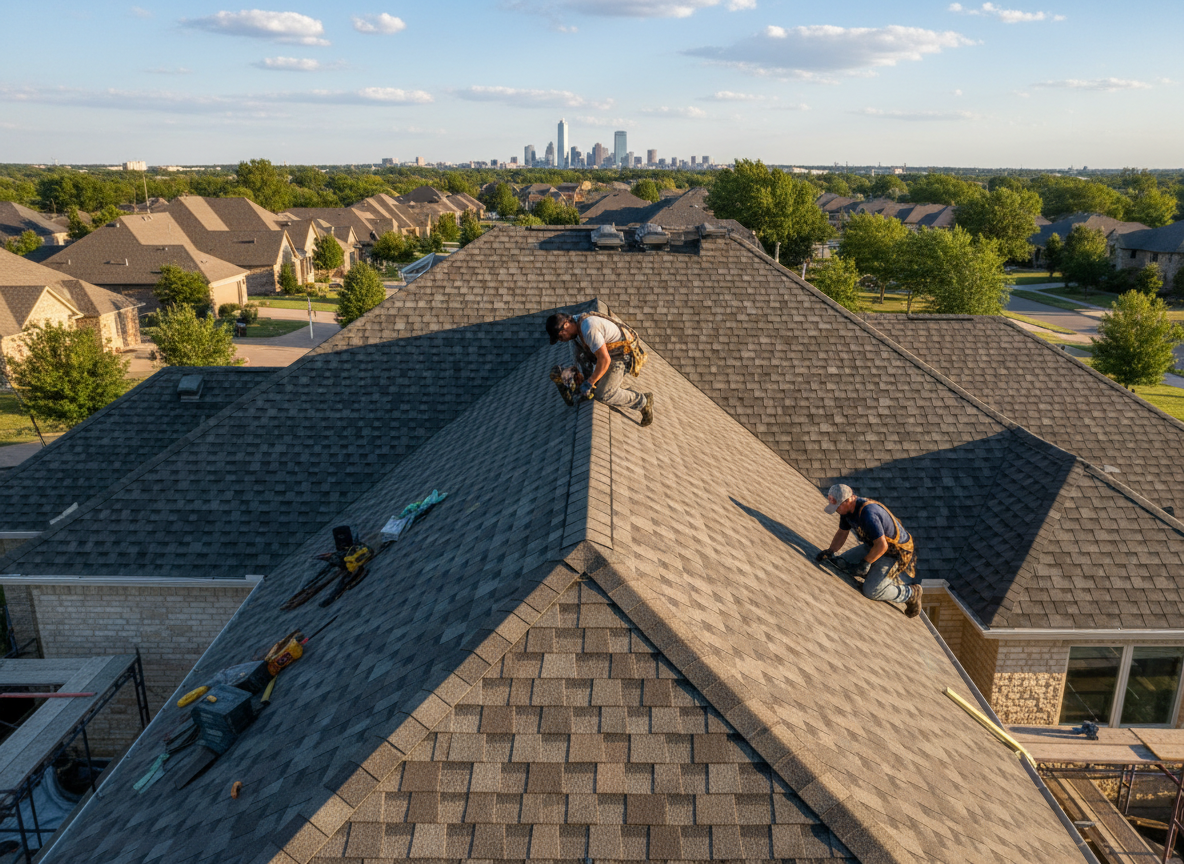
Asphalt shingle is the covering on most houses in the United States, and it is the one most often misunderstood. The shingle is a composite: a reinforcing mat, usually fibreglass, coated in asphalt and surfaced with mineral granules. Each of those layers does a different job. The mat gives it strength against wind and tearing, the asphalt seals the mat and holds the granules, and the granules protect the asphalt from sunlight. When a roof fails early, it is usually the asphalt that has been cooked away or the mat that has been bruised or creased, and both of those happen underneath a surface that still looks like a roof.
The Two Broad Types
Three-tab shingles are flat, uniform and built to a single exposure. They are the cheaper option and they perform adequately on simple roofs, but they have less material per square metre and less resistance in wind.
Architectural or dimensional shingles are laminated from two or more layers, with a random tab pattern and a heavier profile. The extra thickness improves wind performance, adds impact resistance in the better products, and looks less like a sheet of repeating rectangles on a large roof. Most residential work in the United States now uses this class of product.
Beyond the two, products are graded by wind rating and impact class. Wind ratings describe the speed a shingle is warranted to resist when correctly fastened, and impact classes run from one to four, with four being the most resistant to hail. Those two ratings are the specification that matters, because they describe what the roof will do in the weather it will actually meet.
What Sits Underneath
Shingle is a surface, not a system. Beneath it is an underlayment, and beneath that is the deck. The underlayment is what keeps a building dry when water gets past the shingle, which happens far more often than the surface suggests: at every penetration, at every valley, behind every flashing, and across any field where wind has lifted or hail has bruised a course.
Underlayment is specified by weight and, in some cases, by climate. Heavier felt or a synthetic membrane is used under most modern installations; a self-adhering membrane is used at the eaves in snow country to resist ice dams, and in some jurisdictions it is required. The laps always run with the direction of water, and the number of laps depends on the pitch.
Deck condition decides how long the shingle will last. A shingle fastened to a deck that flexes between rafters will crack along the fastening line, and a shingle laid over a deck that is not flat will hold water in the low spots. No product specification compensates for a bad deck.
Ventilation and the Life of a Shingle Roof
Asphalt ages faster when it is hot. A shingle roof over an under-ventilated attic runs hotter than the outdoor air for most of a summer day, and the asphalt oxidises and loses its oils at a rate that shortens the covering's life from below. Ventilation is therefore part of a shingle installation, not an optional extra.
The requirement is balance: intake at the eaves and exhaust at or near the ridge, sized to the attic volume and the pitch. Blocked soffit vents, insulation pushed against the deck and ridge vents installed without intake all defeat the system. In cold climates, the same imbalance produces condensation and ice damming, which turns a ventilation problem into a water problem at the eaves.
How a Shingle Roof Fails
Failure follows a predictable order. First the sealant strips release where the sun and wind have worked them, and tabs begin to lift at edges and ridges. Then granules start to shed, visible in gutters and at downspout outlets. Then the mat becomes brittle and tabs crack when walked on. Finally the underlayment beneath fails, and water that has been getting under the courses for years reaches the deck.
Hail and wind compress that timeline. Hail bruises the mat and knocks granules loose in a single afternoon; wind creases tabs so they never seal again. A roof that has taken either can look sound from the ground while its remaining life has been cut dramatically.
Repairing Shingle
Shingle repairs are local by nature and depend on the match. Replacing a course or a small area means lifting the courses above it, cutting out the damaged shingle, nailing the replacement at the correct exposure and resealing. The repair is fast; the difficulty is material.
Colour and profile change over time, and discontinued products cannot be matched exactly. A repaired area will usually read as a repair from close up, which is cosmetic rather than defective. What matters is that the replacement matches in weight, exposure and rating so the patched area behaves like the rest of the roof.
Where the damage is concentrated at details — a split boot, a lifted ridge cap, a rusted valley — the repair is at that detail rather than in the field, and it is usually straightforward.
Shingle Across the Country
In the South Central hail belt, impact is the defining risk, and the impact class of the product is a legitimate specification criterion. Hail season peaks in spring, and a roof can meet several damaging events in a decade.
On the Gulf and Atlantic coasts, wind is the driver. Fastening patterns, edge metal and the continuity of the roof-to-wall connection decide performance, and approved product systems are required in some states and mandatory inside the High-Velocity Hurricane Zone of South Florida.
Across the northern tier, shingle roofs live with snow load, freeze-thaw and ice dams. An ice barrier at the eaves and ventilation that keeps the deck cold are what prevent the annual February stain at the ceiling edge.
In the desert Southwest, heat is the enemy. Shingle surfaces reach very high temperatures, asphalt oxidises faster, and the diurnal swing works at every fastener. A shingle roof there can be structurally sound and still be near the end of its life at an age that would be mid-life in a cooler climate.
What to Have Ready When You Call
The state and city, the approximate age of the roof, whether it has one layer or two, and what the roof is doing: lifting, shedding granules, staining ceilings or simply looking worn. Photographs from the ground help, particularly of the ridges and the gutters below the slopes.
Call (833) 406-0167 and describe what the shingle is showing. The answer will be about the assembly, not only the surface.
Where Shingle Roofs Actually Leak
Almost no shingle leak starts in the middle of a slope. Water arrives at the places where the plane is interrupted: valleys, wall junctions, chimneys, skylights, vent pipes, the ridge and the edges. Each of those is a detail built from metal, membrane or sealant rather than shingle, and each has a shorter life than the field around it.
The ridge deserves particular attention because it takes the highest wind load on the roof. Ridge caps are the first thing to lift in a storm and the first thing to be missed in an inspection, because they are at the top of a slope where nobody wants to walk. A roof with sound field shingles and failed ridge caps leaks at the top and stains in the middle of a ceiling.
What Shingle Cannot Do
Shingle is a steep-slope covering. Below roughly a four-in-twelve pitch it cannot shed water reliably on its own, and below two-in-twelve most products are not permitted at all. Where a roof has a low-slope section, the correct answer is a membrane system, not a shingle laid with extra sealant.
It also cannot span a gap. A shingle bridging a soft spot in the deck flexes every time it is walked on and cracks along the fastening line. Re-shingling over a soft deck is the most common way a new roof turns out to be an old one.
And it cannot be judged by appearance alone. Two roofs that look identical from the street can be ten years apart in remaining life, because the difference sits in the underlayment and in the heat the attic has been holding.
Timing a Replacement Honestly
The decision to replace is usually made on three signals arriving together: granules in the gutter every spring, tabs that lift and will not reseal, and interior staining that returns after each repair. Any one of those on its own is a repair conversation. The three together, on a roof past the middle of its expected life, is a replacement.
Age alone is a poor signal, because climate and ventilation change the timeline so much. A well-vented shingle roof in a temperate climate can outlast the same product on a hot, poorly vented attic by a decade. That is why an assessment on the roof matters more than a date on a document.
Getting a Second Opinion Worth Having
If two assessments disagree, the disagreement is usually about the deck, the underlayment or the extent of impact damage rather than about the shingle. Ask each assessor to show the photographs behind their conclusion, and specifically to show the deck and underlayment where a repair is proposed and the field where a replacement is proposed.
A conclusion supported by dated photographs of what was found can be checked. A conclusion supported by a price is a sales position, whichever way it goes.
What a Shingle Job Includes
A shingle job includes the deck and the membrane as well as the surface. That means the sheathing checked for soundness and flatness, the underlayment specified for the pitch and the climate, and an ice barrier at the eaves where snow sits. It includes the edge metal, the valley lining, the boots and the ridge ventilation, and the product details with their wind and impact ratings. The old covering is removed rather than covered over, so none of it is guesswork.
How it works
- 1
Inspect the assembly
Shingle surface, underlayment, deck, flashings and ventilation, because each one decides the others.
- 2
Establish the specification
Product class, impact and wind ratings, underlayment and edge details for the climate.
- 3
Strip to the deck where needed
Old shingle removed, deck repaired, underlayment laid with laps running with the water.
- 4
Install and detail
Correct exposure and fastening, valleys and penetrations flashed, ridge ventilation completed.
- 5
Document the finish
Product details, ratings, photographs and the permit record where one applies.