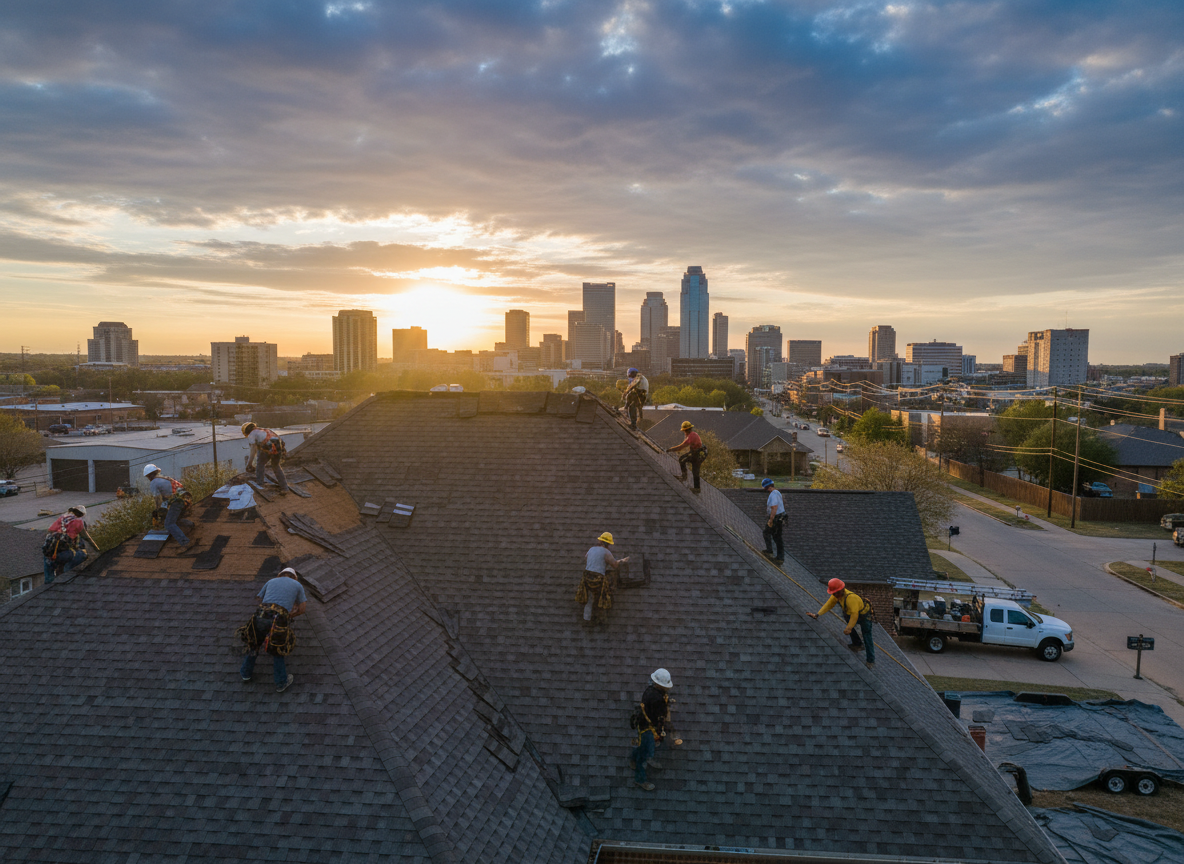
Ask two Californians what worries them about a roof and you get two different answers. In the foothills above Santa Rosa or San Bernardino the answer is embers. In the Sacramento Valley it is a summer that bakes a shingle flat and hard, followed by the first real storm of November landing on a roof that has spent six months learning to crack. In a 1920s bungalow in Pasadena it is clay tile that has outlived two underlayments. The state runs on a Mediterranean pattern — a wet half-year and a dry half-year — and on a building code pushed further toward wildfire resilience than almost any other, so a roof decision here is shaped by code and insurance as much as by weather.
Four exposures that decide a California repair
Embers, not flame
Flame is rarely what takes a house on the wildland edge. Wind-carried embers arrive ahead of the fire front and settle where a roof is least able to defend itself: the valley where two planes meet, the gap behind a ridge cap, the screened opening on a gable vent, the gutter holding a season of oak leaves. If a roof cavity takes an ember, the building burns from the attic outward. The state building code handles this through its wildfire-exposure provisions, which set roof-covering classes, limit where vents may open and call for non-combustible flashing inside mapped hazard zones. Re-roofing within one of those zones is a materially different job from re-roofing outside them, and the difference lives in the details rather than in the shingle.
A wet season that arrives in a handful of days
California does not spread rain evenly through the year. A few atmospheric river events can carry a large share of annual precipitation, and they deliver it over a day or two, driven sideways, onto a surface that has been hot and dry since April. The result is a specific failure mode: the hairline crack that opened in August, the sealant that cured hard in July, the flashing that moved a millimetre away from the stucco. Nothing shows for months. Then the first proper storm arrives and a ceiling stains. Most leak work done in a wet week is on conditions that were already there in September.
Interior heat and the ultraviolet bill
From Redding down through Sacramento and Fresno to Bakersfield and the Coachella Valley, the roof spends the cooling season at temperatures that degrade asphalt and chalk painted metal. There is no wet interval to reset it. Granule loss, curled tabs, brittle sealant and split pipe boots show up first on the west and south slopes, and they show up years before the warranty table suggests, because the driver is sunlight rather than storm damage.
Fog, damp and the north coast
Marine air keeps shaded slopes wet along the coast from Santa Barbara north, which is enough for algae streaking, lichen and, in the wettest pockets, moss. Higher up, Sierra roofs carry snow for weeks and then deal with meltwater refreezing at the eave. A roof in Truckee and a roof in El Centro are in the same state and share almost no failure modes.
Code, cool roofs and the seismic question
California's energy standards belong inside the roofing conversation rather than beside it. Many reroofs and new roofs have to meet thresholds for solar reflectance and thermal emittance, and products are tested and listed for those values through the Cool Roof Rating Council. Practically, the colour and surface a homeowner wants may not be the product that can legally go on a given slope in a given climate zone — a specification that ignores the requirement can be installed perfectly and still fail inspection.
Seismic detailing sits in the same bracket for older housing. A large share of the state's pre-1980 homes have roof-to-wall connections and cripple walls that predate current bracing expectations. A roofing permit does not require that work, and it is not a repair. But when the sheathing is exposed during a replacement it is the only economical moment to address it, and a homeowner deserves to hear the option rather than find it afterwards.
Coverings you meet between San Diego and Redding
Clay and concrete tile
Tile defines southern California and the Mediterranean and Spanish-colonial housing of Los Angeles, Santa Barbara, San Diego and older Central Valley neighbourhoods. It is genuinely two systems. The tile itself can last many decades and shrugs off sun and small hail. The underlayment beneath it cannot, and the underlayment is what fails. A leaking tile roof is almost never a tile problem; it is a forty- or fifty-year-old membrane gone brittle, and the repair is a lift-and-relay with the field tile stacked, the membrane replaced, and broken pieces swapped as it goes back down.
Asphalt composition shingle
Shingle covers the great majority of suburban California and essentially all housing built since the 1970s. It is the fastest thing to repair and the quickest to lose to sun. Inland, the limiting factor is ultraviolet exposure rather than any storm, which is why a shingle roof in Fresno can be finished long before its advertised service life.
Wood shake and shingle
Cedar shake survives on older Bay Area, Los Angeles and north-coast houses. It is a handsome covering and an increasingly difficult one: fire exposure makes it hard to insure and many jurisdictions restrict it on new work and replacement, so what looks like a simple repair can turn into a code question before anyone lifts a course.
Low-slope and flat assemblies
Flat roofs are not a commercial-only category in California. Mid-century modern housing, beach-area apartments, San Francisco and Oakland infill, and most downtown commercial stock sit under built-up, modified bitumen, TPO or EPDM. These fail at seams, at drains and scuppers, at rooftop unit curbs and at parapet terminations. A leak in the middle of a membrane field is unusual; a leak at a scupper that has been blocked since spring is routine.
Metal
Standing seam and exposed-fastener panels appear on agricultural buildings, on rural and hillside custom housing, and increasingly on rebuilds in fire country, where metal can meet the highest fire classification available and then outlast several cycles of everything else the state does to a roof.
The thirteen services, in California terms
Emergency roof repair
An emergency call here is usually one of two things: a roof opened by wind in a winter front, or a fire-adjacent property where the covering has been compromised and the house needs to be defensible again before the next wind event. The immediate task is to stop water or embers entering, isolate anything structurally unsafe, and record the opening in photographs before material is moved. Nothing permanent gets designed on the night of the call.
Emergency roof tarping
A tarp is a holding measure for a roof that cannot be worked yet — wet, steep, or waiting on an insurer's inspection. In California heat, adhesive-backed sheeting lets go quickly, so it is battened mechanically and weighted at the eave, with the battens placed so they do not abrade what is left of the covering. On a fire-damaged roof the tarp also keeps ash and debris out of the attic until the structure has been assessed.
Roof leak repair
Leak diagnosis starts indoors and works outward. Water runs along rafters, trusses and battens, so the stain on a ceiling is normally not under the opening. Attic inspection, moisture readings and, when conditions allow, a controlled water test narrow the entry point before anything is opened. On tile and low-slope roofs this step matters more than on shingle, because the failed layer is buried and guessing at it is expensive.
Storm and hail damage repair
Hail is not California's headline exposure, but it arrives with winter thunderstorms in the Central Valley and the Sierra foothills and leaves the same evidence it leaves anywhere: bruised mat, dented soft metals, granules washed into the gutters. The survey is directional and recorded slope by slope, separating fresh impact from ordinary weathering, because the two lead to different decisions.
Roof repair
Everyday repairs cover the ordinary failures — a lifted ridge cap, a failed pipe boot, a valley that has lost its metal, a counter-flashing that has separated from stucco. The goal is to return the detail to what it was designed to do. Sealing over a failed detail is not a repair; it is a delay with a shorter life than the original.
Roof replacement
Replacement in California is decided by underlayment age on tile roofs, by ultraviolet exhaustion on shingle roofs, and increasingly by what the fire hazard zone will permit. Tear-off exposes the deck, which is where rotted sheathing, old fastener patterns and abandoned penetrations become visible. Reflective values, fire classification and ventilation are settled before the covering goes back down, because none of them can be changed afterwards without starting again.
Roof installation
On new construction the specification is the job. Roof class in a hazard zone, reflectance in a climate zone, tile underlayment in the south and wind uplift at exposed coastal and ridge sites all get decided on paper. What goes under the visible layer determines how the roof behaves in fifteen years, long after the surface has been judged.
Shingle roofing
Shingle work is repair, replacement and detail correction on the most common covering in the state. The questions that matter are how the product handles sustained heat, whether the attic ventilates enough to let the deck dry, and whether the fire classification is adequate for the address.
Tile roofing
Tile work is membrane work with tile handling attached. Field tile is lifted and stacked, the underlayment is replaced, and the tile is re-laid with broken units matched or substituted. Valley metal, eave closures and the bird-stops at the ridge usually get replaced at the same time, because they are the parts that were holding water back.
Metal roofing
Metal repair covers fastener and washer replacement on exposed-fastener panels, seam and clip work on standing seam, and coating or repainting where the finish has chalked. Panels move with temperature across a California day, so every fixing has to allow that movement rather than resist it.
Flat roof repair
Low-slope repair is seam, drain, curb and termination work. Ponding is treated as a drainage problem first: a membrane that sits under standing water will fail at its laps no matter how well they were welded. Scuppers, internal drains and overflow outlets get cleared and corrected before any membrane is touched.
Roof coating
A reflective coating can extend a sound low-slope roof and cut heat gain, and in California it is also one route to meeting a reflectance requirement. It cannot rescue a wet assembly. Moisture testing and surface preparation decide whether coating is appropriate at all, and a coating applied over trapped water hides the problem for a season.
Roof inspection
An inspection produces a condition record — covering, flashing, penetrations, drainage, attic side, photographs of each. It is what a homeowner uses to choose between repair and replacement, and it is what makes a later insurance or wildfire conversation legible instead of anecdotal.
What's included when we open a California roof
- A roof and attic assessment before any scope is written, with photographs of the failed detail and the area around it.
- A written scope that keeps covering, underlayment, deck repair and flashing as separate lines, so nothing appears later that was not discussed.
- Deck inspection wherever the covering is opened, because soft sheathing under a sound surface is common after a long, slow leak.
- Flashing rebuilt rather than buttered with sealant where the detail has failed at stucco, a chimney or a valley.
- A magnet sweep of the working area and a walkthrough of the completed repair with the photographs in hand.
California metros and towns we cover
Coverage across California takes in Los Angeles and its basin, San Diego and the border counties, Orange County from Anaheim to Santa Ana, the Inland Empire around Riverside and San Bernardino, San Jose, San Francisco, Oakland and the Bay Area, Sacramento and the Central Valley through Stockton, Modesto and Fresno, Bakersfield, Santa Barbara and San Luis Obispo on the central coast, and the north through Redding and Chico. The desert communities around Palm Springs are covered as well.
These are places we work, not premises we hold. Our base is Oklahoma City, Oklahoma, and every job in the state runs from that single headquarters rather than from a California branch. What shifts from one end of the state to the other is the exposure: an ember problem in the foothills, a reflectance specification in the valley, a lift-and-relay on a tile roof in the south.
Elsewhere on the site
California is the southernmost of the three West Coast states, and the conditions all three share — atmospheric rivers, marine damp, fire season — are set out on the West Coast region page. The full national index sits at roofing by state.
How a California job runs
The first conversation. You describe the symptom and roughly when it started — a stain that appeared in the first storm, granules in a downspout, a tile that slid, a ceiling that has begun to bow. The address, the covering and whether the property sits in a mapped fire hazard zone are confirmed at this point, because all three change what can be installed.
The assessment. The roof is walked where walking is safe, the attic is inspected from inside, and the failed detail is photographed along with the surrounding field and the soft metals. An intermittent leak is traced rather than guessed at.
The scope. The repair is written in parts — what comes off, what goes back, what is reused and what is left alone — and where a genuine choice exists, such as section repair against a whole slope, both are described.
The work. Materials are staged, the deck is checked as it is exposed, and anything additional is reported before it is covered. On a fire-zone re-roof the venting and flashing details are inspected as they are built, not at the end.
The handover. The finished work is reviewed with you, the photographs are handed over, and the roof is cleared of fasteners and debris. Anything found and not repaired is written down, so the next decision starts from a record rather than from memory.
Talk through a California roof
A California roof usually gives warning before it fails, and the warning is easy to read once someone knows what the state does to roofs. Call (833) 406-0167 and tell us what you have noticed: where the water appears, when it started, what the covering is, and whether the address sits in a fire hazard zone.
Around California
We regularly work near:
- 📍Griffith Observatory, Los Angeles
- 📍Golden Gate Bridge, San Francisco
- 📍Balboa Park, San Diego
- 📍Yosemite National Park
- 📍Joshua Tree National Park
Roof Repair in California — Local Notes
- •Cool-roof reflectance requirements vary by climate zone and roof slope, so the product follows the address rather than the preference.
- •A lot of southern California tile housing has no gutters at all, which makes the eave detail and the ground drainage part of the repair.
- •Inside a mapped fire hazard zone the vent and flashing details carry as much weight as the covering class.