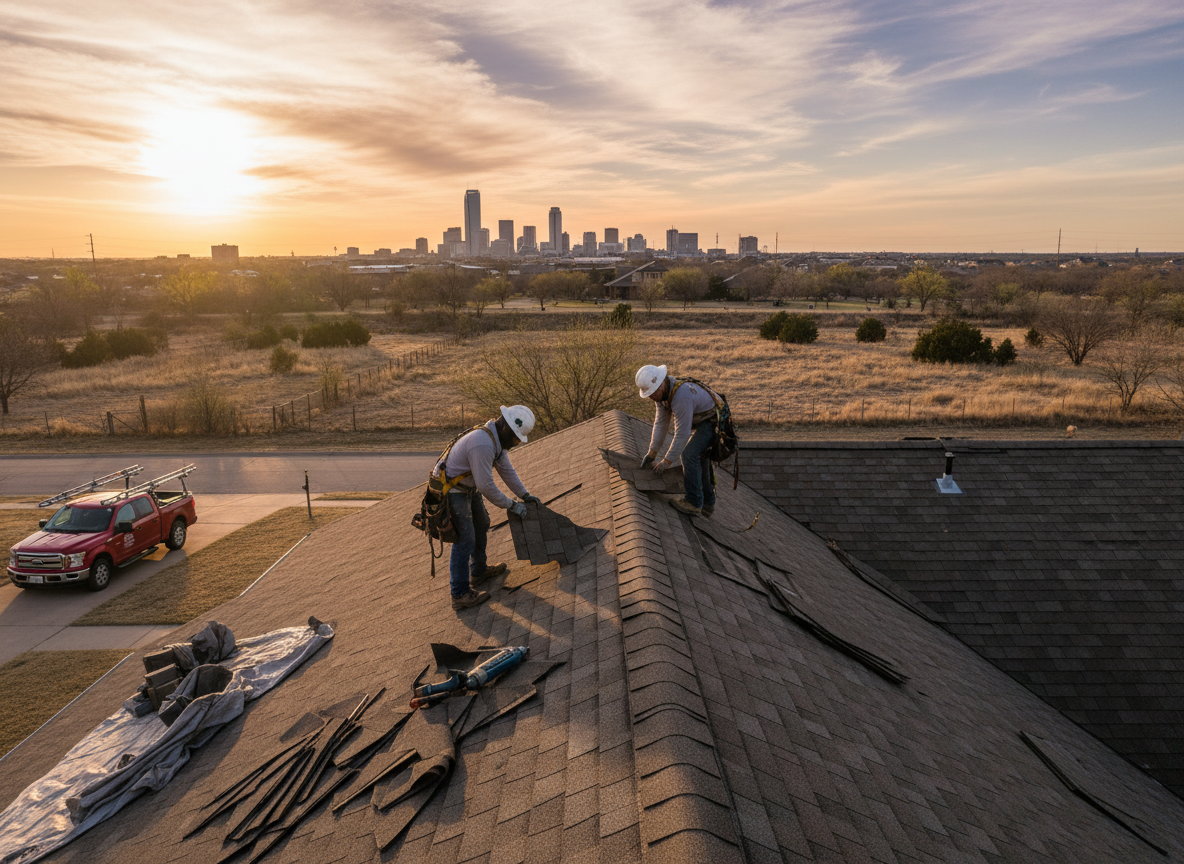
Oregon does not have one roof climate. It has several, and which one a house sits in decides almost everything about a repair. West of the Cascades a roof works through a long wet season, under trees, in air that stays damp into June. East of the range it works in sun, wind, snow and, in the wrong year, fire. The Willamette Valley belongs to the first category and Bend belongs to the second, and a roofer who treats them the same will misread both.
This guide covers what Oregon weather does to a roof, what the housing stock is made of, the services available statewide, the metros covered, and how the work is sequenced. If water is already inside the house, call (833) 406-0167 and start with where it is showing.
West of the Cascades: rain as a season, not an event
The rain that defines western Oregon is less a series of storms than a condition that switches on in October and off in May. The ground stays wet, the humidity stays high, and a roof is rarely fully dry for months. Most of the water arrives in frontal systems that can park over the valley for days, with the heaviest totals falling against the Coast Range and the western slopes of the Cascades.
That changes the diagnosis. In a place where rain is constant, water entering is only half the problem; the other half is drying. An attic that cannot move air will hold moisture from November to April whether or not the covering leaks, and a deck that stays damp is a deck that rots from underneath while the shingles above it still look serviceable.
Moss is not cosmetic
Moss is the signature of a western Oregon roof. It takes hold on shaded slopes and where fir needles and leaf litter have built a damp bed, and once established it does two things: it holds water against the covering, and it lifts the shingle edges as it spreads, opening the laps that shed water in the first place. Black algae streaking and lichen follow the same moisture.
None of it is an emergency. All of it shortens the life of the roof. How it is removed matters more than what is applied: pressure washing strips the granules that protect the asphalt and drives water under the laps, which is why scraping, treating and letting the growth die back before clearing it is the safer order of work.
Three details that fail over and over
None of them is the middle of the roof.
The gutter comes first. A Douglas fir or a bigleaf maple over a house will fill a run of gutter with needles inside a season, and once it backs up the water goes into the fascia and the eave instead of down the downspout. The valley comes second, because two planes meeting is where debris collects in exactly the place water concentrates. The penetration comes third: a pipe boot, a furnace flue, a skylight, where a rubber collar hardened by summer sun tears at the first cold snap.
A leak in open field with nothing above it is unusual here. When one is reported, the first question is what used to be there.
Wind, and the way rain arrives sideways
Pacific storms reach Oregon with wind attached. Rain driven at an angle finds wall junctions, gable ends and the underside of rake overhangs that a vertical downpour never reaches, and the stronger windstorms that come through every few winters test edge metal and ridge fastening far more than they test the centre of a slope. After a wind event the evidence is at the perimeter: lifted rake trim, a ridge cap that has shifted, a gable vent that has lost its screen.
East of the Cascades: snow that stays, then fire
Cross the range and the numbers change. Bend, Redmond, Prineville and Klamath Falls see less precipitation in a year than the coast can see in a season, but it arrives as snow and it sits. Roofs there are built to shed — steeper pitches, metal more often, tighter valleys — and meltwater refreezing at the eave is the recurring winter failure.
Summer is hot, dry and increasingly smoky. The wildfire exposure that was always part of the eastern landscape stopped being theoretical after the Labor Day fires of 2020, when a single wind event drove fire through communities from the Santiam Canyon to the Rogue Valley. What that changed for roofing is the same thing it changed in California: embers, vent openings and the details at ridges, valleys and eaves now carry as much weight as the covering itself.
Coverings you will meet in Oregon
Asphalt composition shingle
Composition shingle covers the overwhelming majority of Oregon housing, from 1920s bungalows in Portland and Eugene to new build in Bend and Medford. In the valley it is a covering under constant biological pressure; in the high desert it is a covering under sun and snow. Neither is a reason to choose something else, but both change how often the roof needs attention.
Cedar shake and shingle
Cedar was the traditional covering of the Pacific Northwest and it survives on a lot of older Portland, Salem and coast housing. It is handsome, it insulates, and it is the most fire-exposed covering commonly found on a house. Many jurisdictions restrict it on new work and on replacement, and insurers increasingly ask about it, so a shake repair is often also a conversation about what the roof should be next.
Metal
Metal is the rural standard — barns, shops and farmhouses across the valley and the eastern counties — and it is increasingly common on custom housing, where standing seam sheds snow and suits rainwater collection. Exposed-fastener panels make up the other half of the metal stock, and their failure is nearly always a washer.
Low-slope and flat
Portland's commercial core, its mid-century apartment blocks and a good deal of infill rely on modified bitumen, TPO and EPDM. These fail at seams, at drains and at parapet terminations, and west of the Cascades there is an extra problem: they do not dry out between rain events, so a small seam failure has months to work its way into the deck.
Tile
Tile is uncommon in Oregon. It appears on some older Portland and coastal properties and on Spanish-revival houses, and where it does the work is the same as anywhere — the tile is durable, the underlayment under it is not, and the underlayment is what keeps the house dry.
The thirteen services, in Oregon terms
Emergency roof repair
Oregon storm damage rarely looks dramatic. It is usually a tree limb through a slope, a section of ridge lifted in a windstorm, or a roof that was already tired and has now opened over a bedroom. The immediate work is to stop water entering, make the area safe to inspect, and photograph the opening before anything is cleared, because the record is what the repair is planned from.
Emergency roof tarping
A tarp is what a roof gets when it cannot be worked yet — a steep pitch in the rain, a wet deck, or a property waiting on an insurance inspection. On a wet Oregon roof the sheeting is battened down mechanically rather than stuck, because nothing adhesive holds on a damp surface, and the battens are set where they will not chafe the remaining covering.
Roof leak repair
Leak work begins in the attic. Water follows rafters and battens, so a stain rarely sits under the opening, and in a roof that is wet for months the trail can run a long way before it shows. Moisture readings and a controlled water test are used to confirm an entry point before anything is opened, which matters on tile and low-slope roofs where the failed layer is buried.
Storm and hail damage repair
Hail in Oregon concentrates east of the Cascades and in the valley thunderstorms of late spring. It leaves bruised mat, dented soft metals and granules in the gutters, and the survey is recorded slope by slope so that fresh impact can be separated from ordinary weathering. The two look similar from the ground and lead to completely different decisions.
Roof repair
Ordinary repairs are the lifted ridge cap, the split pipe boot, the valley that has lost its metal, the counter-flashing that has pulled away from a chimney. The aim is to put the detail back to doing what it was designed to do, not to bury it in sealant. On a roof that stays wet for six months, a sealant patch is a very short delay.
Roof replacement
Replacement in Oregon is usually decided by age and by how many details have already been repaired. Tear-off exposes the deck, which is where the real answer lives: soft sheathing, old fastener patterns, abandoned flues and, in western Oregon, rot that never showed from above. Ventilation gets specified at the same time, because the roof has to be able to dry from below.
Roof installation
New installation is a specification decision. West of the Cascades that means underlayment, ventilation and detailing for a roof that will be wet most of the year; east of the range it means snow shedding, ice at the eave and fire classification. What goes under the covering is decided on paper, because none of it is reachable afterwards.
Shingle roofing
Shingle work is repair, replacement and detail correction on the covering most Oregon houses use. The questions that matter are how the product behaves under sustained moisture and moss, whether the attic ventilates, and whether the fire classification suits where the house stands.
Tile roofing
Tile work in Oregon is underlayment work. Field tile is lifted and stacked, the membrane underneath is replaced, and the tile is re-laid with broken units matched or substituted. Valley metal, eave closures and ridge fixings usually get replaced at the same time, because they are the parts that were actually holding water back.
Metal roofing
Metal repair means fastener and washer replacement on exposed-fastener panels, seam and clip work on standing seam, and recoating where a finish has chalked. Panels expand and contract daily, so fixings have to allow movement, and a washer that has perished is a leak waiting for the next front.
Flat roof repair
Low-slope repair is seam, drain, curb and termination work. Ponding is treated as a drainage problem before any membrane is touched: a roof that stands under water will fail at its laps however well they were welded, and in western Oregon the standing water may not evaporate for weeks.
Roof coating
A coating can extend the life of a sound low-slope roof and improve reflectivity, but it cannot rescue a wet assembly. Moisture testing decides whether coating is even appropriate, and on a roof that never dries the answer is often no. Where it is appropriate, surface preparation is most of the job.
Roof inspection
An inspection produces a condition record — covering, flashing, penetrations, drainage, attic side, photographs of each. It is the document that separates a repair from a replacement, and it is what makes a later insurance conversation factual rather than a matter of recollection.
What a repair visit covers
- A roof and attic assessment before a scope is written, with photographs of the failed detail and the ground around it.
- A written scope that lists covering, underlayment, deck work and flashing separately, so the invoice cannot surprise you later.
- Deck inspection wherever the covering is opened, because in western Oregon soft sheathing under a sound shingle is routine rather than exceptional.
- Gutters, valleys and outlets checked as part of the repair, since a blocked outlet will undo good flashing work within a season.
- A magnet sweep of the working area and a walkthrough of the finished repair with the photographs in hand.
Oregon metros and towns covered
Coverage in Oregon runs through the Portland metro — Portland itself, Gresham, Hillsboro, Beaverton, Lake Oswego, Oregon City — down the valley through Salem, Albany, Corvallis, Eugene and Springfield, and on to Roseburg, Medford, Grants Pass and Ashland in the south. On the coast it includes Astoria, Tillamook, Newport, Coos Bay and Brookings. East of the Cascades it covers Bend, Redmond, Prineville, Madras, The Dalles, Pendleton, La Grande, Baker City, Ontario and Klamath Falls.
Every one of those names is a coverage area. There is no Oregon depot and no local yard; the single headquarters sits in Oklahoma City, Oklahoma, and work in the state is dispatched from it. What changes between the coast and the high desert is the exposure, which is why the address matters before the product does.
Where this sits on the site
Oregon is the middle of the three West Coast states and shares the marine and fire-season conditions set out on the West Coast region page. Every state guide we publish is collected at roofing by state.
What happens once you get in touch
Triage. A first call is sorted by risk: an active leak, a hole in the covering and a question about moss are three different jobs with three different timelines. The state, the city, the covering and whether the roof is flat all get established at this stage.
Site assessment. The roof is walked where it is safe, the attic is inspected from inside, and the failed detail is photographed with enough surrounding context to show why it failed. Intermittent leaks are traced with moisture readings rather than assumed.
Written scope. The repair is described in parts — removed, replaced, reused, left alone — and where there is a real choice, both options are set out rather than one being pushed.
Construction. Materials are staged, the deck is examined as it is exposed, and any additional rot or failed flashing is reported before it is covered. Work on a wet roof is sequenced around the weather, not against it.
Close-out. The finished repair is reviewed with you, photographs are handed over, and the roof is cleared of fasteners and debris. Anything observed and not repaired goes into writing so that the next decision starts from evidence.
Talk about an Oregon roof
Oregon roofs fail slowly and then announce themselves in the first week of rain. Call (833) 406-0167 and describe what you have noticed — where the water shows, when it started, the covering on the roof, and whether the house sits west or east of the Cascades.
Around Oregon
We regularly work near:
- 📍Crater Lake National Park
- 📍Multnomah Falls
- 📍Haystack Rock, Cannon Beach
- 📍Mount Hood
- 📍Powell's City of Books, Portland
Roof Repair in Oregon — Local Notes
- •Moss is a maintenance item in western Oregon, not a cosmetic one — it lifts shingle laps as it spreads.
- •Fir needles fill gutters faster than most homeowners expect, and a blocked outlet undoes good flashing work.
- •East of the Cascades the same roof faces snow shed in winter and ember exposure in summer.