Washington is organised by a mountain range. West of the Cascade crest the climate is maritime: wet, mild, grey for months, and generous to moss. East of it the state is dry enough to be called shrub-steppe, with cold winters, snow that lingers, wind off the Columbia plateau and a fire season that has become part of the roofing conversation. Seattle and Spokane are in the same state and share almost no roof problems.
The roof's year, west of the crest
October. The first real frontal rain lands after a dry September, and it finds every sealant that shrank over the summer. This is the month leaks appear that have existed since July.
November to February. The wet core. Rain arrives in long, low-intensity events with wind behind them, and the roof simply never dries. Anything that depends on drying out — a damp attic, a wet deck, a membrane lap that was never properly closed — is exposed here rather than fixed.
March and April. The moss flush. Growth that was dormant through the cold starts actively spreading just as the rain eases, and needles and leaf litter from the winter are still sitting in the valleys and gutters feeding it.
June to September. Dry, bright and, increasingly, smoky. Asphalt cures hard, sealant embrittles, and the roof is at its most brittle exactly when the first autumn rain is coming.
West of the crest: a roof that never gets to dry
The maritime side of Washington is defined by duration rather than intensity. Rain falls often but rarely hard, humidity stays high, and the interval in which a roof can dry out is short and unreliable. That single fact explains most of the failure patterns here.
Moss is the visible one. It grows on the shaded slopes, holds water against the covering and prises shingle edges apart as it spreads, and it is a permanent maintenance item rather than a one-time clean. Algae streaking and lichen follow the same damp. Underneath, the quieter problem is ventilation: an attic that cannot move air keeps the deck damp through the winter, and a damp deck rots while the shingles above it still look intact from the ground.
Gutters matter more here than in most climates, because a Douglas fir or a cedar over a roof will load a gutter run with needles in a single season. Once a run backs up, water goes into the fascia board and the eave rather than down the downspout, and the damage shows up as a soft fascia rather than a ceiling stain.
East of the crest: snow that sits, then melts
Spokane, the Columbia Basin and the Okanogan run on a different set of rules. Precipitation is far lower, but what falls in winter stays, and the roof carries it for weeks. Meltwater refreezing at the eave is the classic failure: water runs to the cold edge of the roof, freezes, and backs up under the courses above it. Steeper pitches, metal in more places and carefully detailed valleys are how roofs there are built to cope.
Spring is the other half. A fast thaw puts water on a roof faster than the covering was designed to receive it, and the places that fail are the ones that always fail under volume — valleys, box gutters, scuppers and the low side of a flat section.
Three events that shaped how roofs here are built
Windstorms. The lowland windstorms that come through every few winters — the Inauguration Day storm of 1993 and the Hanukkah Eve storm of 2006 are the ones still talked about — take shingles off at edges and ridges first, and they test the perimeter of a roof far more than its field. After one, the evidence is at the rake, the ridge and the gable vent.
Volcanic ash. The 1980 eruption of Mount St. Helens put ash across much of eastern Washington. Ash is heavy when it is wet, it fills valleys and gutters, and it is abrasive enough to wear a surface if it is swept off carelessly. The lesson stayed in the local vocabulary: after a dust or ash event, clear the roof and the drainage before it rains.
Wildfire. The Carlton Complex in 2014, the Okanogan fires in 2015, the Labor Day fires of 2020 that destroyed Malden, and the Gray and Oregon Road fires in Spokane County in 2023 have made ember exposure a practical roofing concern east of the crest rather than a theoretical one. Embers lodge in valleys, vents and gutter lines and ignite the debris collected there.
Coverings you will meet in Washington
Asphalt composition shingle
Shingle is the default covering on Washington housing, from Craftsman bungalows in Seattle and Spokane to post-war ranches and new subdivisions. On the west side it lives under moss pressure and constant moisture; on the east side it lives under snow, sun and freeze-thaw. Same product, two very different service lives.
Cedar shake and shingle
Cedar shake is the historic covering of the Puget Sound region and it is still on a great many older houses in Seattle, Tacoma and Bellingham. It handles rain well and fire badly. Restrictions on new wood roofs and insurer questions about existing ones mean a shake repair often becomes a decision about the next roof rather than this one.
Metal
Metal covers the agricultural east — barns, machine sheds and farmhouses — and is increasingly chosen on custom housing for snow shedding, longevity and water collection. Standing seam and exposed-fastener panels behave differently in a freeze: one allows movement through clips, the other relies on a washer that perishes.
Low-slope and flat
Seattle's commercial stock, its mid-century apartment buildings and a good deal of modern infill sit under TPO, EPDM or modified bitumen behind parapets. These fail at seams, drains, unit curbs and parapet terminations, and on the west side the extra problem is that ponding water may not evaporate for weeks at a time.
Tile
Tile is rare in Washington. Where it appears, usually on a house built to a Mediterranean or Spanish-revival pattern, it behaves as tile does everywhere: the units last, the underlayment under them does not, and the underlayment is what has to be replaced.
The thirteen services, in Washington terms
Emergency roof repair
An emergency here is usually wind-related — a ridge opened, a rake lifted, shingles gone from one slope — or a limb through the deck after a winter storm. The first job is to stop water entering and make the roof safe to work on, and to photograph the opening before debris is cleared. The permanent repair is designed from that record, in daylight.
Emergency roof tarping
Tarping is what happens when the repair cannot start yet: the roof is too wet, the pitch is too steep, or an insurer needs to see the damage first. On the wet side the sheeting is battened mechanically because nothing adheres to a damp deck, and the battens are positioned so they do not wear through what remains of the surface.
Roof leak repair
Leak tracing starts inside the attic and works outward, because water follows framing and the stain is seldom under the opening. On a roof that is wet for months, the trail can be long. Moisture readings and a controlled water test establish the entry point before material is removed, which saves opening a sound section to find a failed boot three metres away.
Storm and hail damage repair
Hail in Washington belongs mostly to the eastern plains and the basin, arriving with spring and summer thunderstorms. It bruises the mat under the granules and dents soft metals, and the survey is recorded slope by slope so new impact can be told apart from the weathering that was already there.
Roof repair
Routine repairs are the lifted ridge cap, the failed pipe boot, the valley that has lost its metal, the chimney flashing that has pulled away. The purpose is to restore the detail, not to conceal it. On a roof that stays damp for six months, a sealant patch over a failed flashing buys very little time.
Roof replacement
Replacement is decided by age, by how many details have already been repaired, and by what the deck looks like underneath. Tear-off is the only honest inspection of sheathing, and on the west side it commonly reveals rot that never showed from above. Ventilation and underlayment are specified at the same time, because neither can be added later without taking the roof off again.
Roof installation
New work is specified for the side of the state it is on. West of the crest that means drainage, ventilation and moss-resistant detailing; east of it, snow shedding, ice at the eave and fire classification. The visible layer is the last decision, not the first.
Shingle roofing
Shingle work covers repair, replacement and detail correction on the most common covering in the state. The questions are how the product copes with sustained moisture and moss on one side, and with freeze-thaw and sun on the other, and whether the attic above it can dry.
Tile roofing
Tile work in Washington is underlayment work. The field is lifted and stacked, the membrane beneath is replaced, and the tile is re-laid with broken units substituted. Eave closures, valley metal and ridge fixings are usually renewed at the same time, since they are the parts doing the actual waterproofing.
Metal roofing
Metal repair means washers and fasteners on exposed-fastener panels, clips and seams on standing seam, and recoating where a finish has chalked. The panel moves every day with temperature, so fixings have to permit that movement — a rigid fixing is how a panel tears at the fastener hole.
Flat roof repair
Low-slope work is seam, drain, curb and termination repair. Ponding is dealt with as drainage before membrane: a roof holding water will fail at its laps regardless of the weld quality, and on the west side that water may sit for weeks. Scuppers, internal drains and overflows are cleared and corrected first.
Roof coating
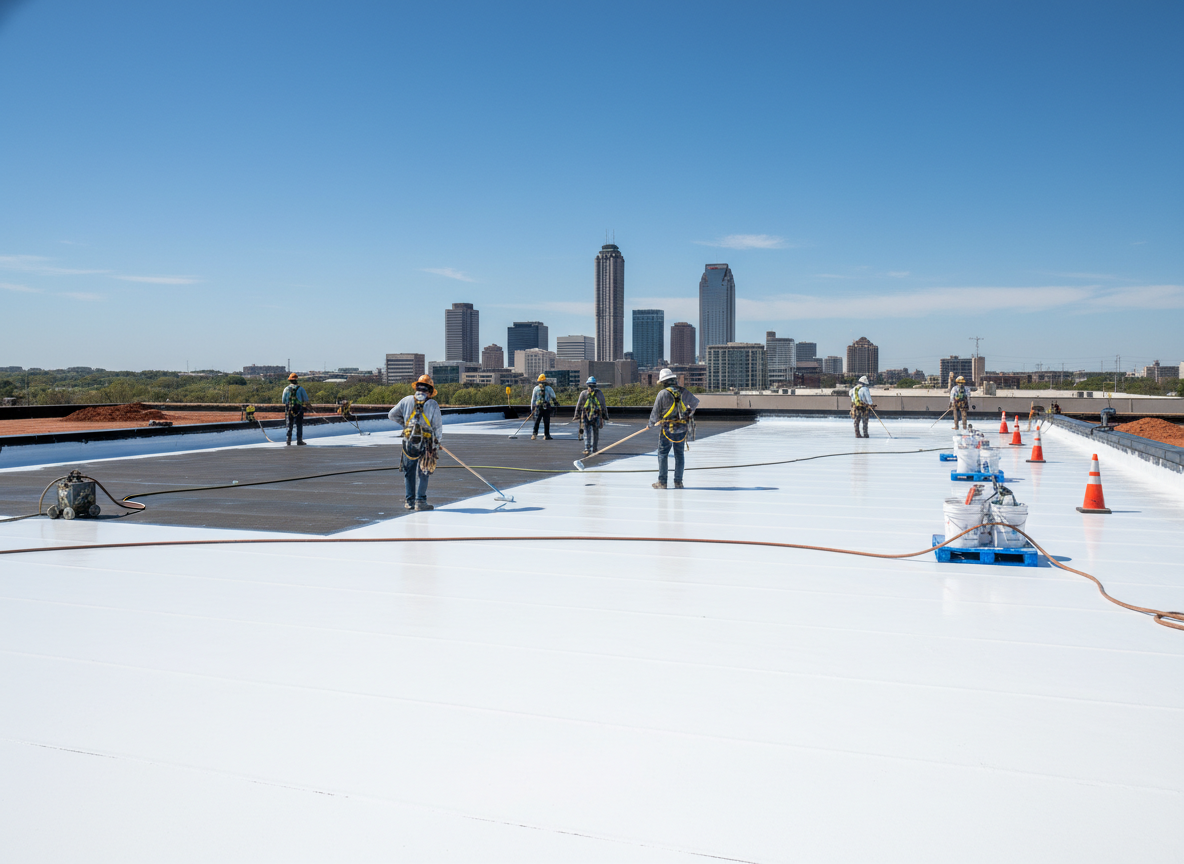
A coating can add life to a sound low-slope roof and lift its reflectivity, and it cannot save a wet assembly. Moisture testing decides whether coating is appropriate; on a roof that never dries, the answer is frequently no. Where it is appropriate, the preparation is most of the work.
Roof inspection
An inspection produces a condition record — covering, flashing, penetrations, drainage, attic side, photographs of each. It is what a homeowner uses to choose between repair and replacement, and it is what turns an insurance or wildfire question into something documented rather than remembered.
What comes with a Washington repair
- A roof and attic assessment before a scope is written, with photographs of the failed detail and its surroundings.
- A written scope separating covering, underlayment, deck repair and flashing, so the invoice cannot contain work that was never discussed.
- Deck inspection wherever the covering is opened, because on the west side soft sheathing under an intact shingle is common.
- Gutter runs, valleys and outlets checked as part of the job, since a blocked outlet will undo good flashing within a season.
- A magnet sweep of the ground and a walkthrough of the finished repair with the photographs handed over.
Washington metros and towns covered
Coverage in Washington includes Seattle, Bellevue, Redmond, Kirkland, Kent, Renton, Federal Way, Auburn, Tacoma, Puyallup, Everett, Marysville, Lynnwood, Olympia, Bremerton, Bellingham, Mount Vernon, Longview and Centralia on the west side, plus Vancouver and the Columbia corridor. East of the crest it includes Spokane, Spokane Valley, Cheney, Yakima, Ellensburg, Wenatchee, Moses Lake, Kennewick, Pasco, Richland, Walla Walla and Pullman.
All of these are coverage areas rather than premises. The company operates from one headquarters, in Oklahoma City, Oklahoma, and holds no Washington branch, yard or local crew. What differs across the state is the exposure, and that is what the address tells us before anything else does.
Where this sits on the site
Washington is the northernmost of the three West Coast states, and the marine, rain-season and fire conditions all three share are described on the West Coast region page. The national index of state guides is at roofing by state.
How a Washington repair is sequenced
First contact. You describe what you have noticed and when — a stain after the first storm, a shingle in the yard, a soft spot at the eave, moss that has spread across a slope. The address, the covering and which side of the Cascades the house is on are established immediately, because they decide almost everything that follows.
Assessment. The roof is walked where it can be walked safely, the attic is inspected from inside, and the failed detail is photographed with enough context to explain the failure. An intermittent leak is traced with readings rather than guessed at.
Scope. The repair is written in parts — what is removed, what is replaced, what is reused and what is deliberately left — and where there is a real alternative, both are described instead of one being steered.
Build. Materials are staged, the deck is examined as it is exposed, and any additional rot or failed flashing is reported before it is covered. Roof work on the west side is sequenced around the weather rather than in spite of it.
Handover. The completed repair is reviewed with you, the photographs are handed over, and the roof and ground are cleared of fasteners and debris. Anything seen and not repaired is recorded so the next decision begins from evidence.
Talk about a Washington roof
A Washington roof rarely fails without a warning, but the warning is usually a maintenance signal rather than a dramatic one — moss creeping, a fascia going soft, a stain that only appears in the first storm of the year. Call (833) 406-0167 and say where the water appears, when it started, what the roof is covered with, and whether the house is on the wet side or the dry side of the mountains.
Around Washington
We regularly work near:
- 📍Space Needle, Seattle
- 📍Mount Rainier National Park
- 📍Pike Place Market, Seattle
- 📍Grand Coulee Dam
- 📍Mount St. Helens National Volcanic Monument
Roof Repair in Washington — Local Notes
- •West of the Cascades a roof may not dry out for months, which makes ventilation part of the repair rather than an extra.
- •Cedar shake is common on older Puget Sound housing and is the most fire-exposed covering on the block.
- •East of the crest, meltwater refreezing at the eave is the winter failure to design against.