New Jersey can be crossed in an afternoon, and in that afternoon the roofing problem changes twice. Along the Shore the exposure is wind and salt: barrier islands, low-lying towns behind them, and a building stock that has been rebuilt after storms more than once. Inland, in the older boroughs and the dense inner suburbs, it is age and density — two- and three-family houses with flat roofs over porches, dormers cut into 1920s roofs, and gutters shared with a neighbour's wall. In the north-west corner, where the Highlands rise toward the Delaware Water Gap, it is snow and ice like anywhere in the Appalachians.
New Jersey is also the most densely populated state in the country, which changes the practical side of roof work rather than the technical one: narrow lots, close neighbours, material staged in a driveway, and a repair that has to protect the building next door as carefully as the one it is on. This page sets out what the state's weather does to roofs, which coverings dominate which part of it, the services available, the metros covered and how the work runs. If water is inside now, call (833) 406-0167 and describe where it is showing and which storm brought it.
The weather a New Jersey roof has to absorb
The coastal exposure: wind first, water second
On the Shore the wind arrives before the rain, and it is the wind that decides how much damage a storm does. Uplift works on edges, ridges and hips, and it works hardest on the windward corner of a roof, which is why a storm can strip one slope of a house and leave the other untouched. Barrier islands and the towns immediately behind them take the brunt; the further inland a building sits, the more the storm has been broken down by other buildings and trees.
The rain that follows is driven at an angle, so it reaches wall junctions, dormer cheeks and the heads of windows rather than falling onto the field of the roof. A leak that only appears during a named storm is a detail problem, and repairing the slope will not solve it.
Salt and the corrosion clock
Salt spray carries inland for miles during a coastal storm, and it settles on every metal surface on a roof: fasteners, edge metal, vents, valley metal and the fixings holding a gutter. Corrosion on a Shore roof therefore runs years ahead of the same roof inland, and the first failures are usually at the fixings rather than in the covering. A shingle field can look intact while the nails holding it have thinned to the point where the next strong wind takes the tabs.
Snow and ice in the north-west
The Highlands and the ridge country through Sussex, Warren and Morris counties are a different climate from the Shore: colder, snowier, and prone to the freeze-thaw cycling that opens flashings. Ice dams form on older houses with limited insulation, and the water typically enters at an eave or a valley rather than in the middle of a slope. The state is small, but the difference between Cape May and High Point is a genuine difference in what a roof is asked to survive.
Humid summers and afternoon storms
Inland summers are humid, and the roof stays damp through the night. Algae streaking on shaded slopes, moss in valleys and around north-facing dormers, and the general softening that comes with a deck that never fully dries are common. Summer thunderstorms bring hail and occasional tornadoes and microbursts, and the damage from a microburst is local and directional: one street takes it and the next does not.
Roof coverings typical of New Jersey housing
Asphalt shingle across most of the state
Laminated shingle covers the majority of New Jersey homes: the 1920s bungalows, the post-war suburbs, and the newer subdivisions inland. It repairs in sections and is available everywhere. On the Shore it is judged on wind rating and on how the fixings behave under salt; inland it is judged on ice at the eave and ventilation through a humid summer.
Flat and low-slope roofs on older urban housing
In Newark, Jersey City, Elizabeth and the older boroughs, a great many two- and three-family houses carry a flat roof over the main block and a low-slope roof over a rear extension or a porch. These are built-up or modified-bitumen assemblies, often with a parapet at the front, a scupper or a rear gutter, and a hatch. They fail at the seams, the parapet flashing and the drain, and they are where a leak most often starts in a building that has been added to three times.
Slate on the older suburbs
Slate survives on the established suburbs — Montclair, Glen Ridge, Millburn, Summit and parts of Trenton and East Orange — and on churches and civic buildings throughout the state. The repair logic is the same everywhere: slate outlives its flashings, so the work is usually metalwork or the replacement of individual units with salvaged material of matching size and thickness.
Metal on farm buildings and the Pine Barrens
Through-fastened metal covers barns, sheds and outbuildings through the southern interior, and standing seam appears on newer rural homes. The failure mode is at the fastener washer rather than in the sheet, and where a roof sheds onto a doorway the edge detail and snow guards matter.
What the roofing services look like on the Jersey Shore and inland
Emergency roof repair
A coastal emergency is measured in hours before the next high tide of weather arrives. Openings are closed, a ceiling holding water is relieved safely, and the pattern of damage is photographed while it is still fresh enough to read.
Emergency roof tarping
Uplift, not rain, is what pulls a tarp off a Shore roof, so it is fixed with battens through the tarp rather than adhesive under it. Where the forecast has another system behind the first, the tarp is installed to survive it.
Roof leak repair
A leak that only appears during a named storm is nearly always a wall or dormer detail, and the search starts at the junction rather than in the field. Inland, the same symptom usually points at a porch roof meeting the house.
Storm and hail damage repair
Wind damage is directional, so the survey begins with which elevation took the weather and works back from there. Hail is recorded separately on the slope and on the soft metals, since one is a covering question and the other is a documentation question.
Roof repair
Small repairs here are dominated by junctions: where a porch roof meets a wall, where a dormer meets a slope, where a chimney leaves the plane. Those are the places a New Jersey roof is most likely to fail, and they are repaired as details rather than patched as areas.
Roof replacement
Replacement on the coast has to answer a question inland roofs do not: how the new covering is held down. Fixing pattern, edge metal and underlayment are specified together, and the deck is inspected only once the old covering is off.
Roof installation
New roofs near the water are specified for uplift and for corrosion, with fixings and flashings chosen for salt rather than for cost alone. Inland, the same roof is specified for ice at the eave and for a humid summer in the attic.
Shingle roofing
Shingle remains the state's default covering, and on the coast the nailing pattern matters more than the colour or the style. A roof nailed for an inland exposure can lose tabs in a coastal storm that a correctly fixed roof would survive.
Tile roofing
Tile appears on a limited number of properties, generally older or architecturally distinctive, and the work is beneath it. Lifting and relaying over a new membrane is the standard repair; replacing the tile itself is rarely the issue.
Metal roofing
Metal on the Shore is a corrosion question first and a fastening question second. Inland it is a shedding question: where the snow and rain leave the roof, and whether that place is a path, a door or a garden.
Flat roof repair
The flat roofs of the older boroughs are repaired at the parapet, the rear gutter and the seam. A rear extension roof that ponds is treated as a drainage failure, because that is what it usually is.
Roof coating
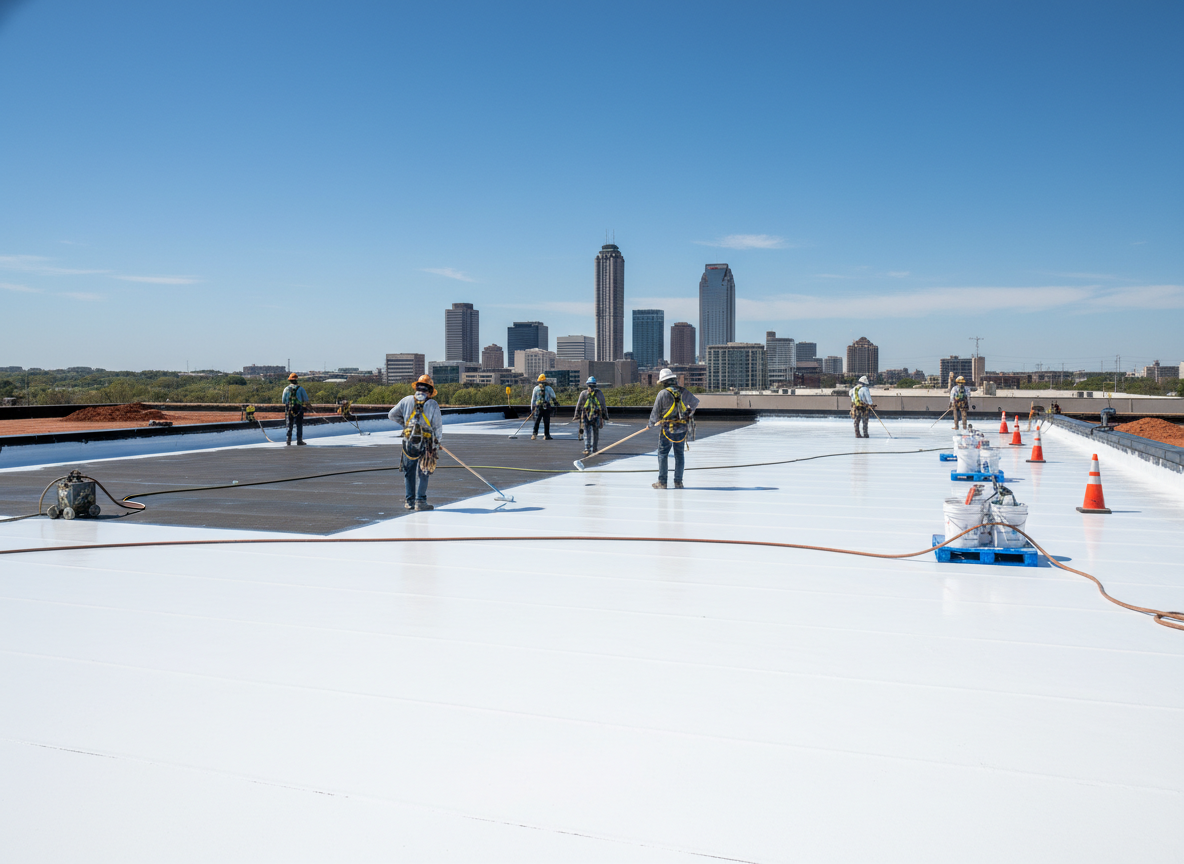
Coating a flat roof can buy years where the assembly is dry and the drainage works. On the coast the coating also has to cope with grit and salt carried in wind, so surface preparation decides the outcome as much as the product.
Roof inspection
A New Jersey inspection reports the covering, the junctions, the drainage and the fixings, because near the water the fixings are where the next failure starts. The record is dated and photographic so it can be compared after the next storm.
What's included in a New Jersey roof repair
- The direction of the storm read against the damage before a scope is discussed, so the pattern is recorded as evidence rather than as an impression.
- Fixings, edge metal and vents checked for corrosion wherever salt spray reaches the building.
- Porch-roof, dormer and wall junctions opened and inspected where a leak only appears in storms.
- Parapets, rear gutters and drains photographed on every flat roof, including the route water takes to the street.
- Soft sheathing reported as soon as the deck is exposed, with photographs taken before anything is covered.
- A closing walkthrough with the photographs and a written note of what was seen but left alone.
New Jersey metros and cities covered
Coverage in New Jersey includes Newark, Jersey City, Paterson, Elizabeth, East Orange and the dense inner suburbs, Trenton and the Mercer County towns, New Brunswick and central Jersey, Edison and Woodbridge, Toms River and the central Shore, Atlantic City and Atlantic County, Cape May and the southern Shore, Long Branch and Asbury Park, Morristown, Cherry Hill, Camden, Vineland and the rural south.
These are coverage areas, not offices. The company is headquartered in Oklahoma City, Oklahoma, and works across New Jersey from that base. What changes is the exposure: a Shore roof is judged on wind uplift and salt, an inner-suburb flat roof on parapets and drains, and a Highland roof on snow and ice.
From the first call to a finished repair
A call about a New Jersey roof usually starts with a storm. The shingles are lifting on one slope, the porch ceiling is stained, water is coming down inside the wall, granules are in the gutter. The address, the building type and the covering are taken down, and the call is triaged: an active leak during a storm and a question about a roof that is simply old do not get the same response.
The visit reads the building before it reads the roof. Which way the damaged slope faces, whether the porch or addition has its own roof, where the water is appearing inside, and how close the neighbouring building is. On the Shore the fixings and the edge metal get as much attention as the covering, because that is where salt shows first.
The scope separates the covering from the underlayment, the deck, the flashing and the metalwork, so that the invoice matches what was agreed. Where there is a genuine choice — a section repair against a slope replacement, a coating against a re-cover — both are set out with what each one assumes about the condition underneath.
Work is sequenced around the weather. On the coast that means watching the forecast and not opening a roof that cannot be closed before the next system; inland it means the same discipline around rain and, in winter, around ice. Material is staged on the property, protection goes over anything below, and the deck is inspected as it is exposed.
The repair is reviewed with you at the end, with the photographs of the damage and of the finished work, and anything noticed but not repaired is written down for the next decision.
Other Northeast state guides
The coastal exposure described here runs the length of the Northeast seaboard, and the Northeast region page sets out how it changes from state to state. The state index lists every state we cover.
- Roof repair in New York
- Roof repair in Pennsylvania
- Roof repair in Massachusetts
- Roof repair in Connecticut
- Roof repair in Virginia
- Roof repair in West Virginia
- Roof repair in Maryland
Call about a New Jersey roof
On a Shore roof the question is usually which storm did the damage; inland it is usually which of three additions to the house is leaking. Both are answered the same way, by reading the building and the water path before deciding what to repair. Call (833) 406-0167, describe what you are seeing and where, and the first step is narrowing it down.
Around New Jersey
We regularly work near:
- 📍Cape May Lighthouse
- 📍Liberty State Park
- 📍Delaware Water Gap
- 📍Barnegat Lighthouse
- 📍Atlantic City Boardwalk
Roof Repair in New Jersey — Local Notes
- •On the Shore, salt corrodes fasteners and edge metal before the covering itself shows any failure.
- •Two- and three-family houses in the older boroughs often have a flat main roof and a low-slope porch roof that fails at the wall junction.
- •Wind damage is directional: one slope and one corner can be stripped while the rest of the roof is untouched.