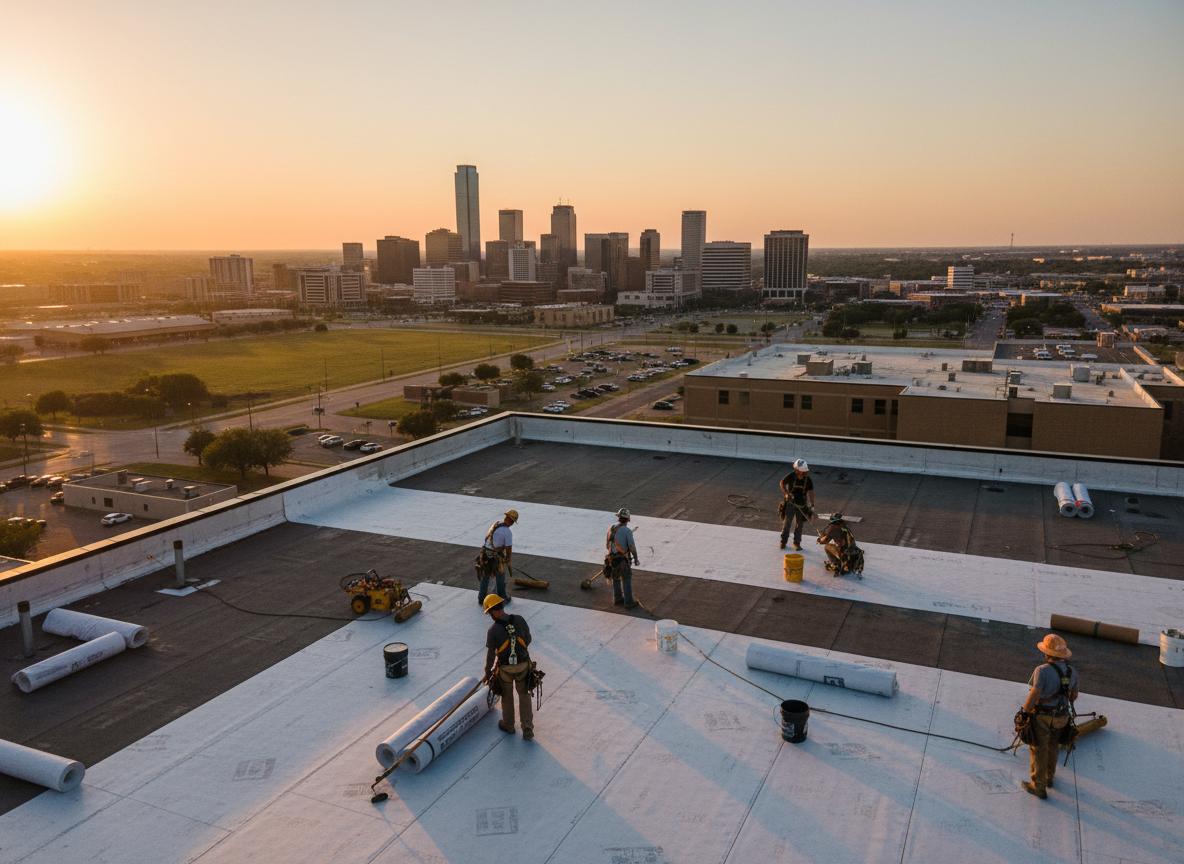
Pennsylvania is a state where the roof on the building in front of you was designed for a different century. Philadelphia holds one of the largest stocks of rowhouses in the country, and a rowhouse roof is a flat or very low-slope surface tucked behind a parapet, sharing a party wall with the house next door and draining through a scupper that nobody has looked at since the last owner. Pittsburgh's hillsides carry older houses with slate and steep pitches on streets too narrow to stage a truck. Between them sits a great deal of 1920s twin housing, post-war suburb and farm building with a metal roof that has been recoated twice.
That building stock is why roof repair in Pennsylvania is often a detailing problem rather than a covering problem. The weather matters — ice in the west, snow in the north-east, humid summers, spring hail — but a rowhouse in Fishtown and a farmhouse outside Lancaster fail for reasons that have more to do with how they were built than with how hard it rained. If water is coming in now, call (833) 406-0167 and describe where it appears and which wall it appears against; on a city rowhouse the wall is usually the answer.
What Pennsylvania weather does to a roof
Winter in three registers
The state does not have one winter. Erie, on Lake Erie, sits in a lake-effect snow belt and takes repeated heavy falls off the water. The Poconos and the northern tier are simply cold and snowy. Western Pennsylvania and the Laurel Highlands get ice — freezing rain that glazes the covering, loads the eaves and then holds, followed by rain that cannot drain because the ice is in the way. The south-east around Philadelphia gets less snow but more freeze-thaw cycling, which is arguably harder on a roof: every melt runs into a detail, every night's freeze expands it, and a joint that survives one winter opens in the third.
Ice, eaves and the parapet
Icicles hanging from a city parapet are usually read as decoration and are in fact a diagnosis. The same heat loss that produces an ice dam on a pitched roof produces a solid band of ice at the top of a rowhouse wall, where the parapet meets the roof. Water backs up behind it, finds the counter-flashing that has separated from the brick, and travels down inside the wall rather than across the ceiling. By the time a stain appears in a second-floor room the roof itself may be dry.
Humid summers and thunderstorms
Pennsylvania summers are humid enough that a roof stays damp through the night, and shaded north slopes grow algae and moss that hold water against the covering. Afternoon thunderstorms arrive with wind and, in spring, hail. Hail is not the state's headline exposure the way it is on the plains, but the same storms that drop quarter-sized stones in the Midwest arrive here weakened rather than absent, and a bruised shingle mat is a slow failure wherever it happens.
Wind, trees and the wooded suburbs
The south-east and the Pittsburgh hills are heavily wooded, and a wooded roof has a different maintenance profile: gutters fill, valleys collect debris, limbs abrade the covering, and shade keeps everything wet for longer. Straight-line wind in a summer storm takes limbs down onto ridges and valleys more often than it takes whole roofs off.
Roof types and housing stock you will find in Pennsylvania
Rowhouse roofs: flat, parapeted and shared
The defining Pennsylvania roof is the Philadelphia rowhouse: a low-slope roof behind a masonry parapet, draining to the front or the rear, sharing a party wall on both sides. Coverings range from built-up roofing and modified bitumen to newer single-ply membranes and, on some blocks, a roof deck laid over the membrane. The failure points are the parapet counter-flashing, the scupper, the step flashing where the roof meets the party wall, and any skylight or hatch that was cut into it later. Water that enters at a party wall is often blamed on the roof next door, and occasionally that is correct.
Slate on the older suburbs and institutions
Slate covers a large share of the region's late nineteenth and early twentieth-century housing — the Main Line and Mount Airy in Philadelphia, the older neighbourhoods of Pittsburgh, churches and civic buildings across the state. Sound slate outlives its flashings several times over, so the repair is usually metalwork or the replacement of individual units with salvaged material. Nail fatigue is the quiet killer: the slates are fine and the nails holding them have corroded through.
Asphalt shingle on the twentieth century
Most of the state's post-1920s housing is shingled: the twins of the 1920s, the post-war suburbs, and the vast tract build that followed. Laminated shingle repairs in sections and is available everywhere. Here it is asked to survive freeze-thaw at the eave and, in the south-east, a humid summer that keeps the deck damp; ventilation and an ice barrier at the eave decide how long it lasts.
Metal on farms, barns and rural homes
Lancaster County and the central ridge country are full of metal roofs — standing seam on houses, through-fastened panels on barns and outbuildings. These are repairable panel by panel, and the recurring failure is at the fastener washer rather than in the sheet. Where a metal roof sheds onto a doorway or a path, snow guards and a properly detailed edge matter.
Built-in box gutters
Older cities here, Philadelphia included, have built-in gutters: a channel formed into the roof structure and lined with metal. When the lining corrodes or a seam opens, water goes into the building rather than over the edge, and the damage appears at a ceiling well inside the house. Repairing one is sheet-metal work and often masonry work at the same time.
Roof repair services in Pennsylvania
Emergency roof repair
When a shared wall is taking water, the emergency is as much about the neighbour as the roof. The entry is stopped, the wall is opened only where it needs to be, and the parapet above is photographed before the repair begins.
Emergency roof tarping
On a street where the houses touch, a tarp has to be fastened without damaging the next roof and without sending water over the party wall. Battened rather than glued, and sized to the roof it is protecting.
Roof leak repair
Rowhouse leaks are diagnosed by following the wall, not the stain. A damp patch a storey below the roof usually means a parapet flashing or a party-wall step that has opened, and both are metal details rather than shingle ones.
Storm and hail damage repair
Spring storms here arrive with wind, hail and limbs in the same hour, sometimes on the same roof. Each is recorded separately, because a limb strike, a hail bruise and an old repair look alike from the pavement and are treated differently.
Roof repair
Much of the work in this state is sheet metal and masonry: a box gutter lining renewed, a chimney counter-flashing cut into the brick, a valley re-laid, a scupper rebuilt. Sealant is a last resort, not a method.
Roof replacement
Re-roofing a rowhouse means planning the tear-off around a shared wall and a narrow street, then rebuilding the deck, the ice barrier and the ventilation in one pass because none of them can be reached again.
Roof installation
New work on twins, infill and farm buildings is specified for the exposure at the address: snow in the north, ice in the west, and drainage that does not depend on a single outlet on a city lot.
Shingle roofing
The 1920s twins and the post-war suburbs are shingled, and their roofs live or die on the ice barrier at the eave and on whether the attic can vent through a humid summer.
Tile roofing
Tile is a small share of the state's stock and usually old. The repair is under the tile: lift, renew the underlayment, relay what can be reused and match what cannot.
Metal roofing
Lancaster County barns and ridge-country houses run on metal. Washers, laps and the discharge point are the three things that decide whether a metal roof stays watertight through a Pennsylvania winter.
Flat roof repair
Flat roofs are the Pennsylvania speciality. Scuppers, parapets and laps are inspected in that order, because a blocked outlet will destroy a sound membrane faster than sunlight will.
Roof coating
An old tar roof can sometimes be kept going with a coating, but only after moisture testing and only where the drainage has been fixed. Coating a roof that ponds is a way of hiding the problem rather than solving it.
Roof inspection
For a buyer or an owner of an older rowhouse, an inspection is really a history: which flashing is original, which has been patched, and what the parapet is likely to do next winter.
What's included in a Pennsylvania roof repair
- Parapet, counter-flashing and scupper inspected on every flat roof before a scope is discussed.
- Party-wall step flashing examined from both roofs where access allows, so the repair is not limited to one side of a shared wall.
- The attic assessed for heat loss whenever ice is the complaint, because the dam is a symptom of a warm roof.
- Deck and sheathing recorded as the covering comes off, with photographs taken before the damaged material is removed.
- Box gutter linings reported as metalwork, with the condition of the lining stated rather than assumed.
- A closing walkthrough with the photographs and a written list of what was found but not repaired.
Pennsylvania metros and cities covered
Coverage in Pennsylvania includes Philadelphia and its suburbs, Pittsburgh and the surrounding valleys, Allentown, Bethlehem and Easton in the Lehigh Valley, Reading, Lancaster and York, Harrisburg and the capital region, Scranton and Wilkes-Barre, Erie, State College, Altoona, Johnstown, Chester and the smaller boroughs between them.
These are coverage areas, not offices. The company is headquartered in Oklahoma City, Oklahoma, and works across Pennsylvania from that base. The exposure changes from one end of the state to the other: a Philadelphia roof is judged on parapets and party walls, a Pittsburgh roof on hillside staging and ice, an Erie roof on lake-effect snow.
How the work runs, from the first call to a finished repair
It begins with what you can see. A stain on a ceiling, a damp patch at the top of a wall, a scupper that overflows in heavy rain, a piece of slate on the pavement. The call establishes the address, the building type and the covering, and it separates an active leak from a maintenance question so that the response matches the problem.
The visit starts inside on most Pennsylvania buildings, because the interior tells you which wall to look at. The roof is then walked where it is safe, the attic is inspected, and the parapet, the flashing and the drainage are photographed. Where the complaint is ice, the insulation and ventilation are assessed at the same time, since a repair that ignores them is a repair that will be repeated.
The scope is written in parts — covering, underlayment, deck, flashing, metalwork — so that nothing appears on the invoice that was not agreed beforehand. Where there is a real choice, such as a section repair against a full slope, or a coating against a re-cover, both are described with what each one assumes about what is underneath.
The work itself is planned around an occupied building on a narrow street: material staged at the rear where possible, protection over the neighbour's side, and the deck inspected as it is exposed so that soft sheathing is reported before it is covered.
At the end, the repair is reviewed with you, the photographs are handed over, and anything noticed but not repaired is written down. On a hundred-year-old rowhouse that list is usually longer than the repair itself, and it is the most useful thing to leave behind.
Other Northeast state guides
Pennsylvania shares the Northeast's winter exposure with seven neighbouring states, described on the Northeast region page. The full list of states we cover is on the state index.
- Roof repair in New York
- Roof repair in New Jersey
- Roof repair in Massachusetts
- Roof repair in Connecticut
- Roof repair in Virginia
- Roof repair in West Virginia
- Roof repair in Maryland
Talk to a roofer about a Pennsylvania roof
Frank Lloyd Wright's Fallingwater, in Fayette County, has been dealing with a leaking roof since the 1930s, which is a reminder that a difficult roof is usually difficult because of its detailing rather than its age. Most Pennsylvania roofs are more forgiving than that, but they still fail at the parapet, the party wall and the gutter before they fail anywhere else. Call (833) 406-0167 and describe where the water is showing. That single detail usually narrows the conversation to one or two suspects.
Around Pennsylvania
We regularly work near:
- 📍Independence Hall
- 📍Fallingwater
- 📍Gettysburg National Military Park
- 📍Presque Isle State Park
- 📍Longwood Gardens
Roof Repair in Pennsylvania — Local Notes
- •On a Philadelphia rowhouse the parapet counter-flashing and the scupper are the two details that cause most interior damage.
- •Step flashing at a party wall is shared between two owners, so a repair has to account for both sides of the wall.
- •Built-in box gutters are sheet-metal work: patching them with sealant postpones the problem rather than solving it.