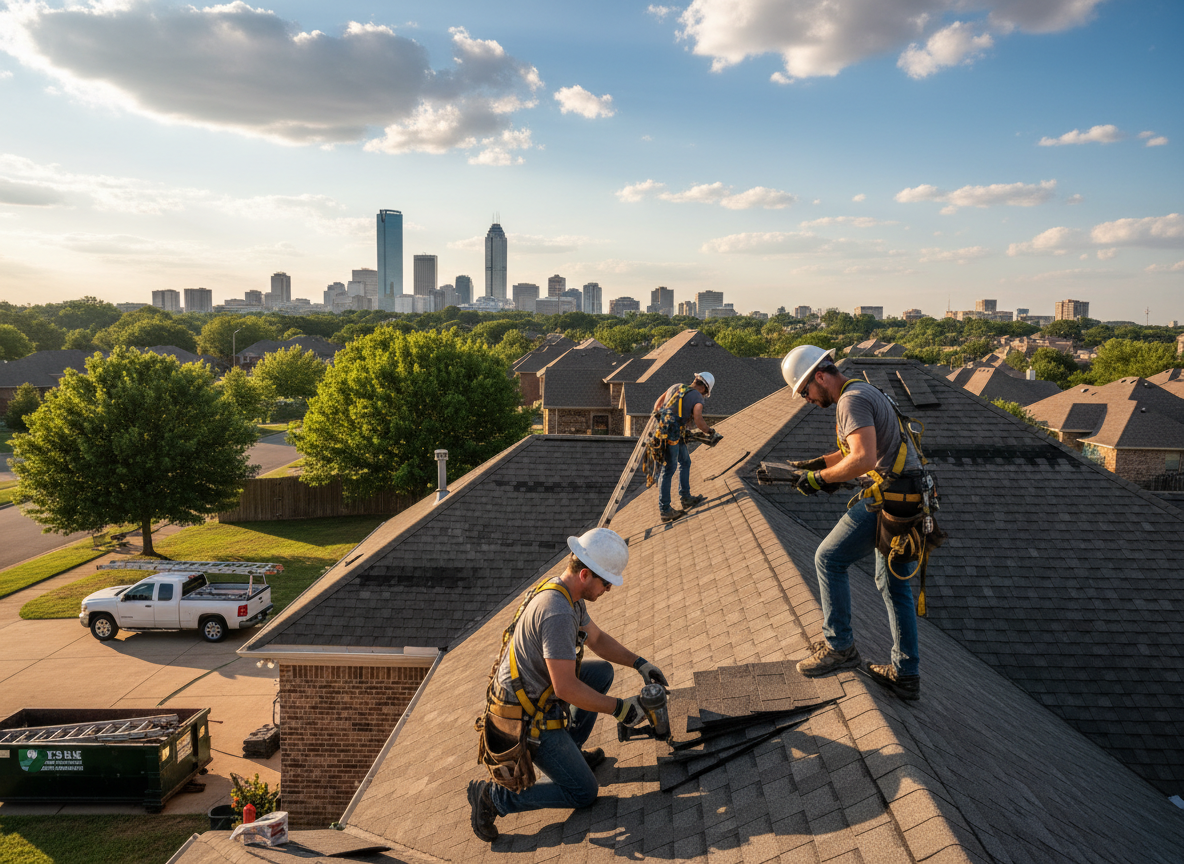
Virginia runs from the Atlantic to the Alleghenies, and the roof on a house at one end of that line is dealing with a different set of forces from the roof at the other. In Hampton Roads and on the Eastern Shore the exposure is wind-driven rain from tropical systems, salt in the air and a water table that has been rising for a century. In the Piedmont the problem is summer heat, humidity and spring hail. In the Blue Ridge and the Shenandoah Valley it is snow, freezing rain and wind on an exposed ridge. Richmond and the older cities sit somewhere in the middle, with brick, slate and a housing stock old enough that the flashings are the interesting part.
Virginia is also a state where a great many roofs are on buildings that people care about — colonial-era houses, historic districts, farm buildings with standing seam — so the work often has to preserve something as well as keep the water out. What follows covers the weather, the coverings, the thirteen services in local terms, the metros covered and how a repair runs. If water is coming in now, call (833) 406-0167 and describe where it shows and what the weather was doing.
What Virginia weather does to a roof
Tropical remnants and the Tidewater
Virginia sits far enough north that a hurricane usually arrives weakened, and far enough south that the remnants still carry enormous rainfall. Hurricane Camille's remnants in 1969 produced rainfall in Nelson County that remains the state's reference point for what a dying storm can do inland, and Hurricane Isabel in 2003 pushed surge into Hampton Roads and tore at roofs across the region. The lesson for a roof is that the water often arrives with wind behind it and in quantities the details were never tested against.
In Hampton Roads, wind-driven rain finds wall junctions, chimney sides and the heads of windows, and the ground being wet for days means a slow leak inside a wall has time to spread before anyone notices it.
Salt and the Eastern Shore
On the Eastern Shore and along the Atlantic edge of Virginia Beach, salt settles on every metal component. Fasteners, edge metal, vents and valley metal corrode years ahead of the same roof inland, and a shingle field can look intact while its fixings have thinned. Wind uplift is the other half: edges, ridges and hips go first, and they go on the elevation facing the weather.
Piedmont heat, humidity and hail
Central Virginia summers are hot and humid, and the roof loads from both sides — sun on the covering, heat in the attic beneath it. Ultraviolet exposure ages asphalt and bleaches paint on metal, algae streaks the shaded slopes and moss settles in valleys that stay damp. Spring and summer storms bring hail to the Piedmont often enough that a bruised shingle mat is a routine finding, and the damage is easy to miss because a bruised mat can stay watertight for months.
Blue Ridge and Valley ice
West of the Piedmont the elevation changes the winter. Freezing rain glazes the covering, snow sits on north-facing slopes, and the freeze-thaw cycle works on every flashing detail and every masonry joint. Ice dams form where heat escapes into an attic, and on a steep mountain roof the water that backs up behind the ice can travel a long way before it shows inside. Ridge-top wind is its own exposure: it lifts edges, works at ridges and drives rain into places a sheltered roof never sees.
Roof types and housing stock in Virginia
Brick, slate and the colonial roof
Virginia's older housing is brick, often with a steep pitch originally covered in wood shingle and later in slate or asphalt. Brick chimneys, parapets and cornices are part of the roof rather than separate from it, and they hold water in a way that a wood-framed wall does not. On these buildings the flashing is the whole game: chimney flashing, step flashing at a dormer, and the counter-flashing where a parapet meets a roof.
Standing seam on farms and rural buildings
Standing seam and through-fastened metal cover barns, sheds and rural houses through the Valley and the southside, and standing seam is increasingly used on new rural homes. The recurring failure is the fastener washer rather than the sheet, and where a roof sheds onto a doorway or a path, snow guards and a properly detailed edge matter.
Townhouses and low-slope porch roofs
Northern Virginia's townhouse clusters and the older urban housing in Richmond and Norfolk carry a great deal of low-slope roofing: porch roofs, bay projections, rear additions and flat roofs on commercial blocks. These fail at the junction with the wall, at the parapet and at the drain, and a leak that appears at a porch ceiling usually started where the porch roof meets the house.
Asphalt shingle across the suburbs
Most of the state's late twentieth-century housing is shingled. It repairs in sections and is available everywhere. Here it is asked to survive heat and ultraviolet exposure in the Piedmont, wind-driven rain in the Tidewater and freeze-thaw in the mountains, which is three different specifications for one product.
Tile and synthetic slate on newer and historic-revival housing
Clay tile and synthetic slate appear on architecturally styled houses across the state, from older urban buildings to new construction built to look older. On any tile roof the tile is the wear layer and the underlayment beneath is the waterproofing, so an ageing roof is repaired by lifting and relaying the covering over a new membrane.
Roofing services in Virginia
Emergency roof repair
After a tropical system the first visit stops the water and records the damage in the same pass, because a claim and a repair both depend on what was there before anything was removed. On a historic building that record also shows what will need to match.
Emergency roof tarping
Tidewater wind will find any loose edge, so a tarp is fastened with battens and kept inside the building's own roof line. Where a second system is forecast, the temporary cover is installed to survive it rather than to last the afternoon.
Roof leak repair
On a brick house the search follows the wall. Water enters at a chimney, a parapet or a valley, travels behind the brick and appears on a ceiling that can be two rooms away from the opening, which is why the interior is inspected before the roof.
Storm and hail damage repair
Piedmont hail bruises a mat without breaking it, and Tidewater wind lifts tabs without removing them. Both are recorded slope by slope on the same visit, with the storm direction noted, because that is what explains the pattern.
Roof repair
The repairs that matter here are flashing repairs: chimney counter-flashing cut into brick, valley metal re-laid, a step flashing at a dormer rebuilt, a porch roof junction re-detailed. On a Virginia house those are the failures that produce interior damage.
Roof replacement
A replacement exposes the deck and every earlier repair, which is when the underlayment, the ice barrier in the mountains and the ventilation are settled. On an older or historic building the covering is chosen to suit what is already there.
Roof installation
New roofs are specified by region rather than by preference: uplift and salt in the Tidewater, snow and ice in the Valley and Ridge, and drainage that copes with short intense Piedmont storms.
Shingle roofing
On the state's subdivisions the questions are impact resistance in hail country, wind rating near the coast and how the covering ages under a long, hot summer.
Tile roofing
Tile and synthetic slate are used on architecturally styled houses old and new. The covering is the wear layer and the membrane beneath does the waterproofing, so the repair is to lift, renew and relay.
Metal roofing
Standing seam covers farms and rural homes through the Valley, and the fastener washer is what fails first. Where the roof discharges onto a path or a doorway, guards and edge detail are part of the job.
Flat roof repair
Low-slope work in Virginia is mostly townhouse porch roofs, bay projections and the flat roofs of older commercial blocks. The junction with the wall is inspected before the field of the membrane.
Roof coating
A reflective coating can cut heat gain on a top floor and extend the life of a dry low-slope roof. It is not a repair for a roof that ponds, and a moisture test decides whether it applies at all.
Roof inspection
On an older Virginia building an inspection doubles as a record of original fabric: which slate, which flashing, which brick joint. That is what tells an owner what can be repaired and what would count as an alteration.
What's included in a Virginia roof repair
- Roof-to-brick junctions inspected as flashing details, since that is where most Virginia leaks begin.
- Chimney flashing and the masonry joint above it assessed as one repair rather than two.
- Storm direction recorded against the pattern of damage before anything is handled.
- Ice barrier and drip edge specified in the mountains wherever a covering is opened at an eave.
- Porch roofs, parapets and drains photographed on low-slope and townhouse work.
- A closing walkthrough with the photographs and a written list of anything found but left alone.
Virginia metros and cities covered
Communities across Virginia where coverage applies include Virginia Beach and the oceanfront, Norfolk, Chesapeake, Portsmouth and Hampton Roads, Newport News and Hampton, Richmond and the surrounding counties, Arlington, Alexandria, Fairfax and the Northern Virginia suburbs, Fredericksburg, Charlottesville, Lynchburg, Roanoke and the Roanoke Valley, Winchester and the northern Valley, Harrisonburg, Blacksburg, Danville and the southside, and the Eastern Shore.
These are coverage areas, not offices. The company is headquartered in Oklahoma City, Oklahoma, and works across Virginia from that base. The exposure varies more here than in most states: a Virginia Beach roof is judged on wind and salt, a Richmond roof on brick and slate, a Roanoke roof on ice and snow load.
How the work runs, from the first call to a finished repair
A call starts with a description and a date. When did the water appear, what was the weather doing, and where inside the building is it showing. The address, the building type and the covering are recorded, and the call is triaged so that an active leak is handled differently from a question about a roof that is simply due.
The visit reads the interior first. On a brick house, a damp patch high on a wall can mean the chimney flashing, the parapet or a valley, and the interior tells you which wall to work from. The roof is then walked where it is safe, the attic inspected, and the flashing, valleys and drainage photographed.
The scope is written in parts, so that covering, underlayment, deck, flashing and metalwork are separated and the invoice matches what was agreed. Where there is a genuine choice — a section repair against a slope replacement, a coating against a re-cover — both are set out with what each one assumes about the condition underneath.
Work is sequenced around the weather, which in Virginia means watching the summer storm pattern as closely as the winter one. Material is staged, protection goes over anything below, and the deck is inspected as it is exposed so that soft sheathing is reported before it is covered.
The repair is reviewed with you at the end, the photographs are handed over, and anything noticed but not repaired is written down. On a historic building that note is often the starting point for the next phase of work.
Other Northeast state guides
Virginia's mix of coastal and mountain exposure is described alongside the rest of the region on the Northeast region page. Every state we cover appears on the state index.
- Roof repair in New York
- Roof repair in Pennsylvania
- Roof repair in New Jersey
- Roof repair in Massachusetts
- Roof repair in Connecticut
- Roof repair in West Virginia
- Roof repair in Maryland
Call about a Virginia roof
A Virginia roof usually tells you which part of the state it is in by how it fails: wind-driven rain at a wall junction in the Tidewater, hail bruising in the Piedmont, ice at a valley in the Valley and Ridge. Call (833) 406-0167, describe what you are seeing and when, and the first step is identifying which of those it is.
Around Virginia
We regularly work near:
- 📍Monticello
- 📍Mount Vernon
- 📍Shenandoah National Park
- 📍Colonial Williamsburg
- 📍Natural Bridge
Roof Repair in Virginia — Local Notes
- •On brick houses the roof-to-wall junction is the detail that fails most often, and the damage appears inside the wall before the ceiling.
- •Tidewater roofs are judged on wind uplift and salt; Piedmont roofs on hail bruising and heat; Valley roofs on ice.
- •Historic districts can review visible roof changes, so the material and detailing matter as much as the repair.