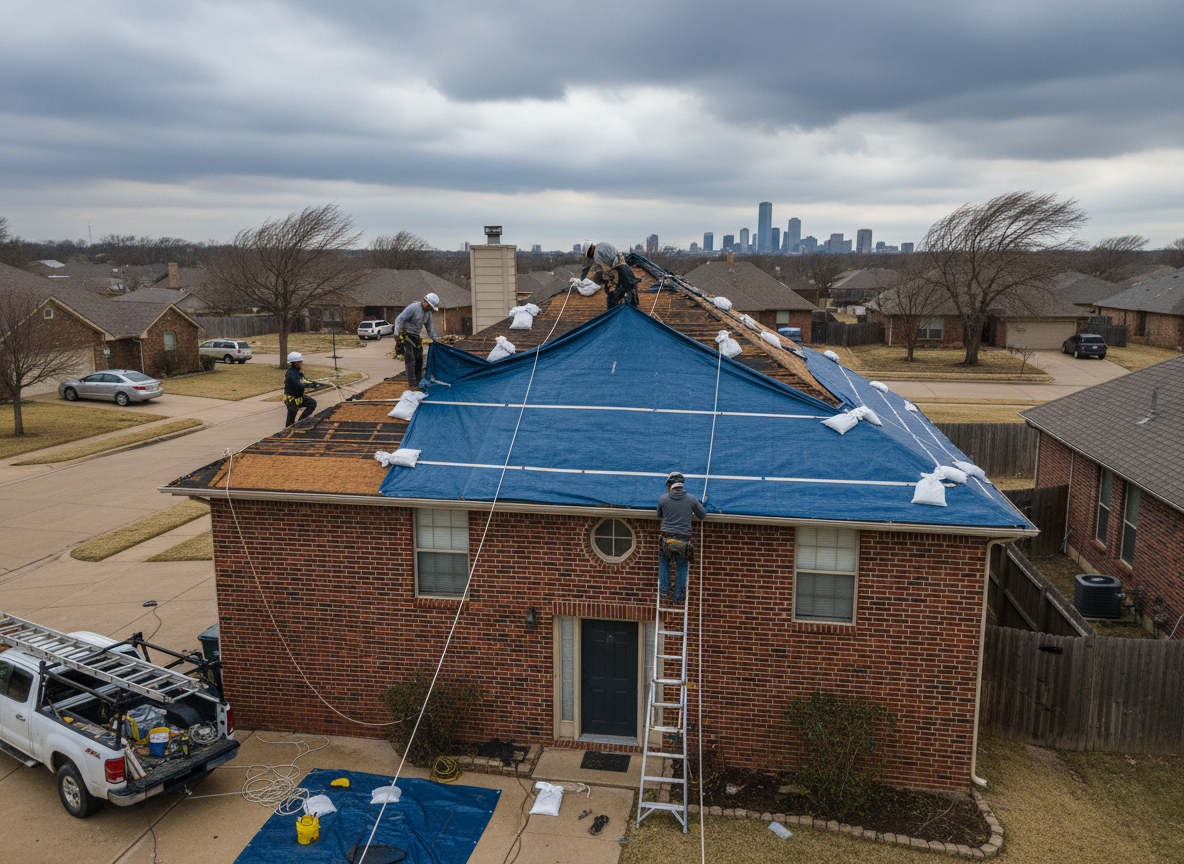
West Virginia roof work is shaped by the ground as much as by the weather. A house on a hillside outside Charleston or Elkins may have its roof at the level of the road and its front door three flights down, or the reverse; a barn in the Alleghenies may sit at the end of a track that a delivery truck cannot use. Scaffolding, staging, ladder placement and how a bundle of shingles reaches the ridge are part of the estimate here, not an afterthought. Then there is the weather that made the terrain: snow in the high counties, freezing rain in the valleys, summer downpours that turn a creek into a torrent in an hour, and a hardwood canopy that drops limbs onto roofs every time the wind gets serious.
That combination — steep ground, dense trees, metal roofs and a long winter at elevation — gives West Virginia a roofing profile quite unlike the rest of the Northeast region. This page covers the exposure, the coverings, the services in local terms, the places covered and how a repair runs. If water is coming in, call (833) 406-0167 and describe where it shows; on a mountain house the first question is often which side of the ridge the water is coming from.
What West Virginia weather does to a roof
Snow at elevation, ice in the valleys
The higher counties of the Alleghenies — Pocahontas, Tucker, Randolph, Preston and their neighbours — carry snow for months and take lake-enhanced and upslope falls that the lowlands never see. Snow that stays is a load, and it also melts from underneath wherever heat escapes, runs to a cold eave and refreezes. In the valleys the dominant winter event is freezing rain: a glaze that loads the covering, the gutters and every branch above the roof, and then holds until the temperature rises.
When it does rise, the melt arrives all at once. That is when the flashings that were marginal in December become leaks in February.
Wind, trees and limbs
The state is heavily forested, and a wooded roof has a different failure profile from an open one. Straight-line wind and summer downbursts take limbs down onto ridges, valleys and the edges of roofs; a limb that stays on a roof holds moisture against the covering and can puncture it. Debris fills valleys and gutters, and shade keeps the whole assembly damp for longer than the exposure would suggest.
Rain that arrives fast
West Virginia's steep terrain means rain concentrates. A summer storm can put a month of water through a valley in an afternoon — the 2016 flooding in Greenbrier County is the reference point for how quickly that happens. Roofs are rarely the direct casualty of a flood, but the storm that causes one also drives water sideways into wall junctions, lifts edge metal and pushes water through any flashing that was already open. Saturated ground and moving debris then affect the building underneath the roof.
Humidity, shade and moss
Summers are humid, and a roof under trees stays wet through the night. Moss and algae on shaded slopes are the visible sign, and the invisible one is a deck that never fully dries. On a north-facing slope under hardwoods, sheathing can soften well before anything appears on a ceiling.
Roof types and housing stock in West Virginia
Metal: the mountain default
Metal is the covering that made sense here long before it was fashionable. Through-fastened panels cover barns, sheds, churches and a great many houses; standing seam appears on newer homes and on renovations where snow shedding matters. Metal handles the snow, sheds it fast and repairs panel by panel. The recurring failures are the fastener washer, the sealant at a lap and the edge detail where the roof discharges onto a walkway.
Asphalt shingle on the twentieth-century housing
Most of the state's post-war housing is shingled, including a great deal of small frame housing in the towns along the rivers. Shingle repairs in sections and is available everywhere, but here it is asked to survive freeze-thaw at the eave and a humid summer under trees, and ventilation is usually the difference between a roof that lasts and one that does not.
Roofing work available across West Virginia
Emergency roof repair
A limb through a roof is the commonest emergency here, and the access plan matters as much as the repair. The opening is closed, the ceiling below is relieved, and the damage is photographed before the limb is cut away.
Emergency roof tarping
Ridge-top wind is what tests a tarp in this state, so it is battened rather than stuck and secured so that it cannot sail downhill. On a metal roof the battens are placed where they will not crush the ribs.
Roof leak repair
On a frame house the water often travels inside the wall before it reaches a ceiling, so the stain can be a room away from the hole. The diagnosis works from the interior outward, and the wall is opened only where the evidence points.
Storm and hail damage repair
Summer systems here bring wind, limbs and hail in one pass, and the record has to separate them. The survey also notes the trees overhanging the roof, because on a wooded lot that is what predicts the next event.
Roof repair
Much of the work is at the seams of a metal roof, the flashing around a chimney or a flue, and the junction where a porch roof meets the house. Those details, not the field of the covering, are what fails on a mountain building.
Roof replacement
Replacing a roof here means planning how the material reaches it before the first bundle is ordered. Once the deck is open, the underlayment, the ice barrier at the eave and the ventilation are set for the next thirty years.
Roof installation
A new roof at elevation is specified for ground snow load and for shedding, with the discharge point chosen deliberately rather than left to wherever the water happens to land.
Shingle roofing
The shingled frame housing along the rivers is judged on the ice barrier at the eave and on whether the attic can dry through a humid summer under trees.
Tile roofing
Tile is almost unknown here outside a few older buildings. Where it exists the repair is beneath it: lift the covering, renew the membrane, relay what is sound.
Metal roofing
This is the state's core trade. Washers, laps, sealant and the edge detail are what fail; panels rarely do. Recoating, snow guards and the discharge point belong in the same conversation.
Flat roof repair
Flat roofs sit on the older commercial blocks and the flat-roofed additions, and they fail at the parapet, the scupper and the lap. A ponding roof is a drainage problem before it is a membrane problem.
Roof coating
On a dry low-slope roof a coating can add years and reduce heat on the floor below. On a wet one it traps moisture, so the moisture reading comes before the recommendation.
Roof inspection
An inspection here includes the trees: what overhangs the roof, what has already dropped, and where the next limb would land. That, plus the condition record, is what an owner actually needs.
What's included in a West Virginia roof repair
- Access and staging planned before the visit, since how material reaches a mountain roof shapes the whole job.
- Overhanging trees recorded in writing, with the limbs that threaten the covering identified.
- Metal fixings, washers and laps inspected on any metal roof, because that is where the water starts.
- Snow guards and discharge points reviewed wherever the roof sheds onto a walkway, a drive or a door.
- Ice barrier and drip edge specified in the snow counties wherever a covering is opened at an eave.
- A closing walkthrough with the photographs and a written note of anything seen but not repaired.
Older housing, and what it asks of a roof
A large share of West Virginia's housing was built quickly for a purpose — coal, timber, rail — and it shows in the roof. These are small frame houses, often with a porch across the front, a steep main pitch and an ell at the back. Many have been re-covered several times, sometimes with a second layer of shingles laid over the first because it was cheaper than a tear-off at the time. Two layers is a weight question before it is anything else, and on a house whose rafters were cut for a lighter covering the answer usually involves stripping back to the deck.
The other inheritance is the porch roof. It is a shallow pitch tied into the main wall, it collects debris from the trees above it, and it is the first place a leak appears when the flashing at that junction has opened. On a mountain house that junction is worth more attention than the field of the main roof, because it is where water gets in and where the damage is hardest to see from outside.
Where a roof has been added to, the transitions are the places to look: a new porch against an old wall, a dormer cut into a slope, an addition with its own low pitch meeting the original roof. Each is a place where two planes meet and where the flashing either sheds water or traps it.
West Virginia metros and cities covered
Coverage across West Virginia reaches Charleston and the Kanawha Valley, Huntington and the western river towns, Parkersburg and the Ohio Valley, Wheeling and Weirton in the northern panhandle, Morgantown and Fairmont, Clarksburg and Bridgeport, Beckley and the southern coalfields, Bluefield, Lewisburg and the Greenbrier Valley, Elkins and the mountain counties, Summersville and the New River Gorge country, Martinsburg and the eastern panhandle.
These are coverage areas, not offices. The company is headquartered in Oklahoma City, Oklahoma, and works across West Virginia from that base. The exposure changes with elevation rather than with distance: a Charleston roof is judged on summer storms and trees, an Elkins roof on snow load, ice and access.
How the work runs, from the first call to a finished repair
A call usually begins with a symptom and a tree. Water on a ceiling after a storm, a limb resting on the roof, a patch of metal lifted at a ridge. The address, the building type and the covering are recorded, along with how the property is reached, because on a mountain lot that decides how the visit is planned.
The visit looks at the interior first, then at the roof and the trees above it. Photographs are taken of the failed detail, the surrounding field, the soft metals and anything overhanging. Where the covering is metal, the fixings and laps are inspected as closely as the sheets.
The scope is written in parts — covering, underlayment, deck, flashing, metalwork and access — so that the invoice matches what was agreed. Where there is a genuine choice, such as repairing a section against replacing a slope or re-coating against re-covering a metal roof, both are described with what each one assumes about the condition underneath.
Work is planned around weather and access. Material is staged where it can be handled safely, protection goes over anything below, and the deck is inspected as it is exposed so that soft sheathing is reported before it is covered. In the snow counties, the rule is not to open a roof that cannot be closed before the next system.
The repair is reviewed with you at the end, the photographs are handed over, and anything noticed but not repaired is written down. On a wooded property that note usually includes the limb that will be the next problem.
Other Northeast state guides
The mountain exposure described here continues north and east through the region, and the Northeast region page sets out how it changes. The state index lists every state we cover.
- Roof repair in New York
- Roof repair in Pennsylvania
- Roof repair in New Jersey
- Roof repair in Massachusetts
- Roof repair in Connecticut
- Roof repair in Virginia
- Roof repair in Maryland
Call about a West Virginia roof
On a mountain roof the water usually arrives from a direction you can see if you stand back far enough, and the tree overhanging the ridge is usually part of the story. Call (833) 406-0167 and describe what the roof is doing, how the property is reached and what is growing over it. Those three answers shape everything that follows.
Around West Virginia
We regularly work near:
- 📍New River Gorge Bridge
- 📍Harpers Ferry National Historical Park
- 📍Seneca Rocks
- 📍Blackwater Falls State Park
- 📍The Greenbrier
Roof Repair in West Virginia — Local Notes
- •On a steep lot, access and staging are part of the repair, not a separate logistics question.
- •Metal roofs in the mountain counties fail at the fastener washer and the lap sealant before the sheet itself.
- •Trees overhanging a ridge are the most common cause of sudden roof damage in this state.