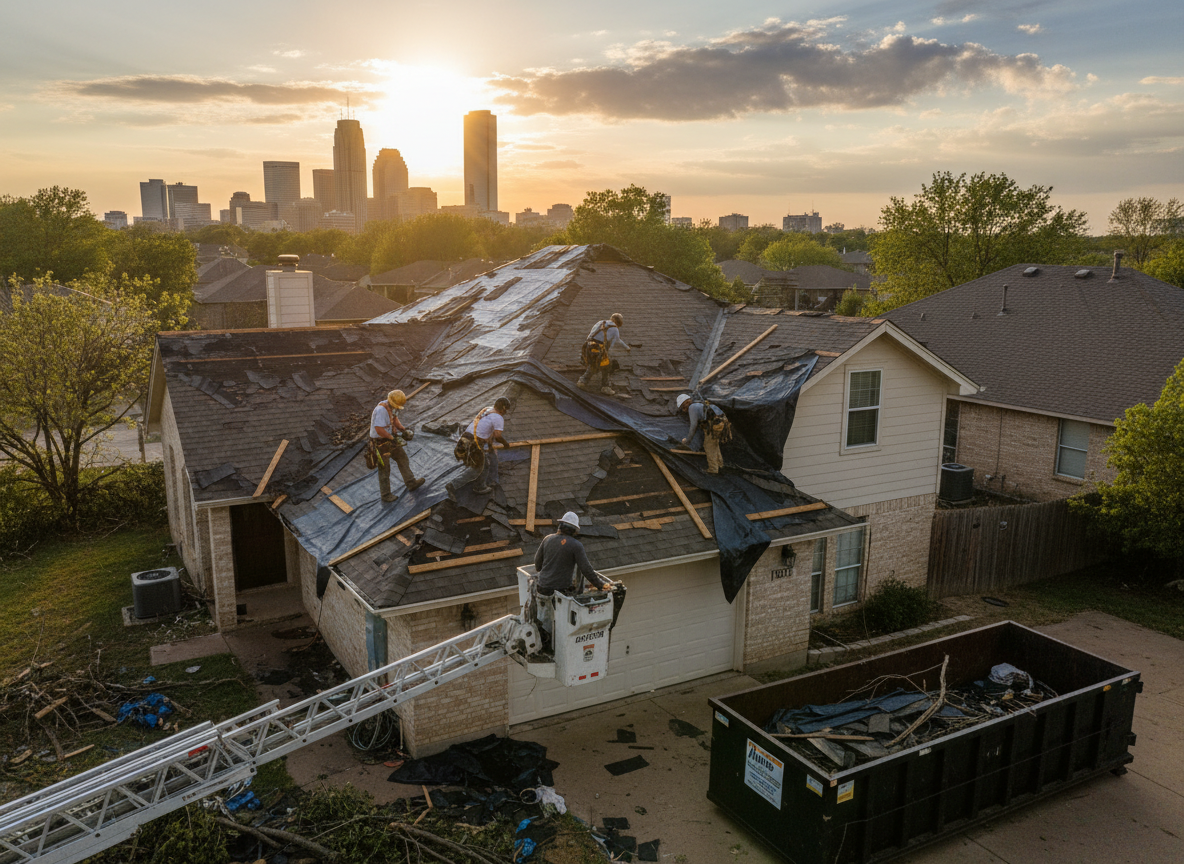
Arkansas is a wet state with a mountain climate bolted onto its northern edge, and both halves are hard on roofs. The Delta and the southern counties deal with heat, humidity and long spring rains; the Ozarks and the Ouachita Mountains deal with freezing rain, ice loading and trees that come down in it. Between them sits a housing stock that is older and more rural than the national average, much of it built before modern underlayment existed. Roof repair in Arkansas is therefore a moisture discipline first and a storm discipline second.
This page explains what the weather does, how Arkansas roofs are built, which services are available, where we cover and what happens from the first call to the finished repair. If water is coming in, call (833) 406-0167 and describe where you are seeing it.
Rain is the default in Arkansas, not the exception
Much of the state receives on the order of fifty inches of rain a year, spread across the seasons rather than concentrated into one wet month. That total matters less than how it arrives: in long steady periods that saturate a roof, and in short violent bursts that overwhelm valleys, gutters and low-slope sections.
A roof that has a small defect will usually survive a gentle rain and leak in a downpour, because volume finds the weakness. The practical consequence is that leaks in Arkansas are often reported as intermittent, and an intermittent leak is the hardest kind to trace. The inspection has to reproduce the condition rather than wait for it — which means looking at the valleys, the wall junctions and the drainage before the next storm does the testing for us.
Humidity is the other half of the water story. Arkansas air stays moist for most of the year, so a damp deck stays damp, and a small leak that would dry out in a drier state keeps the sheathing wet long enough for decay to start.
Where that water goes after it leaves the roof matters as much as the roof itself. In the Delta, the ground is often flat and slow to absorb, so a downspout that discharges at the foundation keeps the base of the wall wet for days after a storm. Gutters that are undersized for the roof area overflow at the fascia instead of carrying the water away, which is why a gutter apron and a correctly sized system are part of a roof repair conversation here rather than a separate trade. The cheapest improvement on many Arkansas houses is a longer downspout and a splash block that moves water two metres further from the wall.
Ice storms in the mountains, and what they bring down
In the Ozarks and the Ouachita Mountains, the damaging winter event is freezing rain. Ice accumulates on the covering and on every tree within falling distance of the house, and the trees are often the problem: a limb through a roof does more damage in a second than a winter of ice does in months. The weight is real as well — an inch of ice across a roof is a load, and it sits on the same overhangs that are already the weakest part of the assembly.
Ice dams do occur in the northern counties, though less predictably than in the upper Midwest. Where they form, the mechanism is the same: warm attic air melts snow above, the melt refreezes at the cold eave, and water backs up under the courses. On steep Ozark roofs the backup is usually short-lived, but the damage to the eave detail can persist for years.
The other winter problem is what ice does to flashing. Water in a lap, behind a counter-flashing or around a vent flange freezes, expands and opens the joint. By the time the ice is gone, the detail that was sealed in the autumn is a drip in the attic.
Hail, tornadoes and spring wind
Spring in Arkansas brings the same convective storms as the rest of the region: hail in swaths, straight-line wind and tornadoes. Hail bruises shingle mats and dents soft metals; wind works on the ridges, rakes and valleys; tornadoes remove covering and sometimes the deck with it.
On rural Arkansas roofs, wind is frequently accompanied by debris. Tree limbs, farm material and gravel from a lane all become projectiles, and the damage they cause is impact damage that has to be distinguished from hail when a claim is being documented. Photographs taken immediately after the event are the only reliable record.
Heat adds the last variable. Arkansas summers are long, humid and still, and an attic that cannot vent will hold that humidity against the underside of the deck through the night as well as the day. The result is a roof that looks sound from the ground and feels soft underfoot at the eaves, where the deck has been wet the longest. Ventilation, air sealing and the condition of the sheathing are therefore checked together on any older Arkansas roof, because repairing the covering over a wet deck only postpones the same problem.
What grows on an Arkansas roof
Shade, warmth and moisture are ideal conditions for algae, moss and lichen, and Arkansas has all three in abundance. Algae shows as dark streaking, usually running down from the ridge on shaded slopes. Moss establishes in the gaps between shingles, in valleys and behind chimneys, and it holds water against the covering. Lichen is the slowest and the most damaging to the surface it grows on.
The point is not cosmetic. A moss-covered slope stays wet after every rain, which shortens the life of the shingle and makes the deck below it vulnerable. Cleaning has to be done without stripping granules, and the long-term answer is usually about shade, drainage and the condition of the covering rather than a treatment alone.
Arkansas roofs, old and new
Shingle on the majority of homes
Laminated asphalt shingle covers most Arkansas houses, from mid-century Little Rock neighbourhoods to new build in the northwest corner. On the older stock, the deck beneath is often board sheathing rather than plywood or OSB, which changes how a repair is fastened and how the deck is assessed when a covering is removed.
Metal in the country
Metal is the practical covering across rural Arkansas: through-fastened panels on houses, barns and shops, and standing seam on newer and higher-value rural buildings. It handles the rain, sheds debris and repairs in panels. The wear points are the fastener washers and the flashings at the ends of the panels.
Pier-and-beam and elevated floors
Much of the older housing sits on piers with a ventilated crawl space. That affects the roof indirectly: air moving under the floor helps dry the house, but a pier-and-beam house often has a lower pitch and a shallower attic than a slab-built one, and the ventilation of that shallow attic is frequently inadequate.
Manufactured and rural housing
Manufactured homes are common in rural counties, and their roofs are usually low-slope with a metal or membrane covering. Repair work there is different: the pitch is shallow, the deck is thin, and the details at the marriage line and the end walls are where leaks begin.
Low-slope commercial
Small-town main streets and the commercial strips along the highways use modified bitumen, TPO and EPDM. Ponding and seam failure are the usual problems, and in Arkansas the rain volume finds both quickly.
Services available in Arkansas
Emergency roof repair
When a storm or a falling limb opens a roof, the immediate job is to stop the water and make the area safe. That means covering the opening, removing anything that could fall further, and protecting the interior before the permanent repair is planned.
Emergency roof tarping
A tarp is a temporary cover, and in Arkansas it has to cope with heavy rain rather than wind alone. It is pitched to drain, fastened mechanically and weighted so that water runs off instead of pooling in the middle of it.
Roof leak repair
Leak tracing here frequently starts with the question of volume: does it leak in every rain or only in a downpour? That answer separates a failed flashing from an overwhelmed valley or gutter. The attic inspection establishes the water path before anything on the roof is opened.
Storm and hail damage repair
Storm repair covers hail impact, wind damage and debris strikes, each documented separately. On a rural roof the debris damage is often the larger part of the claim, and it is recorded before the material is removed.
Roof repair
Routine repair covers the joints that fail in a wet climate: valley metal, step flashing at a wall, chimney counter-flashing, vent boots and the seam where an addition meets the original roof.
Roof replacement
Replacement is driven by age, repeated repairs and the condition of the deck. On older Arkansas homes tear-off settles the question of board sheathing and whether the attic ventilation can be corrected while the roof is open.
Roof installation
A new roof in Arkansas is specified for rain volume and humidity. Underlayment, valley lining, ventilation and the flashing details are decided as a system, because a wet climate punishes any weak point in the assembly.
Shingle roofing
Shingle work covers most of the state's homes. Algae-resistant products are worth considering on shaded slopes, and impact resistance matters where hail is frequent.
Tile roofing
Tile is uncommon in Arkansas but appears on some higher-value and older properties. The work is underlayment-led: lift, renew the membrane, relay and replace broken pieces.
Metal roofing
Metal repair covers fasteners, seams, end flashings and repainting. On rural properties it is often the most practical covering, and panel replacement is usually straightforward where the profile is still available.
Flat roof repair
Low-slope repair is about seams, drains and ponding. In a state with this much rain, drainage capacity is part of the repair rather than an afterthought.
Roof coating
A coating can extend a sound flat or metal roof, but it will not correct ponding or a wet assembly. Moisture testing comes first, then preparation, then the coating.
Roof inspection
An inspection records covering, flashing, drainage, attic side and the condition of the deck. On an older Arkansas house it also identifies the additions and junctions that the original roof was never designed for.
What's included in an Arkansas roof repair
- An attic inspection and a drainage check, because most leaks here are about water volume rather than a single hole.
- Photographs of the failed detail and of any debris damage, taken before removal.
- A written scope separating covering, underlayment, deck and flashing work.
- Flashing rebuilt at additions and wall junctions, which is where older Arkansas roofs most often fail.
- Cleanup and a magnet sweep, with a walkthrough of the finished repair.
Cities covered in Arkansas
Coverage includes Little Rock and North Little Rock, Conway, Hot Springs, Pine Bluff, Fort Smith, Russellville, Fayetteville, Springdale, Rogers, Bentonville, Jonesboro, Searcy, Mountain Home, El Dorado, Texarkana and the communities between them.
These are coverage areas, not offices. The company works across Arkansas from its headquarters in Oklahoma City, Oklahoma. The exposure splits the state: the northwest sees more ice and hail, the Delta more heat, humidity and heavy rain, and the Ouachitas more wind and debris.
The rest of the region
Arkansas shares the region's storm season, and the region page sets out the hail, wind and ice patterns across the six states. Every state we cover is listed on the state index.
- Roof repair in Texas
- Roof repair in Oklahoma
- Roof repair in Kansas
- Roof repair in Colorado
- Roof repair in Missouri
- South Central region overview
From the first call to the finished repair in Arkansas
The call. You describe the symptom and, importantly, when it happens: every rain, only in heavy rain, only after ice, or all the time. That single answer narrows the cause more than anything else.
The inspection. The roof is examined at the valleys, junctions and penetrations first, because those are where a wet-climate roof fails. The attic is checked for staining, daylight and soft decking, and the gutters and discharge are reviewed as part of the water path.
The scope. The repair is written in parts and priced by part, so a decision can be made about what to do now and what can wait. Where a junction needs rebuilding rather than sealing, that is explained before the work starts.
The work. Materials are staged, the deck is inspected as it is exposed, and any rot is reported before it is covered. Rain is planned around rather than worked through, and an open roof is never left exposed overnight when it can be closed.
The finish. The repair is walked with you, photographs are handed over, and the gutters are checked so that the water has somewhere to go when the next system arrives.
Talk to a roofer about an Arkansas roof
Rain, ice, hail and shade each leave their own evidence on a roof, and an Arkansas house often carries several at once. Call (833) 406-0167, describe what you are seeing, and the first step is working out whether the roof is failing at a detail, at the drainage, or through the deck itself.
Around Arkansas
We regularly work near:
- 📍Arkansas State Capitol, Little Rock
- 📍Buffalo National River
- 📍Hot Springs National Park
- 📍Ozark National Forest
- 📍Ouachita National Forest
Roof Repair in Arkansas — Local Notes
- •Much of the older housing sits on piers with a shallow attic, where ventilation is often the reason a deck stays damp.
- •Manufactured homes in rural counties usually have low-slope metal or membrane roofs, and the marriage line is a common leak point.
- •Shade, warmth and moisture make moss and algae a structural issue on Arkansas roofs rather than a cosmetic one.