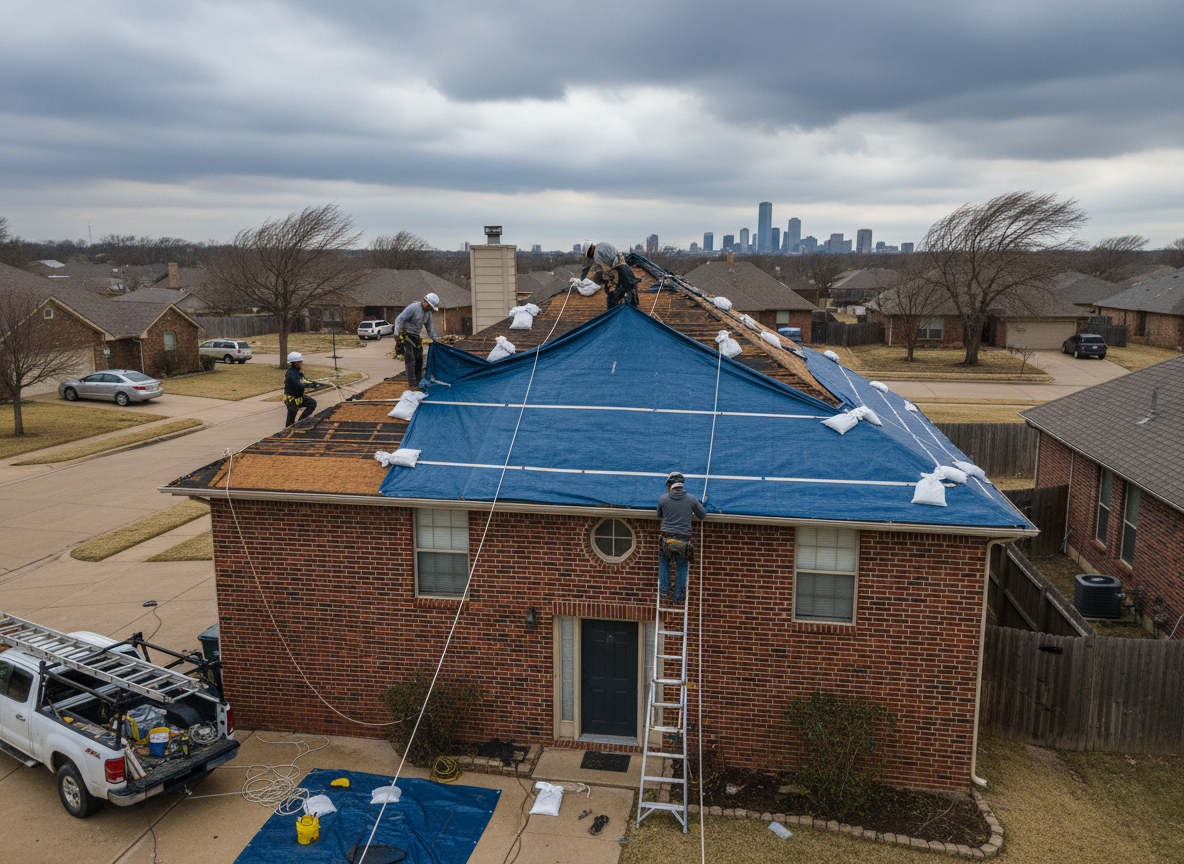
A roof in Texas is asked to handle more than one kind of weather in the same year, and often in the same month. The Gulf coast deals with tropical systems and air that stays heavy with moisture for weeks. North and central Texas sit under the most active hail corridor in the country. The Panhandle and West Texas get wind that never stops, sun that bleaches a shingle in a few summers, and winter air cold enough to freeze a flashing detail that had been fine for a decade. Roof repair in Texas is therefore less about one failure mode and more about recognising which one is in front of you.
This page sets out how we approach roof repair across the state: what the weather does to a roof, which coverings are common in which part of Texas, the services available, the metros we cover, and how the work runs from the first call to the final walkthrough. If water is already coming in, call (833) 406-0167 and describe what you are seeing — the conversation starts with where the water shows and when it started.
What Texas weather does to a roof
Coastal Texas: wind-driven rain, salt and humidity
From Beaumont and Port Arthur through Houston, Galveston and down the coast to Corpus Christi and the Rio Grande Valley, the roof is tested by water arriving at an angle. In a tropical system the rain does not fall so much as travel, and it finds wall junctions, chimney sides, window heads and the edges of roof-to-wall flashing that a vertical downpour never touches. A leak that only appears during a tropical storm or a hurricane is usually a detail problem rather than a hole in the field of the roof, and repairing the slope alone will not stop it.
Humidity does slower work along the same coast. It keeps sheathing damp, feeds algae streaks and moss on shaded north slopes, and makes any moisture trapped under a shingle mat much harder to dry out. Salt air attacks fasteners, vents, valley metal and the edges of galvanised components long before the covering itself fails.
North and central Texas: the hail corridor
Hail forms in the strong updrafts of supercell thunderstorms, and the corridor that runs from the Red River through Dallas–Fort Worth, Waco, Austin and the Hill Country produces a high share of the large stones recorded in the United States. The National Weather Service treats hail one inch in diameter as severe — roughly the size of a quarter — and stones that size can bruise the mat beneath an asphalt shingle without breaking the surface. Damage arrives in a swath, which is why two neighbouring houses can end up with very different roofs after the same storm.
A bruised mat is a slow failure. The roof may stay watertight for months while its remaining life drops sharply, and the granule loss that follows exposes the asphalt to the same sun that is already ageing it. That gap between the physical damage and the visible leak is why a hail assessment in Texas is a documentation exercise as much as a repair one.
West Texas and the Panhandle: wind, sun and freeze-thaw
From Abilene and San Angelo west through Midland–Odessa to Lubbock and Amarillo, the roof works in a drier, windier, harsher light. Sustained wind lifts edges first, and a tab that flaps through one season will crack at the sealant strip and never seal again. Ultraviolet exposure at this latitude breaks down the asphalt and burns the colour out of painted metal. Winter brings freeze-thaw: water sits in a lap or behind a counter-flashing, freezes overnight, expands, and opens the joint a little wider each time. The hard freeze of February 2021 showed how quickly a normally mild state turns a small flashing failure into a ceiling on the floor.
Heat, attic temperature and the load from below
Texas summers load the roof from both sides. The sun heats the covering while the attic heats the deck, so a shingle at 140°F on its surface is sitting on sheathing at a similar temperature and ageing from underneath as well as on top. Ventilation is part of the diagnosis: an attic that cannot move air will shorten the life of any covering above it, and no covering will fix a deck that stays wet.
Roof coverings you will find across Texas
Architectural asphalt shingle
Laminated asphalt shingle is the default on Texas homes, from 1950s ranch houses to new suburban build around Dallas, Houston, San Antonio and Austin. It repairs in small sections, is available everywhere in the state, and is the product most often tested by hail. Impact-rated products are specified more often here than in most states, because the exposure justifies the choice rather than the marketing.
Clay and concrete tile
Tile is common in San Antonio, Austin, the Hill Country and parts of the Rio Grande Valley, where the material suits both the climate and the regional architecture. On a tile roof the tile is the wear layer and the underlayment is the waterproofing. Tile can survive stones that would destroy a shingle, while the underlayment beneath it ages on its own schedule and cannot be assessed from the ground.
Metal
Rural Texas runs on metal: through-fastened panels on barns, shops and farmhouses across the plains, and standing seam on newer rural homes and commercial buildings. Metal handles hail better than most coverings, sheds heat, and repairs panel by panel. A dented panel is usually a cosmetic issue rather than a leak, but a failed fastener washer is a leak waiting for the next rain.
Low-slope and flat assemblies
Commercial buildings and the flat-roofed additions on older houses use modified bitumen, TPO or EPDM. These fail at seams, drains, scuppers and penetrations rather than in the field, and ponding water is the usual accomplice. A flat roof in Houston and a flat roof in El Paso fail differently: one from standing water, the other from thermal movement and sun.
Pre-1960 housing stock
Much of the state's older housing sits on pier-and-beam foundations behind brick veneer, which changes how a roof meets a wall. There is no siding to tuck a flashing behind, so the detail becomes a masonry one that has to be cut, sealed and counter-flashed properly. On these houses the roof is also the lid on a ventilated crawl space, and air movement under the floor affects how much moisture reaches the deck above.
Thirteen services, written for Texas roofs
Emergency roof repair
When a storm opens a roof, the priority is to stop water entering the house tonight and to make the repair safe to inspect. In Texas that often means securing a ridge or a valley that has lost its covering, isolating a ceiling that is about to come down, and photographing the opening before anything is moved. The permanent repair is planned from that record rather than from memory.
Emergency roof tarping
A tarp buys time when the roof cannot be worked safely — after a hurricane on the coast, or on a steep pitch that is still wet. Heat makes adhesive-backed tarps fail in a Texas summer, so the tarp is mechanically battened and tied rather than stuck down, and the battens are placed where they will not abrade the remaining shingles.
Roof leak repair
Leak work starts inside, at the wet point, and works back to the detail that failed. Water travels along rafters and battens, so the stain is rarely under the opening. Attic inspection, moisture readings and, where the weather allows, a controlled water test establish the entry point before anything on the roof is taken apart.
Storm and hail damage repair
After a hail event the work is a directional survey: soft metals, ridge caps, vents, valleys, and the condition of the mat on each slope, recorded slope by slope. Separating new impact marks from weathering and from old repairs matters, because a claim and a maintenance decision depend on different answers.
Roof repair
Field repairs cover the ordinary failures: a lifted ridge cap, a cracked pipe boot, a valley that has lost its metal, a chimney counter-flashing that has pulled away from the masonry. The aim is to restore the detail to what it was designed to do, not to cover it with sealant and hope.
Roof replacement
A replacement in Texas is usually decided by hail history, age and how much of the roof has already been repaired. Tear-off exposes the deck, which is where rotted sheathing, failed fasteners and old flashing problems become visible. Ventilation and underlayment are specified at the same time, because they are inaccessible once the covering is back down.
Roof installation
New installation on Texas homes is a specification decision as much as a construction one: impact resistance on the plains, wind uplift on the coast, and tile underlayment in the Hill Country. What is installed under the covering determines how the roof performs in ten years, long after the visible layer has been judged.
Shingle roofing
Shingle work covers repair, replacement and the repair of failed detail on an otherwise sound roof. On a Texas roof the questions are impact rating, wind rating and how the product behaves on a deck that reaches high temperatures every summer.
Tile roofing
Tile work is mostly underlayment work. Lifting and relaying tile to replace the membrane beneath it is the standard repair on older tile roofs in San Antonio and Austin, and broken tile is matched or replaced at the same time so the covering stays water-shedding.
Metal roofing
Metal repair in Texas covers fastener replacement on through-fastened panels, seam work on standing seam, and repainting where the coating has chalked. Panels move with temperature, so fasteners and flashings have to allow that movement rather than fight it.
Flat roof repair
Flat and low-slope repair is seam, drain and penetration work. Ponding is addressed as a drainage problem first, because a membrane that sits under water will fail at its laps regardless of how well they were welded.
Roof coating
A reflective coating can extend the life of a sound low-slope roof and reduce heat gain, but it will not rescue a wet assembly. Surface preparation and moisture testing decide whether a coating is appropriate, and on a Texas roof the summer sun is what the coating is being asked to resist.
Roof inspection
An inspection produces a condition record: covering, flashing, penetrations, drainage, attic side, and photographs of each. It is the document a homeowner uses to decide between repair and replacement, and it is the document that makes a later storm claim legible.
What's included in a Texas roof repair
- A roof and attic assessment before any scope is written, with photographs of the failed detail and the surrounding area.
- A written scope that separates the covering, the underlayment, the deck repairs and the flashing work, so nothing appears on the invoice that was not agreed.
- Deck inspection wherever the covering is opened, because soft sheathing under a sound shingle is common after a long leak.
- Flashing rebuilt rather than sealed where the detail has failed at a masonry wall, chimney or valley.
- Cleanup of the working area with a magnet sweep for fasteners, and a walkthrough of the finished repair with the photographs on hand.
Cities and metro areas covered in Texas
Coverage in Texas includes the Dallas–Fort Worth metroplex, Houston and the surrounding Gulf counties, San Antonio, Austin and the Hill Country, El Paso, Lubbock and the South Plains, Amarillo and the Panhandle, Waco, Corpus Christi and the Coastal Bend, Beaumont–Port Arthur, Midland–Odessa, Abilene, Tyler and East Texas, Wichita Falls, Laredo and the Rio Grande Valley from McAllen to Brownsville.
These are coverage areas, not offices. The company is headquartered in Oklahoma City, Oklahoma, and works across Texas from that base. What changes between them is the exposure: a Houston roof is judged on wind-driven rain and humidity, a Lubbock roof on hail and wind, an El Paso roof on sun and thermal movement.
The rest of the region
Texas is one of six states in the South Central region, and the shared exposure — hail, wind, ice and heat — is set out on the region page. Every state we cover is listed on the state index.
- Roof repair in Oklahoma
- Roof repair in Kansas
- Roof repair in Colorado
- Roof repair in Missouri
- Roof repair in Arkansas
- South Central region overview
How a Texas roof repair runs, from the first call
The call. You describe the symptom — a stain, a missing shingle, granules in the gutter, a ceiling that has started to sag — and roughly when it began. The address and the covering type are confirmed, and the call is triaged: an active leak and a maintenance question do not get the same response.
The assessment. The roof is walked where it is safe to walk, and the attic is inspected from inside. Photographs are taken of the failed detail, the surrounding field and the soft metals. Where a leak is intermittent, the water path is traced rather than guessed at.
The written scope. The repair is described in parts: what is removed, what is replaced, what is reused, and what is being left alone. Options are set out where there is a genuine choice, such as repairing a section against replacing a slope.
The work. Materials are staged, the deck is inspected as it is exposed, and any additional rot or failed flashing is reported before it is covered. On a hail-damaged roof the work is sequenced so that the documentation photographs are taken before the damaged material is removed.
The walkthrough. The finished repair is reviewed with you, the photographs are handed over, and the roof is checked for fasteners and debris. Anything that was found but not repaired is written down, so the next decision is made with a record rather than a memory.
Talk to a roofer about a Texas roof
Roof damage in Texas rarely announces itself cleanly. A stain that appears in a hurricane, granules in a gutter after a hailstorm and a shingle that lifts in a spring wind are three different problems with three different repairs. Call (833) 406-0167, describe what the roof is doing, and the first step is working out which of them you are looking at.
Around Texas
We regularly work near:
- 📍The Alamo, San Antonio
- 📍Texas State Capitol, Austin
- 📍Galveston Seawall
- 📍Guadalupe Mountains National Park
- 📍Big Bend National Park
Roof Repair in Texas — Local Notes
- •Brick veneer wall junctions are the most common flashing failure on Texas homes — there is no siding to tuck a membrane behind.
- •On the coast, salt air attacks valley metal, vents and fasteners before the covering itself fails.
- •Panhandle roofs face unobstructed wind, so edge metal and ridge fastening matter more than the field of the slope.