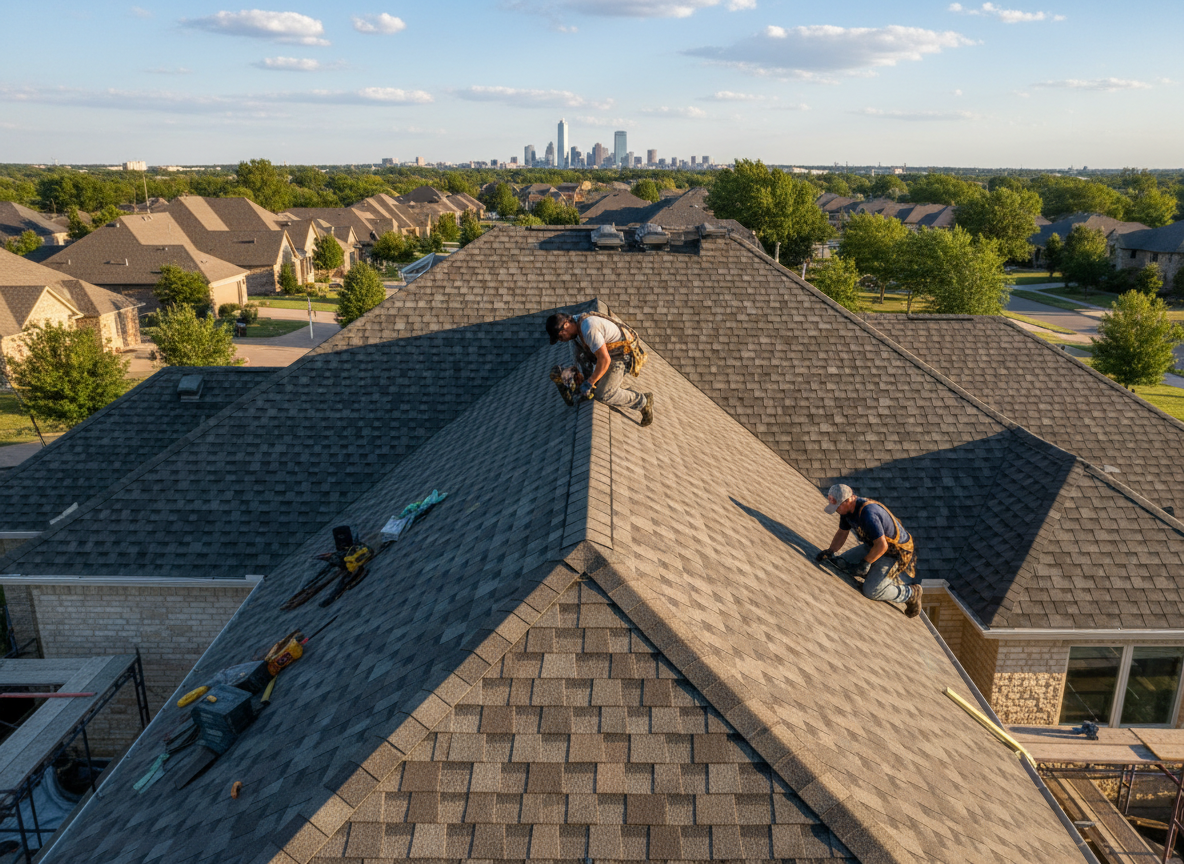
Kansas gives a roof nowhere to hide. The state is open, the tree cover is thin across most of it, and the wind that crosses a wheat field has nothing to slow it down before it reaches a ridge. Add hail in spring, wind-driven snow in winter, and a summer sun that sits in a cloudless sky for weeks, and the roof becomes the part of the house that absorbs the most weather with the least protection. Roof repair in Kansas is mostly about the connections: the fasteners, the edges and the flashings that hold a covering onto a building in a place where the air is always moving.
This page describes what the Kansas climate does to a roof, how the state's housing is built, which services are available, the cities we cover and how a repair proceeds. If the roof has lost material or is leaking, call (833) 406-0167 and describe the symptom — where it shows and when it started.
Wind is the first test on a Kansas roof
A shingle roof is a system of overlapping pieces held down by a sealant strip and by nails. Wind does not need to be violent to defeat it. A sustained twenty-five mile an hour wind on a corner of a roof creates lift at the rake and the ridge, and a sealant strip that has been softened by a hot summer and dusted with grit will let go. Once a tab is standing up, the nails that hold it are working loose in the deck, and the tab will flap until it tears or leaves.
On the open plains the exposure is worse because there is no windbreak. Farmsteads with a shelter belt are protected; a house on a bare quarter section is not, and a roof there will show edge wear years before an identical roof in town. This is why the perimeter details matter more than the brand of shingle: starter course, rake edge, ridge and hip, and the fastening pattern at the eaves.
Hail, and the way it has to be recorded
Hail in Kansas arrives with the same supercell systems that cross the plains in spring and early summer. The National Weather Service treats one-inch stones as severe, which is the size at which a shingle mat starts to bruise. Larger stones crack the mat outright, dent the soft metals and break vents.
The difficulty is that hail falls in a swath a few blocks wide. One part of a town is hit and the next is not, and within a single roof one slope can be marked while the opposite slope is clean because the stones came in at an angle. A useful hail assessment therefore records each slope separately, along with the soft metals — valley metal, vents, gutters, downspouts and flashing — because those show impact more plainly than a weathered shingle surface.
That record also protects you later. A roof can carry bruising through several seasons before it leaks, and by then the storm that caused it is a memory. Photographs taken in the days after the event are the difference between a documented claim and an argument.
Snow, ice and a prairie winter
Kansas winter is not the deep-snow winter of the upper Midwest, but it brings two things that damage roofs: wind-driven snow and freezing rain. Snow that is blown horizontally finds every gap — a ridge vent, a gable vent, the edge of a flashing — and packs into the attic, where it melts and wets the insulation and the deck. Freezing rain coats the roof, fills the gutters and creates ice at the eaves.
Ice dams form where warm attic air melts snow on the upper roof and the meltwater refreezes at the cold overhang. The water then backs up under the courses and appears indoors at the exterior wall. The remedy is not simply to chip the ice away; it is to reduce the heat escaping into the attic and to have an ice barrier under the lowest courses, which is what the model codes call for where ice damming has a history.
Freeze-thaw also works on the details. Water in a lap joint, behind a counter-flashing or around a vent flange freezes overnight and expands, and the joint opens a little each cycle. By spring the roof has a leak that cannot be traced to any single storm.
Sun, drought and the summer roof
A Kansas summer is bright and long. Ultraviolet light breaks down the asphalt in a shingle, and the granule loss that follows exposes more of it. Thermal movement is the other half: a dark roof surface can be hot enough to expand the deck and the metal flashings, and the daily cycle of expansion and contraction works on every fastener and sealant joint.
Dry summers also move the ground, particularly on the clay soils found through much of the state. That movement shows up in the house as cracks and sticking doors, and at the roof as flashings that have been pulled slightly out of position where a wall meets a roof.
What covers a Kansas roof
Asphalt shingle, layered and re-layered
Laminated asphalt shingle is the covering on most Kansas homes, and on the older housing stock in the small towns it is often the second or third layer. A layered roof is not automatically a problem, but it hides the deck, adds weight, and makes the next repair harder to judge. When we open a roof that has been layered, the deck inspection becomes the most important part of the job.
Metal on farms and acreage
Through-fastened metal is everywhere on Kansas agricultural buildings, and it has moved onto rural houses because it handles hail, sheds snow and can be repaired in panels. Fastener washers are the wear item: a perished washer is a leak, and a panel that has been walked on in cold weather can crease at the rib.
Older small-town housing
County seats and railroad towns hold a lot of housing from before 1940, with steeper pitches, dimensional lumber and details that were built by hand. Stone and brick walls are common, and flashing into masonry is a different trade from flashing behind siding. These roofs reward a repair that respects the original detail rather than one that covers it.
Low-slope commercial
Main street blocks and the commercial strips along the highways are low-slope: modified bitumen, TPO and EPDM. The failure points are seams, drains and the penetrations added over decades by successive tenants.
Services available in Kansas
Emergency roof repair
When wind has opened a roof, the first job is to close it. That means securing loose panels or shingles that could tear loose, covering an opening, and checking that water is not already tracking into a ceiling. The permanent repair is planned once the roof can be examined properly.
Emergency roof tarping
A tarp on a Kansas roof has to survive wind, which means battens, weights and ties rather than a draped sheet. It is a temporary measure to keep water out until the covering can be repaired, and it is installed so that it does not abrade what is left of the roof.
Roof leak repair
Leak tracing starts in the attic. Wind-driven rain and ice both put water into places a vertical rain never reaches, so the stain is usually downstream of the entry. Moisture readings and a controlled water test establish the detail before anything is dismantled.
Storm and hail damage repair
Hail and wind repair is documentation first: slope by slope, soft metals, ridge and edges. The scope follows the record, and the record is what makes a claim or a warranty discussion possible months later.
Roof repair
Routine repair covers lifted ridge caps, failed vent boots, valley metal that has rusted through, and flashings that have pulled away from a masonry wall. On the plains, edge and rake repairs are common because that is where wind starts its work.
Roof replacement
Replacement on a Kansas roof usually follows a hail event on an ageing covering, or a repair history that has stopped making economic sense. Tear-off removes the layers, exposes the deck and allows the ice barrier, underlayment and ventilation to be corrected at the same time.
Roof installation
A new roof in Kansas is designed for uplift. Nailing pattern, starter course, edge metal and ridge fastening are the parts that decide whether the covering stays on in a spring wind, and they are all decided before the first course is laid.
Shingle roofing
Shingle work covers repair and replacement on the state's dominant covering. Impact-rated products are worth discussing on a roof that has already been hit once, and wind ratings matter more here than in most of the country.
Tile roofing
Tile is uncommon in Kansas but not unknown on older and higher-value houses. The work is the same discipline as anywhere: lift and number the tile, renew the underlayment, relay with replacements for the pieces that break.
Metal roofing
Metal repair covers fastener and washer replacement, seam work, and the flashings at panel ends and penetrations. On agricultural buildings the priority is keeping the building dry; on a house it is also appearance, which is why panel matching matters.
Flat roof repair
Low-slope repair is seam, drain and penetration work. Ponding is solved as drainage first, because a membrane under standing water will fail at the laps regardless of how well they were made.
Roof coating
A reflective coating can extend the life of a sound flat roof and cut summer heat gain. It is only appropriate on a dry assembly, so moisture testing and surface preparation come first.
Roof inspection
An inspection produces a written condition record with photographs: covering, flashing, edges, drainage, attic side and remaining life. On a layered roof it also establishes how many coverings are present, which changes every later decision.
What's included in a Kansas roof repair
- A wind and impact survey of the edges, ridge and field, because those fail in that order on the plains.
- Photographs of each slope before material is removed, kept as a record you can produce later.
- A deck inspection wherever the covering is opened, including the number of existing layers and the condition of the sheathing.
- Flashing details rebuilt at masonry walls rather than sealed over, since much of the older housing has stone or brick walls.
- Cleanup with a magnet sweep, and a walkthrough of the repair before the crew leaves.
Cities covered across Kansas
Coverage in Kansas includes Wichita and the surrounding suburbs, Topeka, the Johnson County cities of Overland Park, Olathe, Lenexa and Shawnee, Kansas City, Lawrence, Manhattan, Salina, Hutchinson, Emporia, Hays, Dodge City, Garden City, Liberal, Pittsburg and the communities between them.
These are coverage areas, not offices. The company works across Kansas from its headquarters in Oklahoma City, Oklahoma. The exposure changes with the map: the south-central counties see more hail, the western third sees more wind and dust, and the northern tier sees more ice.
The rest of the region
Kansas shares the plains storm season with the rest of the region, and the shared weather is described on the region page. Every state we cover is listed on the state index.
- Roof repair in Texas
- Roof repair in Oklahoma
- Roof repair in Colorado
- Roof repair in Missouri
- Roof repair in Arkansas
- South Central region overview
How a Kansas roof repair is carried out
Before anything is ordered, the roof is inspected from the ground and on the surface, the attic is checked, and the covering is identified. On a layered roof, the number of layers is established at this stage because it changes how the repair is approached.
The scope is written in parts — covering, underlayment, deck, flashing, edges — so that a repair can be judged against a replacement on the same terms. Where a slope is repairable we say so; where a repair would only postpone a replacement, that is said plainly as well.
The work is sequenced for wind. Materials are staged and weighted, partially completed slopes are not left exposed overnight if weather is coming, and edge metal and ridge caps are fastened to the specified pattern rather than to habit.
The finish is documented. Photographs of the completed repair, a sweep for fasteners, and a walkthrough that covers what was done, what was found and what was left alone. On the plains, the last part matters: a small lifted edge left unrepaired becomes a missing edge in the next system.
Arrange a look at a Kansas roof
Wind, hail, ice and sun each leave a different signature on a roof, and the same roof usually carries more than one of them. Call (833) 406-0167, describe what you are seeing and when it appeared, and the first step is identifying which of those signatures is on the roof in front of us.
Around Kansas
We regularly work near:
- 📍Kansas State Capitol, Topeka
- 📍Sedgwick County Zoo, Wichita
- 📍Flint Hills near Emporia
- 📍Monument Rocks, Gove County
- 📍Boot Hill Museum, Dodge City
Roof Repair in Kansas — Local Notes
- •Tree cover is thin across much of Kansas, so roofs take wind and sun with little shelter and show edge wear earlier than sheltered roofs.
- •Layered shingles are common on pre-1970 housing in county-seat towns, which hides the deck until the roof is opened.
- •Stone and brick walls in older Kansas towns mean roof-to-wall flashing is masonry work, not siding work.