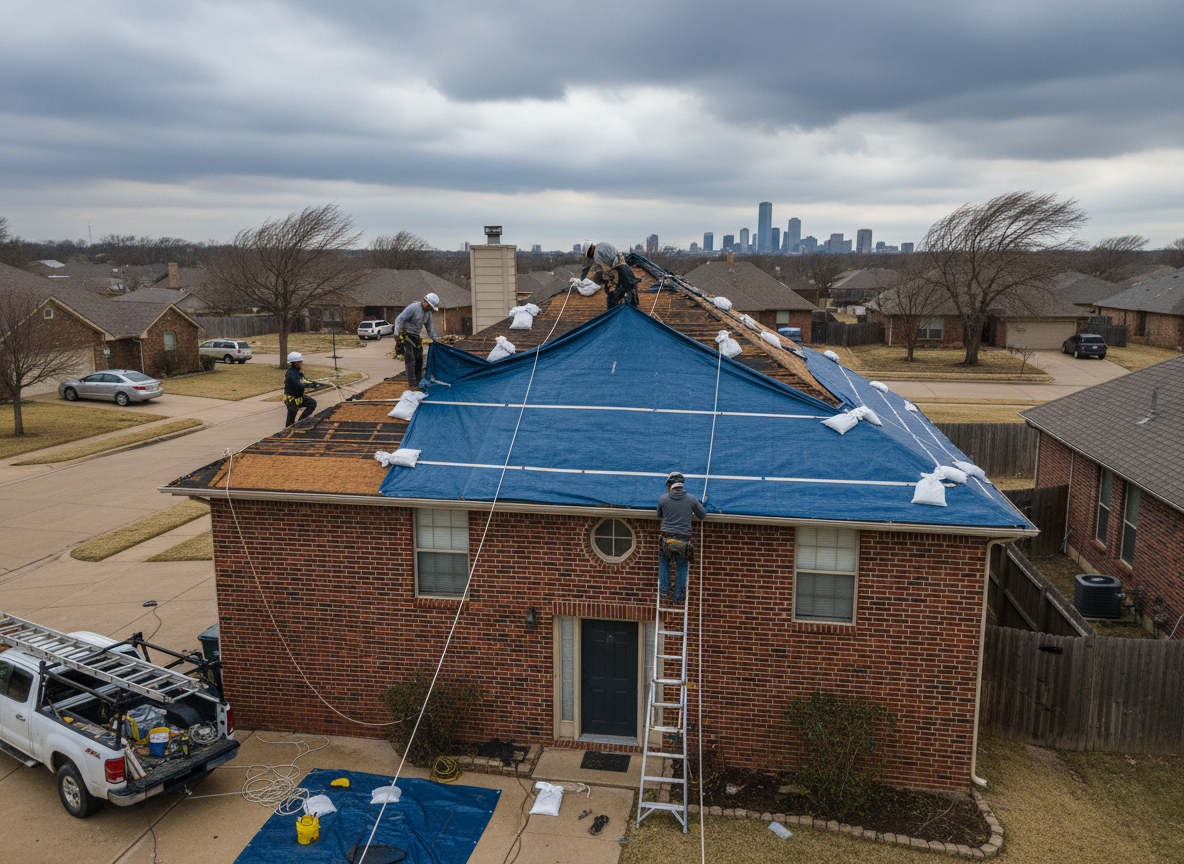
Oklahoma sits in the middle of the most violent part of the country's weather map, and its roofs carry the record. A single spring can bring a hailstorm in April, a wind event in May and an ice storm in December, and each one attacks a different part of the assembly. That is why roof repair in Oklahoma is rarely a matter of replacing a few shingles where the damage is visible: the useful question is which layer of the roof took the hit, and whether the same event also loosened the edges that hold the rest of it down.
We work on roofs across Oklahoma from a headquarters in Oklahoma City, which is also where the company is based. This page explains what the weather does here, how the state's housing stock is put together, which services are available, where we cover, and what happens between your first call and the final look at the finished work. If a storm has just passed, call (833) 406-0167 and describe what you can see from the ground.
Where an Oklahoma roof fails first
The perimeter, before the field
Wind does not lift a roof evenly. It works on the edges, the ridge and the hips, where the pressure difference across a shingle is greatest. Once a tab lifts, the sealant strip that was supposed to hold it down is contaminated with grit and it will not re-bond, so the next gust takes it further. On Oklahoma roofs the first evidence of a wind event is usually a ridge cap lying in the yard or a course of shingles curling along a gable, not a hole in the middle of a slope.
The field, from hail
Hail in Oklahoma is measured against a hard benchmark: the National Weather Service calls stones of one inch severe, and storms here regularly produce more. A stone striking an asphalt shingle does two things at once. It knocks granules loose, and it bruises the fibreglass mat underneath. The granule loss is visible immediately after the storm; the bruise is not, and a bruised mat loses strength and eventually cracks. On a three-tab shingle the damage is easier to spot because the mat is thinner. On a laminated shingle it can hide in the shadow line between courses.
The penetrations, from freeze and thaw
Oklahoma gets cold enough for ice and warm enough to melt it within a few days. Water sits behind a vent flange or under a counter-flashing, freezes overnight, expands, and opens the joint slightly. Repeat that across a winter and a detail that was sealed when it was installed becomes a drip in the attic. Ice storms make it worse by adding weight and by sealing the roof surface so that meltwater cannot drain where it should.
The underside, from heat
Summers here are hot and often dry, and the attic becomes the second roof. A deck that bakes at high temperature all afternoon expands and contracts against every fastener, and a shingle that is already granule-poor will fail from below as fast as from above. Ventilation is not an upgrade on an Oklahoma roof; it is part of whether the covering reaches its expected life.
The year as an Oklahoma roof experiences it
Spring is the season that sets the repair calendar. Supercell thunderstorms form over the southern plains, and the same storm can drop hail on one town, produce a tornado track twenty miles away and push straight-line wind through a third. Late spring and early summer bring the heaviest rain, which is when pre-existing flashing faults show themselves as ceiling stains.
Summer is heat and drought. Shingles cure hard, sealant strips soften, and any deck movement shows up as nail pops. Grass fires on the rural fringe are a reminder that a roof is also the part of a house most exposed to embers.
Autumn is the quiet season for storm damage and the busy one for maintenance: gutters fill, valleys collect debris, and small faults are cheap to fix before winter.
Winter is ice. Freezing rain coats the covering and the gutters, ice dams form where warm attic air reaches a cold eave, and the resulting backup appears as a stain on a ceiling that has nothing to do with a hole. When the ice melts, the freeze-thaw cycle at every penetration starts again.
Roofs as they are built in Oklahoma
Brick veneer and asphalt shingle
The dominant combination on Oklahoma houses is brick veneer walls under a laminated asphalt shingle roof. It is a practical pairing for the climate, and it produces a specific kind of flashing detail: the roof-to-wall junction is a masonry one, cut into the brick and counter-flashed, not tucked behind siding. When that detail fails, the water enters the wall cavity and appears well away from the roof.
Post-war and mid-century neighbourhoods
Oklahoma City, Tulsa and the smaller cities around them have large areas of housing built between 1945 and 1970. Those roofs are typically steeper than modern tract housing, framed with dimensional lumber, and often have had two or three coverings in their life. Fastener length, deck condition and the number of existing layers all matter when one of them is repaired.
Rural acreage and metal
Outside the metros, metal is the practical covering: through-fastened panels on barns, shops and houses on acreage, and increasingly standing seam on newer rural homes. Metal handles hail better than shingle, sheds heat, and can be repaired in panels, but the fasteners and their washers are the wear point, particularly where a panel has been walked on.
Small commercial and flat roofs
Downtown blocks in the smaller cities and the commercial strips along the interstates are low-slope: modified bitumen, TPO and EPDM. These roofs fail at seams and drains, and Oklahoma's summer thermal swing is hard on both.
Services available across Oklahoma
Emergency roof repair
After a tornado or a severe wind event, the immediate job is to make the house weathertight and safe. That means covering an opening, securing loose material that could become a projectile, and isolating any part of the structure that has been compromised. The permanent repair follows once the extent is known.
Emergency roof tarping
Tarping is a temporary measure and should look like one: mechanically fastened, weighted at the edges and clear of sharp metal. In Oklahoma wind, a tarp that is only laid over a roof will be gone by morning, so it is battened down and tied off rather than draped.
Roof leak repair
Finding a leak in Oklahoma often means finding it twice: once at the stain and once at the actual entry. Ice damage, wind-driven rain and a failed pipe boot can all produce the same ceiling mark. The repair is made at the detail, after the water path has been established from inside the attic.
Storm and hail damage repair
Hail repair begins with a slope-by-slope record: impact marks, granule loss, the condition of ridge caps and vents, and the soft metals that show impact most clearly. That record is what separates a repair scope from a replacement decision, and it is also what makes a claim coherent.
Roof repair
Everyday repairs cover the parts that fail between storms: a split boot around a plumbing vent, a valley that has lost its metal, a chimney flashing that has separated from the brick, a ridge cap that has lifted. These are small jobs that become large ones if water is allowed to run behind them for a season.
Roof replacement
Replacement is usually driven by a combination of age, repeated hail damage and the number of previous repairs. On an older Oklahoma home, tear-off also settles the question of deck condition and whether the roof has been layered, which changes both the labour and the disposal.
Roof installation
New roofs in Oklahoma are specified for impact and wind. Underlayment, ice barrier at the eaves, fastening patterns and ventilation are decided before the first shingle goes down, because none of them can be corrected afterwards without removing the covering.
Shingle roofing
Shingle work is the core of the trade here. Repair, replacement and the correction of failed detail on an otherwise sound roof all fall under it, and the choice of product is driven by how much hail the roof is likely to see rather than by appearance alone.
Tile roofing
Tile is less common in Oklahoma than in Texas, but it exists on older and higher-value houses, and it is repaired the same way everywhere: carefully lifted, the underlayment renewed where it has failed, and the tile relayed with broken pieces replaced.
Metal roofing
Metal roofs in Oklahoma are repaired at fasteners, seams and flashings, and repainted where the coating has chalked. A metal roof that has been hail-dented and not perforated is usually a cosmetic question rather than a leak.
Flat roof repair
Low-slope repair is seam and drainage work. Standing water is the first thing to solve, because a membrane holding a pond will fail at its laps no matter how well they were originally welded.
Roof coating
A coating can add years to a sound flat roof and reduce the heat load in summer, but it is only appropriate on a dry assembly. Moisture testing comes before any surface preparation.
Roof inspection
An inspection documents the roof as it is: covering, flashing, drainage, attic side, and the age and condition of each element. In a state where a single spring can produce several events, that record is how you know which storm did what.
What's included when we repair an Oklahoma roof
- An attic inspection as well as a roof inspection, because ice and wind-driven rain both travel before they show.
- Photographs of every slope that is being repaired, taken before material is removed.
- A written scope that names the flashing details being rebuilt and the deck areas being replaced.
- Ice-barrier and underlayment decisions recorded where the repair exposes the eave.
- Debris removal and a magnet sweep of the lawn and driveway at the end of the job.
Cities covered in Oklahoma
Coverage across Oklahoma includes Oklahoma City and the surrounding metro — Edmond, Moore, Midwest City, Yukon, Norman — plus Tulsa, Broken Arrow, Owasso, Bartlesville, Stillwater, Enid, Ponca City, Lawton, Shawnee, Muskogee, Ardmore, McAlester and the towns between them.
These are coverage areas rather than offices. The company is headquartered in Oklahoma City, and the whole state is served from that base. The exposure is not uniform: a Tulsa roof sees more ice and humidity than a Guymon roof, and a Norman roof sees more hail than either.
The rest of the region
Oklahoma sits at the centre of the same hail belt as its neighbours, and the region page covers what the six states have in common. Every state we cover is listed on the state index.
- Roof repair in Texas
- Roof repair in Kansas
- Roof repair in Colorado
- Roof repair in Missouri
- Roof repair in Arkansas
- South Central region overview
From the first call to the finished repair
1. The call and the triage. An active leak, a missing section of roof and a question about a ten-year-old shingle are three different calls. We establish which one it is, what the covering is, and whether the house needs protecting before an inspection can happen.
2. The inspection. The roof is examined from the ground, from the eaves and on the surface where it is safe. The attic is checked for daylight, staining and moisture. Photographs are taken of both sides of the assembly.
3. The scope. You get a written description of the work: what is removed, what is added, how the flashing is rebuilt and what is left alone. If there is a choice between a repair and a replacement, both are described in the same terms so they can be compared honestly.
4. The repair. Material is staged, the deck is checked as it is opened, and anything unexpected is reported before it is covered. Ice barrier, underlayment and fasteners are installed to the specification that was written, not to whatever is on the truck.
5. The finish. The area is cleaned, fasteners are swept up, and the repair is walked with you. The photographs are yours to keep, which matters if an insurer or a future buyer asks what was done and when.
Getting an Oklahoma roof looked at
A roof in this state is asked to survive hail, wind, ice and heat in the same twelve months, and the damage from one event often hides the damage from the last. Call (833) 406-0167, describe what the roof is doing and when it started, and the first step is establishing what actually happened to it rather than what the weather map suggests.
Around Oklahoma
We regularly work near:
- 📍Oklahoma State Capitol, Oklahoma City
- 📍Route 66 through Tulsa
- 📍Wichita Mountains Wildlife Refuge
- 📍Turner Falls, Davis
- 📍Tallgrass Prairie Preserve, Pawhuska
Roof Repair in Oklahoma — Local Notes
- •Brick veneer is standard on Oklahoma homes, so the roof-to-wall junction is cut into masonry and counter-flashed rather than tucked behind siding.
- •Ice barrier at the eaves matters in the north and east of the state, where freezing rain is a yearly event rather than an occasional one.
- •Ridge caps are the first casualty of a straight-line wind event on most Oklahoma roofs.