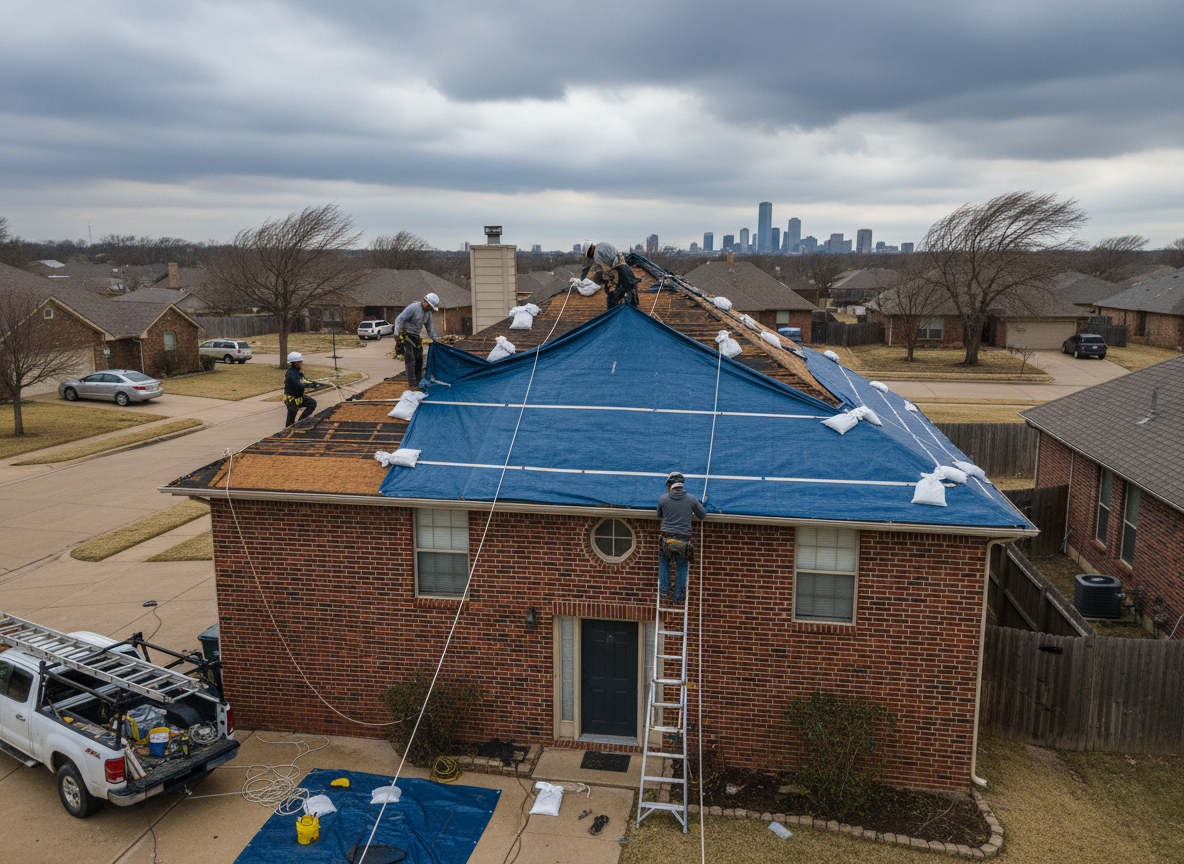
Colorado is two roofing climates stacked on top of each other. Along the Front Range, from Fort Collins through Denver and Colorado Springs to Pueblo, the dominant event is hail, and the corridor is one of the most consistently hit in the United States. West of the foothills, the problem changes: deep snow sits on a roof for months, the sun is fierce at altitude, and the melt-freeze cycle runs twice a day in spring. Roof repair in Colorado means knowing which of those climates the house is in before deciding what the roof needs.
This page covers what the weather does, how Colorado roofs are built for it, the services available, the cities we cover and how a repair is carried out. If the roof is leaking, damaged or holding snow it should not be holding, call (833) 406-0167 and describe what you can see.
Altitude changes what the sun does to a roof
Ultraviolet intensity rises with elevation, and most of Colorado's population lives above five thousand feet. A roof that would last twenty years at sea level is working harder here: the asphalt in a shingle oxidises faster, the colour in a painted metal panel chalks sooner, and the plastic parts — vent stacks, boots, sealants — become brittle years earlier than their labels suggest.
That ageing is not evenly spread. South and west slopes take the most sun and fail first, while shaded north slopes stay damp longer and grow algae or moss. On a single Colorado roof you can often see a decade of difference between one slope and another, which is why a repair scope written from the front of the house is usually wrong.
Hail on the Front Range
The Front Range hail corridor runs along the mountains from the Wyoming line down through Fort Collins, Greeley, Longmont, Boulder, the Denver metro, Colorado Springs and into Pueblo. The topography helps storms organise: moist air from the plains is lifted by the foothills, and the resulting updrafts support large stones. Severe hail, by the National Weather Service definition, starts at one inch, and this corridor regularly produces more.
For a roof, hail is an impact problem before it is a water problem. Stones bruise the mat under the granules, dent the soft metals, crack tile and break plastic vents. The roof may not leak for months afterwards, which is why the assessment is a documentation job: slope by slope, with the soft metals recorded, because they hold the evidence longest.
One practical consequence of a corridor like this is repeated hits. A roof can be damaged in June and damaged again in August, and the second event is often blamed for the first event's damage. Keeping a dated record after each storm is the only way to keep that straight.
Snow load, ice and the melt cycle
In the mountains and along the western slope, snow is the design condition. A roof is framed for a snow load that varies by elevation and county, and the covering is chosen partly for how it sheds. Wet snow is heavier than dry powder, and a roof that has carried a dry winter comfortably can be loaded well beyond its design when a wet storm arrives on top of an existing base.
Ice is the second half of the problem. At altitude the sun melts the surface during the day and the temperature drops below freezing at night, so meltwater refreezes in the gutters, at the eaves and in the valleys. Ice dams form where warm attic air reaches a cold overhang, and the damage appears indoors as a stain near an exterior wall. The cure is insulation and ventilation first, and an ice barrier under the lowest courses as the second line of defence.
Metal roofs behave differently in snow country. They shed snow in slides rather than gradually, which is good for load and dangerous for anything underneath — a walkway, a door, a parked car, a lower roof. Snow guards and a properly detailed eave are part of the installation, not an accessory.
Fire country: embers, ash and the roof assembly
Along the foothills and the urban fringe, wildfire is part of the roof's job description. The roof is the largest horizontal surface a structure presents to falling embers, and embers entering a vent or lodging in a valley full of needles are how many houses are lost while the fire front is still miles away.
What matters architecturally is the assembly: a Class A rated covering, ember-resistant venting, metal rather than plastic where the detail is exposed, and gutters and valleys kept clear of debris. Some counties and districts have wildfire construction standards for new work and for repairs above a certain size, and those requirements vary by jurisdiction. Ash and debris after a nearby fire also load valleys and block drains, which turns a fire event into a water problem at the first rain.
How Colorado roofs are built
Steep pitches and layered underlayment
Colorado roofs tend to be steeper than those in the plains states, because pitch is how a roof sheds snow. A steep roof needs more underlayment discipline, not less: ice and water membrane at the eaves and in valleys, a full synthetic underlayment over the field, and fasteners long enough to hold in a cold deck. At altitude, underlayment that becomes brittle in cold weather will crack when it is walked on during installation.
Asphalt shingle, and impact-rated products
Laminated shingle is the default covering along the Front Range and in most Front Range suburbs. Impact-rated products are common here because the hail exposure justifies them, and because some insurers recognise the rating. On a roof that has already been hit, the choice between repairing a slope and replacing it often comes down to how much of the mat has been bruised rather than how the roof looks.
Concrete and clay tile
Tile appears on higher-value housing along the Front Range and in the southern part of the state. It handles hail better than shingle and handles snow well, but the underlayment beneath it is the waterproofing layer and ages faster than the tile. On a tile roof in Colorado, the repair is usually the membrane, not the tile.
Metal, with the details that suit snow
Standing seam is common on mountain homes and on rural and commercial buildings. It sheds snow, resists hail and lasts, provided the details account for movement and for snow: concealed fasteners, correct clips, snow guards where snow will slide, and flashings that allow thermal movement across a wide temperature range.
Older housing stock
Denver, Pueblo and the smaller Front Range cities hold a lot of early twentieth century housing with steep roofs, dormers and masonry chimneys. Those details — dormer cheeks, chimney crickets, wall-to-roof junctions — are where the leaks are, and they are rebuilt rather than sealed.
Services available across Colorado
Emergency roof repair
An emergency in Colorado is usually an opening created by hail or wind, or snow that has begun to push water into the house as it melts. The immediate work is to stop the water, secure anything loose and protect the interior, with the permanent repair planned once the roof can be assessed.
Emergency roof tarping
Tarping at altitude has to cope with wind and cold. The tarp is mechanically fastened, kept clear of sharp metal and installed so that meltwater runs off rather than pooling behind it. It is a temporary measure, and it is described as one.
Roof leak repair
Leaks in Colorado are frequently ice-related or detail-related rather than field-related. Tracing one means inspecting the attic, reading the staining pattern and testing the suspect detail. A leak that appears only during a melt is telling you about the eave, the valley or the flashing, not about the shingle above it.
Storm and hail damage repair
Hail repair is a documented, slope-by-slope process: impact marks, granule loss, soft metals, vents, and the condition of the tile or shingle. In a corridor that is hit repeatedly, the dated record is as valuable as the repair itself.
Roof repair
Routine repair covers the details that fail between events: chimney flashing, valley metal, vent boots, dormer junctions and the ice-damaged edge of an eave. These are the parts of a Colorado roof that decide whether it survives a melt.
Roof replacement
Replacement is driven by hail history, age and the condition of the details. On a Colorado roof the replacement scope also includes the snow and ice details — eave membrane, valley lining, ventilation — because those are what the next winter will test.
Roof installation
A new roof here is specified for three loads at once: impact, snow and sun. Underlayment, ice barrier, fastening, ventilation and the fire classification of the assembly are all decided before the covering goes down.
Shingle roofing
Shingle work covers repair and replacement across the Front Range. The questions are impact rating, wind rating, and how the product behaves on a deck that swings between hot afternoons and freezing nights.
Tile roofing
Tile repair is underlayment work with a tile relay on top. Broken tile is replaced, the membrane is renewed where it has failed, and the flashing at valleys and wall junctions is rebuilt to shed rather than absorb.
Metal roofing
Metal work in Colorado includes fastener and clip replacement, seam repairs, snow guard installation and repainting where the coating has chalked at altitude. Panels move a long way between a summer afternoon and a winter night, and the details have to allow for it.
Flat roof repair
Low-slope roofs on commercial buildings and mountain additions fail at seams, drains and penetrations, and they collect snow in a way pitched roofs do not. Drainage and load are considered together.
Roof coating
A coating can extend a sound flat roof and reduce heat gain, but at altitude the UV that makes the coating useful also breaks it down faster. Preparation and product choice matter more here than the marketing claim on the bucket.
Roof inspection
An inspection records the covering, the flashings, the attic side, the snow and ice details and the fire-related details. In a state where hail, snow and wildfire can all affect the same roof, that record is what a decision is built on.
What's included in a Colorado roof repair
- A slope-by-slope assessment, because sun, hail and snow do not affect a roof evenly.
- An attic inspection, particularly where a leak appears only during melt or only during a storm.
- Photographs of the failed detail and the surrounding assembly, taken before anything is removed.
- Ice and water membrane reinstated at the eaves and in valleys wherever the repair exposes them.
- A written scope that separates covering, underlayment, flashing and any fire-related detail being corrected.
Cities covered in Colorado
Coverage includes Denver and the metro — Aurora, Lakewood, Thornton, Arvada, Westminster, Centennial — plus Boulder, Fort Collins, Loveland, Longmont, Greeley, Colorado Springs, Pueblo, Grand Junction, Durango, Alamosa, Vail, Aspen, Steamboat Springs and the mountain communities between them.
These are coverage areas, not offices; the company is headquartered in Oklahoma City, Oklahoma. The exposure differs sharply by location: a Denver roof is judged on hail, a Summit County roof on snow load and ice, and a Grand Junction roof on sun, wind and thermal movement.
The rest of the region
Colorado's Front Range sits in the same hail corridor as the plains states, and the region page covers that shared exposure. Every state we cover is listed on the state index.
- Roof repair in Texas
- Roof repair in Oklahoma
- Roof repair in Kansas
- Roof repair in Missouri
- Roof repair in Arkansas
- South Central region overview
From first call to finished repair in Colorado
The call establishes the climate question. Where is the house — Front Range, foothills, mountain valley or western slope — and what is the roof doing? A melt-only leak and a storm leak point at different parts of the assembly, and the answer changes what the inspection looks for.
The inspection covers both sides. The roof surface, the edges and valleys, and the attic are examined, with photographs of the details. Snow cover limits what can be seen, and where it does, that is stated rather than worked around.
The scope names the assembly, not just the covering. Underlayment, ice barrier, flashing and ventilation are written into the repair where they are affected, because on a Colorado roof those are the parts that fail first.
The work is weather-planned. Cold-weather installation uses materials rated for it, adhesives that will cure, and fastening that accounts for a cold deck. Where a repair cannot be completed safely in the conditions, it is staged rather than forced.
The walkthrough closes the record. Photographs, a debris sweep and a written note of anything found but not repaired — particularly the details that the next snow season will test.
Talk to a roofer about a Colorado roof
Hail, snow, sun and embers leave different evidence, and most Colorado roofs carry more than one kind. Call (833) 406-0167, describe what the roof is doing, and the first step is working out which climate load is responsible.
Around Colorado
We regularly work near:
- 📍Colorado State Capitol, Denver
- 📍Garden of the Gods, Colorado Springs
- 📍Rocky Mountain National Park
- 📍Mesa Verde National Park
- 📍Pikes Peak
Roof Repair in Colorado — Local Notes
- •Ultraviolet intensity rises with elevation, so south and west slopes usually age faster than north slopes on the same Colorado roof.
- •Snow guards are a snow-country detail, not an accessory, wherever a metal roof sheds onto a walkway or lower roof.
- •Some counties and fire districts have wildfire construction standards that affect vents, decking and covering class.