Missouri damages roofs with water rather than with spectacle. A Missouri roof is not usually destroyed in an afternoon; it is worn down by freezing rain in January, saturated by a humid summer, and then tested by a spring storm that finds every detail that was already tired. The state also holds some of the oldest housing stock in the country, and an old roof behaves differently from a new one: the deck may be board rather than sheet, the pitch may be steep enough to need staging, and the details may have been repaired four times before anyone wrote them down.
Roof repair in Missouri therefore starts with the house as much as with the weather. This page covers the ice, the humidity, the storm season, the roof types you find here, the services available, the cities covered and how a repair runs. If water is coming in, call (833) 406-0167 and describe where it shows.
Ice storms, and how a backup actually happens
Missouri sits where cold air from the north meets moist air from the Gulf, and the result is freezing rain rather than snow. Ice accumulates on the covering, fills the gutters, coats the downspouts and adds weight to every overhang. When it finally melts, the water has only one place to go if the drainage is blocked, and that place is under the lowest courses of shingles.
The mechanism behind an ice dam is worth understanding because it decides the repair. Warm air escaping into the attic melts snow or ice on the upper roof; the meltwater runs down the slope and reaches the overhang, which is cold because it projects past the insulated wall; it refreezes there, and the ice grows into a barrier. Water then backs up behind it, under the shingles, onto the underlayment and eventually into the house at the exterior wall.
That is why a stain near an exterior wall in February is usually not a hole. It is a drainage and heat problem, and repairing the shingle above it without addressing the attic will produce the same stain next winter. Where freezing rain is a yearly event, an ice barrier under the lowest courses is the standard second line of defence.
Gutters matter more in Missouri than in most states, and they are usually the part of the system nobody inspects until something leaks. A five-inch gutter that is half full of leaves has the capacity of a much smaller one, and in a freezing rain it becomes a solid block of ice that holds meltwater against the fascia. The downspouts have to discharge well away from the foundation, because water that lands at the base of a wall finds the sill plate and the basement rather than the storm drain. When we look at an ice-damaged house, the gutter and the discharge point are part of the diagnosis, not an afterthought.
The humid half of the year
From May to September, Missouri roofs work in warm, wet air. Humidity keeps the deck damp, feeds algae that streaks north slopes black, and encourages moss in the shaded valleys and behind chimneys. Moss holds water against the covering, and its roots work into the gaps between shingles, so a roof that looks merely untidy can be losing years of life underneath.
Humidity also shows up inside. A house that is air-conditioned in summer and heated in winter pushes moisture into the attic from below, and if the attic cannot vent that moisture, it condenses on the underside of the deck. The evidence is dark staining on the sheathing, rusted nail points and, eventually, soft wood. Ventilation and air sealing are roof work in Missouri, not a separate trade.
Hail and wind in the same season
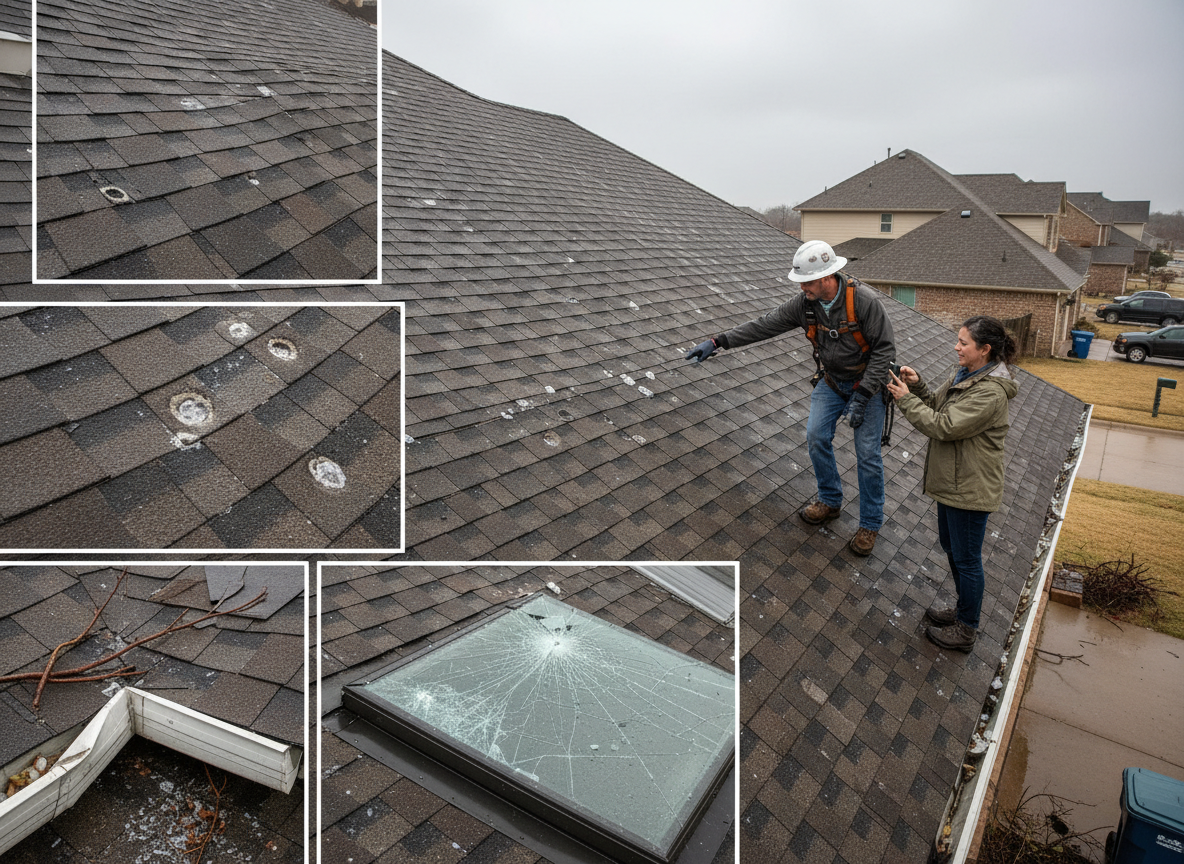
Spring brings the convective storms that cross the state from the southwest, and they carry hail, straight-line wind and occasionally tornadoes. Hail damage here follows the same rule as anywhere: the stones fall in a swath, the bruise under the granule is the part that matters, and the soft metals are where the evidence lasts longest.
Wind damage on Missouri roofs concentrates at the ridge, the rakes and the valleys, and on the older housing stock it often starts with the details rather than the field. A ridge cap that has been loose for a season will let water into the ridge board, and a valley that has lost its metal will funnel it straight into the deck.
Early summer also brings the heavy rain events that the state is known for, and those test the roof in a way that a gentle shower does not. A roof that sheds a steady rain perfectly well can still leak when two inches fall in an hour, because the volume overwhelms a valley, a gutter or a low-slope section that has always drained slowly. On the older housing stock the vulnerable points are the junctions: where a porch roof meets a wall, where a lower roof meets a taller one, and where a chimney interrupts a valley. Water that cannot get away fast enough backs up at exactly those places.
Roofs on old Missouri houses
Brick, slate and steep pitch in St. Louis
St. Louis has block after block of late nineteenth and early twentieth century housing: steep roofs, dormers, masonry chimneys and, on the better-kept examples, slate or clay tile. These roofs are repairable, but they demand a different approach from a modern shingle replacement. Slate is lifted and rehung, not torn off; the flashing at a chimney is cut into the brick and stepped; and the gutters are sized for a roof that sheds a lot of water quickly.
Brick veneer and shingle in the suburbs
Kansas City, Springfield, Columbia and the surrounding suburbs are dominated by brick or brick veneer walls under laminated asphalt shingle. The roof-to-wall junction is a masonry detail, and the most common failure is the counter-flashing where the roof meets the brick — a joint that has to be cut and sealed rather than tucked behind siding.
Rural and Ozark housing
In the Ozarks and the rural counties, metal is common on houses and outbuildings, alongside older shingle roofs on homes that have been added to over decades. Additions are where the leaks are: a lower roof meeting a wall, a porch roof flashed against the main structure, a chimney added after the roof was built.
Low-slope commercial
Downtown blocks, warehouses and commercial strips use modified bitumen, TPO and EPDM. In Missouri the failure pattern is driven by standing water and by the freeze-thaw that follows, which opens seams that were sound in the autumn.
Additions are the most common source of leaks on older Missouri houses, and they are worth describing because the pattern repeats. A porch that was enclosed, a rear extension built with a lower pitch, a garage roof that now meets a kitchen wall — each creates a junction that the original roof was never designed to accommodate. The flashing at those junctions is often a single piece of bent aluminium sealed with mastic, and it has been doing the job for twenty years. Rebuilding that detail properly, with step flashing and a counter-flashing that sheds rather than seals, is usually the whole repair.
Services available in Missouri
Emergency roof repair
An emergency here is usually water entering through a storm opening or through a detail that has finally failed after ice. The priority is to stop the water and protect the interior; the permanent repair follows an assessment of what the ice or the wind actually did.
Emergency roof tarping
Tarping is a temporary cover for a roof that cannot be repaired yet. It is fastened mechanically, weighted at the edges and set so that meltwater and rain run off it rather than collecting behind it.
Roof leak repair
Leak work in Missouri frequently involves distinguishing between three causes with similar symptoms: an ice backup at the eave, a failed flashing at a wall or chimney, and condensation from the attic. Each has a different repair, and the wrong one will not stop the stain.
Storm and hail damage repair
Hail and wind repair is documented slope by slope, with the soft metals recorded. On older roofs the assessment also separates new damage from old repairs, which is what a claim depends on.
Roof repair
Routine repair covers the details that fail first on Missouri houses: chimney flashing, valley metal, step flashing at a dormer, gutter aprons and the mortar joints where a counter-flashing has separated from brick.
Roof replacement
Replacement is decided by age, repair history and the condition of the details. On the older housing stock it also involves the deck: board sheathing, spacing and the question of whether an overlay is being removed before anything new goes down.
Roof installation
A new roof in Missouri is specified for ice at the eaves, for summer humidity and for wind at the edges. Ice barrier, underlayment, ventilation and flashing details are decided together, because they only work as an assembly.
Shingle roofing
Shingle work covers the great majority of Missouri homes. The choices that matter are impact resistance, wind rating and how the product behaves on a deck that stays damp for months at a time.
Tile roofing
Clay tile appears on older and higher-value houses, particularly in St. Louis. Tile is lifted, the underlayment renewed, broken pieces replaced and the flashing at valleys and chimneys rebuilt so the roof sheds the way it was designed to.
Metal roofing
Metal repair covers fasteners, seams, flashings and repainting. On Ozark and rural properties it is often the most practical covering, and it is repaired in panels rather than replaced wholesale.
Flat roof repair
Low-slope repair is seam, drain and penetration work, with drainage solved before the membrane is touched. In Missouri, freeze-thaw is what opens the laps that were welded soundly.
Roof coating
A coating can extend the life of a sound flat roof, but only on a dry assembly. Moisture testing and surface preparation decide whether it will hold, and a coating over a wet roof simply traps the water.
Roof inspection
An inspection records the covering, the flashing, the drainage, the attic side and the age of each element. On an older Missouri house it also establishes what is original and what has been added, which is often the key to where the water is coming from.
What's included in a Missouri roof repair
- An attic inspection, because ice backups and condensation both show indoors before they show on the roof.
- A drainage check — gutters, downspouts and the discharge point — since blocked drainage is what turns ice into a leak.
- Photographs of each failed detail, taken before the repair and again after it.
- Flashing cut and stepped into masonry where the wall is brick, rather than surface-sealed.
- A written scope that separates covering, underlayment, deck and flashing work, and a magnet sweep at the end.
Cities covered across Missouri
Coverage includes St. Louis and the metro — St. Charles, O'Fallon, Chesterfield — plus Kansas City, Independence, Lee's Summit, Springfield, Columbia, Jefferson City, St. Joseph, Cape Girardeau, Joplin, Branson, Rolla, Sedalia and Kirksville.
These are coverage areas, not offices. The company is headquartered in Oklahoma City, Oklahoma, and works across Missouri from there. The exposure divides the state: the St. Louis side sees more ice and older housing, the Kansas City side more hail and wind, and the Ozarks more rain, debris and rural metal.
The rest of the region
Missouri shares the region's hail and ice seasons, and the region page explains how those events differ across the six states. Every state we cover is listed on the state index.
- Roof repair in Texas
- Roof repair in Oklahoma
- Roof repair in Kansas
- Roof repair in Colorado
- Roof repair in Arkansas
- South Central region overview
How a Missouri roof repair proceeds
First, the symptom is placed. Where does the water appear, when does it appear, and what was the weather in the days before? A stain that shows only during a melt, a stain that shows during a driving rain and a stain that is present all summer point at different failures.
Then the roof and the attic are both inspected. The roof side establishes the condition of the covering and the details; the attic side shows the water path, the insulation, the ventilation and whether condensation is part of the problem.
The scope is written to fix the cause. Where the cause is drainage or ventilation, that is stated even when it is not the part of the job a homeowner expected. Sealing over a symptom is the one repair we will not write.
The work respects the house. On older housing that means staging, protecting the masonry, matching materials where the roof is visible and not removing original detail that can be repaired.
The finish is recorded. Photographs of the completed details, a check of the gutters and discharge, a sweep for fasteners and a walkthrough that names anything left for a later decision.
Talk to someone about a Missouri roof
Ice, humidity, hail and old brick all produce leaks that look the same from inside the house, and the repair is different in each case. Call (833) 406-0167, describe what you are seeing and when it appears, and the first task is identifying which of those four is responsible.
Around Missouri
We regularly work near:
- 📍Gateway Arch, St. Louis
- 📍Missouri State Capitol, Jefferson City
- 📍Union Station, Kansas City
- 📍Lake of the Ozarks
- 📍Mark Twain National Forest
Roof Repair in Missouri — Local Notes
- •Freezing rain rather than snow is the defining winter event across most of Missouri, which puts the emphasis on eave detail and drainage.
- •St. Louis holds a large stock of steep, older roofs with dormers and masonry chimneys, where flashing is cut into brick rather than tucked behind siding.
- •Shaded north slopes in the Ozarks and the Missouri River valley hold moisture long enough for moss to establish.