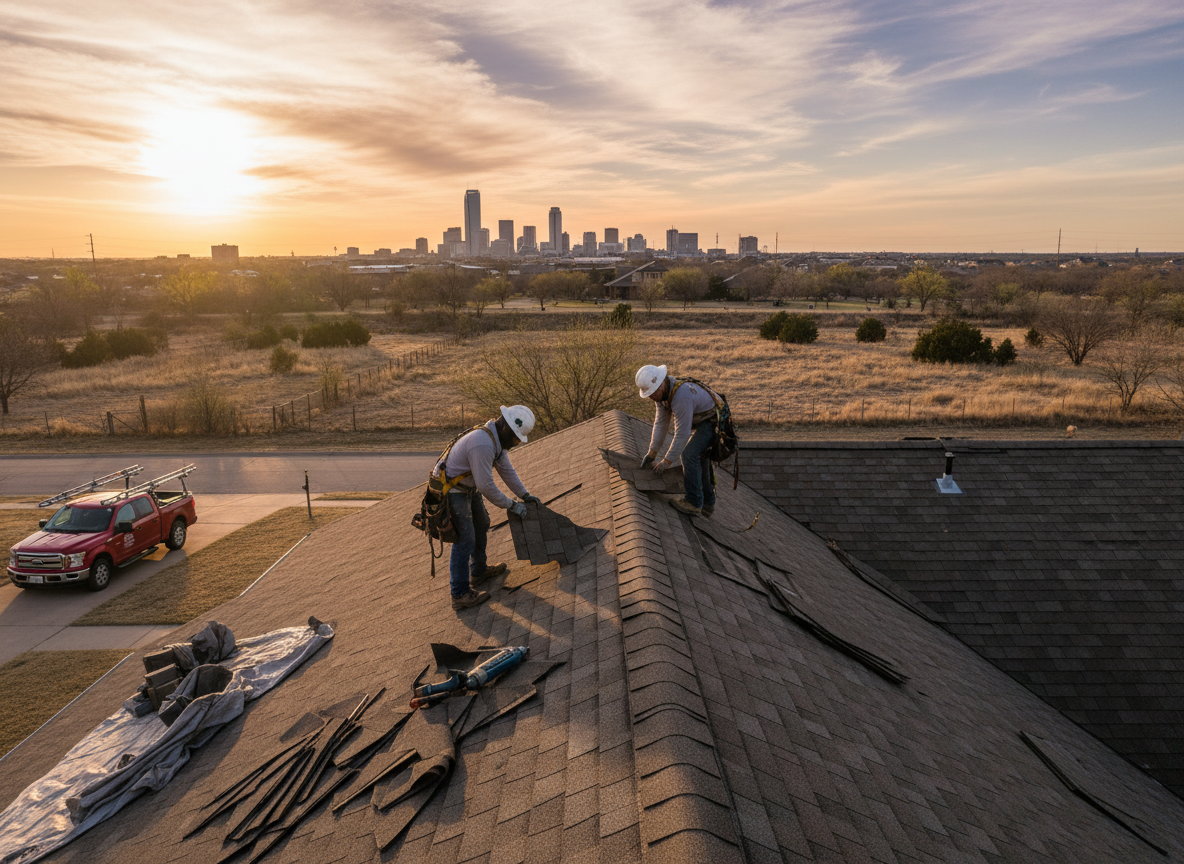
Arizona hands a roof two opposite problems with very little warning between them. For most of the year the state is dry, bright and hot, and the work of the sun is slow and invisible: sealant stiffens, a foam coating chalks and thins, the bedding under a tile field cures until it cracks. Then the monsoon arrives and delivers a season of rain in a handful of afternoons, and every small opening the sun has made becomes a leak at the same time.
Roof repair in Arizona is mostly the business of finding that decay before the first storm tests it. This page sets out what the weather does to a roof here, how Arizona roofs are put together, the services available across the state, the metros covered, and how a job runs from the first call to the final walkthrough. If water is already coming through a ceiling, call (833) 406-0167 and describe where it is showing.
A sun that does not take a season off
Ultraviolet intensity in the desert Southwest is high all year, and the summer is long. Phoenix typically records well over a hundred days a year at or above 100°F, and the roof surface runs hotter still: a dark shingle in direct afternoon sun is far above air temperature, and a foam roof without a reflective coating absorbs the difference.
The practical result is that everything flexible on an Arizona roof has a shorter working life than the same part would have in a cooler state. Pipe boots crack, vent seals shrink, the mastic behind a counterflashing lets go, and the elastomeric skin on a sprayed foam roof thins and powders. None of these parts is expensive on its own; together they are where most desert leaks begin, and none of them is visible from the ground.
The monsoon arrives on a roof that has not been wet in months
The North American monsoon is the shaping event of the Arizona roofing year. The National Weather Service runs its season from 15 June to 30 September, and a large share of the state's annual precipitation falls inside those weeks, in short bursts of high-intensity rain rather than in steady drizzle.
Rain like that does not soak in, it runs. It finds the low point of a flat roof, the inside corner where a parapet meets a field, the valley where two planes meet, the base of a swamp cooler curb. Months of dust have usually filled those same low points and the scuppers that drain them, so the first serious storm is a test of drainage as much as of waterproofing.
The monsoon also brings the dust storms the state calls haboobs: walls of wind-borne sand that abrade coatings, pack debris into valleys and gutters, and can lift loose tile, ridge caps and light metal. A roof that has just been through one should be looked at rather than assumed to have survived.
Why a tile roof leaks without a broken tile
Clay and concrete tile is the covering of choice across much of southern Arizona, and it is genuinely durable — but it is not the waterproofing. The waterproofing is the underlayment beneath it, and the underlayment has a fraction of the tile's life.
Between a summer afternoon and a winter dawn, a desert roof can swing through a wide temperature range, and the materials in the assembly respond at different rates. Tile barely moves. The deck it sits on moves more. The sealant and the fastenings between them have to absorb the difference, and over enough cycles they cannot. That is why a leak on an older Arizona tile roof usually traces back to failed underlayment, a cracked pan at a valley, or a broken mortar joint at the ridge — with every tile above it still intact.
A repair on that kind of roof is a tile lift and relay over new membrane, not a hunt for a missing tile. It is also the reason tile roofs should be inspected on a schedule here rather than after a stain appears on a ceiling.
Flagstaff and the high country run a different climate
Arizona is not one climate, and the roof at 7,000 feet has little in common with the roof in the valley. Flagstaff sits close to that elevation and typically collects somewhere between seven and nine feet of snow over a season, with more in the surrounding mountains, and it stays cold enough between storms for that snow to sit rather than melt away.
Up there the loads are the ones a northern state would recognise: snow sitting for weeks, meltwater refreezing at the eave, ice backing up under the courses, and a melt-freeze cycle that works on every flashing detail through the winter. Shingle and metal are both common, pitch is steeper to shed, and ice and water membrane at the eaves is a normal part of the assembly rather than an upgrade.
Prescott, Payson, Show Low and Pinetop-Lakeside sit between the two worlds — hot dry summers, real snow in winter, and hail in the transition months. Two hours south of the snow line, the same state is running evaporative coolers on a flat roof in ninety-degree October heat.
Fire at the urban edge
Wildfire reaches Arizona houses in two ways: a flame front, and embers arriving ahead of it. The roof is the largest horizontal surface a house presents to falling embers, and embers that enter a vent or lodge in a valley full of pine needles are how a lot of structures are lost while the fire is still miles away.
What matters is the assembly rather than the tile or shingle alone: a Class A rated covering, ember-resistant venting, metal rather than plastic where the detail is exposed, and gutters and valleys kept clear. Some counties and fire districts have their own wildland-urban interface construction standards, and those requirements vary by jurisdiction.
After a nearby fire, ash and debris load valleys, block drains and coat a foam or coated roof. That turns a fire event into a water problem at the next rain, which is why the cleanup belongs in the same conversation as the inspection.
How Arizona roofs are built
Tile over membrane. Clay and concrete tile, in the flat and barrel profiles that give the state its look, laid over a self-adhered or mechanically fixed underlayment. The tile is a rain screen and a heat shield; the membrane is the roof. On a re-roof the tile is lifted and reused where it survives, and the membrane is replaced underneath it.
Sprayed foam with an elastomeric coating. Common on flat and low-slope roofs in Phoenix, Tucson and Yuma, and on commercial buildings statewide. Foam is seamless, insulating and tolerant of odd shapes, and it is entirely dependent on the coating above it: once the coating degrades, the foam underneath starts to break down quickly. Recoating on a cycle is the whole maintenance story.
Asphalt shingle. The default on the postwar tract housing that makes up much of the Phoenix and Tucson suburbs, and on most newer subdivisions. Heat is the enemy here, and attic ventilation matters as much as the product: a hot, poorly vented attic cooks the underside of the deck and shortens the shingle's life from below.
Flat and low-slope with parapets. The patio cover, the addition, the commercial box and the older flat-roofed house all share the same details, and the same failure points: parapet flashing, scuppers, drain outlets and penetrations.
Metal. Standing seam on rural and high-country houses and on custom homes in the foothills, through-fastened panels on agricultural buildings and barns. Coil-coated paint chalks under this much sun, and fasteners with exposed washers perish faster here than almost anywhere.
Services available across Arizona
Emergency roof repair
An Arizona emergency usually arrives during or immediately after a monsoon cell: water through a ceiling, a tile field displaced by wind, a foam coating torn open at a parapet. The first visit stops the water and protects the interior; the permanent repair is planned once the roof can be worked on safely.
Emergency roof tarping
Tarping in this heat is a short-lived measure and is treated as one. The sheet is mechanically fixed rather than weighted, kept off sharp ridge metal, and laid so that monsoon runoff leaves the roof instead of pooling behind it.
Roof leak repair
Desert leaks are frequently drainage or detail failures rather than covering failures: a blocked scupper, a failed pipe boot, a parapet corner that has opened. Tracing one means reading the ceiling stain against the roof plan and testing the suspect detail, not replacing a field of sound tile.
Storm and hail damage repair
Hail is a high-country and eastern-plains problem in Arizona more than a valley one, and it shows up on ridge caps, vents, skylight frames and the soft metals. Wind from monsoon outflows is the more common storm claim in the Valley, and it is documented edge by edge.
Roof repair
The routine work here is the detail work: pipe boots and vent seals, valley metal, counterflashing, tile bedding at ridges and hips, and the sealant joints that hold a parapet together. Done on a schedule, these are what keep a monsoon out.
Roof replacement
Replacement is usually driven by underlayment age on a tile roof, coating exhaustion on a foam roof, or shingle that has been cooked through. The scope includes the ventilation, the membrane and the flashing package, because those decide whether the new covering lasts.
Roof installation
A new roof in Arizona is specified for heat first: reflective or high-SRI surfaces where they make sense, ventilation sized for a long hot season, underlayment rated for deck temperatures far above ambient, and fasteners chosen for a deck that expands every afternoon.
Shingle roofing
Shingle work across the Valley and the southern suburbs is mostly replacement and storm repair. The questions are ventilation, colour and reflectivity, and how the product behaves on a deck that may see extreme heat for months.
Tile roofing
This is core Arizona work: lifting and relaying tile over new underlayment, replacing broken pans and ridge pieces, rebuilding mortar at hips and valleys, and matching profiles on houses where the original tile is no longer made.
Metal roofing
Metal repair covers panel and fastener replacement, seam work, repainting where the coating has chalked, and the flashing details at walls and parapets where thermal movement has opened a gap.
Flat roof repair
Low-slope work on patio covers, additions, commercial boxes and older flat-roofed housing: membrane patching and replacement, parapet and scupper rebuilding, drain work, and ponding correction where the deck has lost its slope.
Roof coating
Coating is central to foam roof maintenance in Arizona and useful on some metal and membrane roofs. Preparation decides the outcome — a coating applied over dust or a chalky surface will fail early, whatever the product claims.
Roof inspection
An inspection records the covering, the underlayment age where it can be judged, the coating thickness and condition, the drainage path and the attic side. In a state where the roof is dry for eight months and then tested in a week, that record is what a repair decision rests on.
What's included in an Arizona roof repair
- A drainage check before anything else, because a blocked scupper and a failed membrane look identical from inside the house.
- An assessment of the underlayment where tile is involved, rather than a report on the tile alone.
- Coating thickness and adhesion checked on foam roofs before any recoat is proposed.
- Photographs of the failed detail and the surrounding assembly, taken before anything is lifted.
- A written scope that separates covering, membrane, flashing and drainage, so the next monsoon has something to be judged against.
Cities covered in Arizona
Coverage includes the Phoenix metro — Mesa, Chandler, Gilbert, Scottsdale, Glendale, Tempe, Peoria, Surprise, Goodyear and Buckeye — plus Tucson, Oro Valley, Marana, Sierra Vista, Casa Grande, Yuma, Flagstaff, Prescott, Prescott Valley, Cottonwood, Sedona, Payson, Show Low, Pinetop-Lakeside and Kingman.
These are coverage areas, not offices. The company is headquartered in Oklahoma City, Oklahoma, and works across Arizona from that base. The exposure differs sharply by location: a Mesa tile roof is judged on underlayment age, a Yuma foam roof on coating condition, and a Flagstaff shingle roof on snow and ice.
The rest of the Mountain West
Arizona shares the region's ultraviolet and monsoon exposure with its neighbours, and the region page sets out what that means across the desert and the high country. Every state covered is listed on the state index.
- Roof repair in Nevada
- Roof repair in Utah
- Roof repair in New Mexico
- Roof repair in Montana
- Roof repair in Idaho
- Roof repair in Wyoming
- Mountain West region overview
From first call to finished repair in Arizona
The call narrows the climate. Where the house sits — valley floor, foothills or high country — decides whether the likely cause is heat, monsoon drainage or snow. That answer changes what the inspection looks for first.
The inspection works from the drainage down. Low points, scuppers, valleys and parapets are checked before the covering, then the attic side is read against what the roof shows. On a tile roof the underlayment is assessed at the edges and at any lifted field.
The scope is written in layers. Covering, membrane, flashing and drainage are listed separately, so a repair on a sound tile field does not turn into a replacement it did not need.
The work is scheduled around heat. Materials are staged in shade, adhesives are chosen for surface temperatures that will be high, and long days start early. Where the roof cannot be left open overnight during monsoon season, the opening is closed the same day.
The walkthrough closes the record. Photographs, a debris and drainage sweep, and a written note of anything found but not repaired — particularly the details the next storm season will test.
Talk to a roofer about an Arizona roof
Heat, dust and a short violent rain season leave very specific evidence, and most Arizona roofs are carrying more than one kind of wear at once. Call (833) 406-0167, describe what the roof is doing and when it does it, and the first step is working out which of those loads is responsible.
Around Arizona
We regularly work near:
- 📍Grand Canyon National Park
- 📍Saguaro National Park
- 📍Camelback Mountain, Phoenix
- 📍Meteor Crater
- 📍Monument Valley
Roof Repair in Arizona — Local Notes
- •On a tile roof the underlayment is the waterproofing layer; the tile above it is a rain screen and a heat shield.
- •Monsoon drainage is a maintenance item — scuppers and valleys that have collected dust all year fail on the first storm, not the tenth.
- •The high country around Flagstaff runs a snow climate, not a desert one, and the roof details there follow the northern pattern.