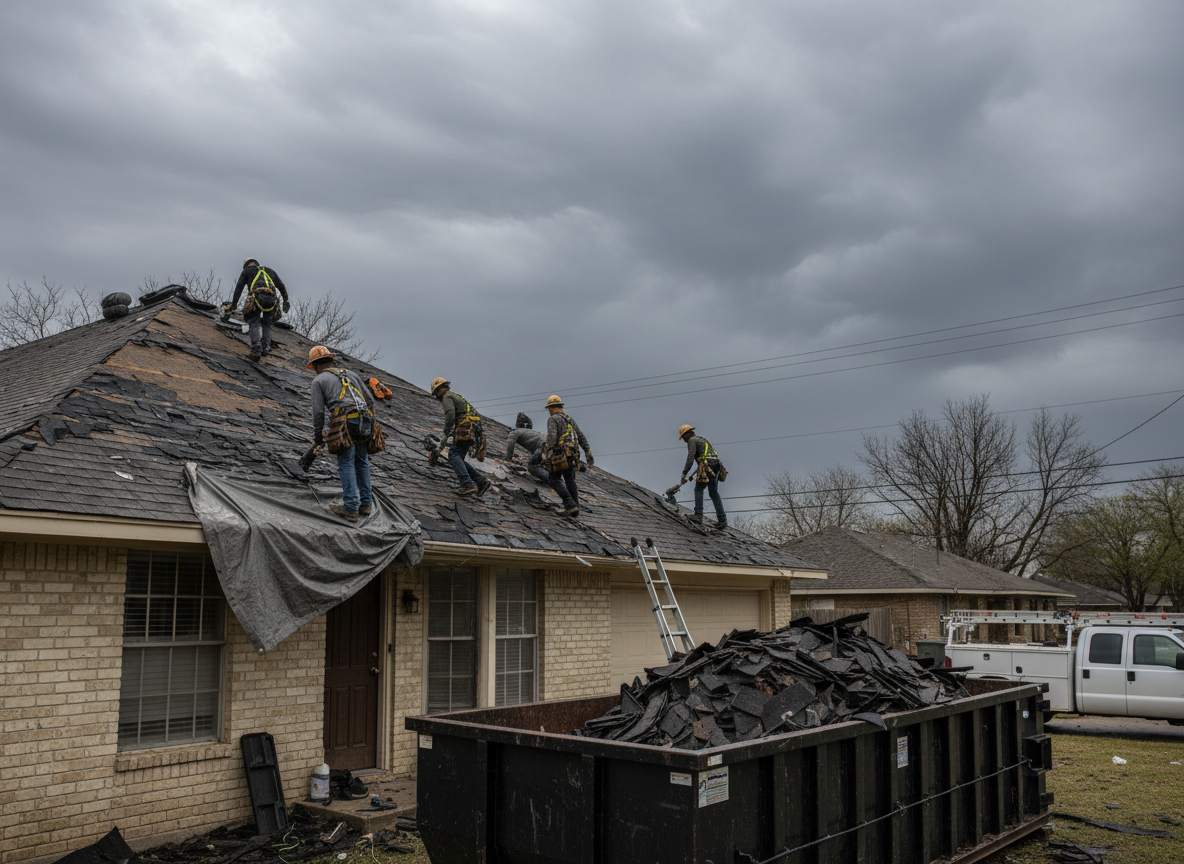
Idaho is usually described as two states, and for roofing purposes that is close to literal. North Idaho is wet: the Panhandle catches Pacific moisture, Coeur d'Alene and Sandpoint see rain through the year and heavy snow in the mountains, and roofs there grow moss, hold moisture and deal with a genuine winter. Southern Idaho is high desert along the Snake River Plain: Boise gets around a foot of precipitation a year, summers are hot and dry, and the dominant loads are sun, wind and spring hail.
Between the two, the mountains and the high valleys add a third condition — deep snow, a long melt and a short working season. Roof repair in Idaho starts by placing the building in one of those three, because a repair that is right for a Boise subdivision is wrong for a cabin above Sandpoint. If the roof is leaking or damaged, call (833) 406-0167.
The Panhandle: moisture, moss and a real winter
North Idaho sits in a maritime-influenced climate that most of the Mountain West does not share. Precipitation is spread across the year rather than concentrated in a monsoon, humidity stays higher, and the north sides of roofs stay damp long enough for moss and algae to establish.
Moss is not cosmetic. It holds water against the covering, lifts the edges of shingle and shake, and in time breaks down the surface it is growing on. Once it is established it comes back unless the cause — shade, debris, a north-facing plane that never dries — is addressed. Clearing it and treating the roof is maintenance; replacing the covering because it was never cleared is the expensive version.
Snow arrives in the Panhandle in quantity, and in the mountains above Sandpoint, Bonners Ferry and Kellogg it stays. Ice at the eave, ice dams and melt-freeze cycles are all part of the winter, and so is the spring melt that tests every valley and flashing at once.
Southern Idaho: sun, wind and a dry summer
Boise and the Snake River Plain run a different programme. Annual precipitation is modest, the summer is hot and dry, and ultraviolet exposure does most of the slow damage: asphalt oxidises, sealant hardens, plastic vents and boots become brittle. The covering often looks sound while the details around it have already gone.
Wind is the recurring event on the plain. Spring and early summer bring sustained wind and gusts that work at ridge caps, edge metal and anything that has been fastened marginally, and the damage is almost always at the perimeter rather than in the middle of a field.
The dry summer also means irrigation and landscape water is everywhere while the roof is dry. A sprinkler head aimed at a wall, a swamp cooler line or a hose left running is a roofing problem in disguise, and it shows up as rot at a fascia or a soffit rather than as a leak.
Hail on the Snake River Plain and the Magic Valley
The plain and the Magic Valley see hail in spring and early summer, sometimes large, and agricultural country takes the worst of it because there is nothing upwind to break the storm. Shingle bruises, metal dents, vents crack, and gutters take impacts that are easy to overlook from the ground.
The complication in Idaho is the number of older coverings on farm buildings and rural houses. A barn roof that has been weathered for thirty years is hard to assess for hail after the fact unless there is a record from before the storm. Where a claim may follow, the documentation is the work: slope by slope, with the accessories included.
Snow load and the spring melt
Across the mountains and the high valleys, snow load is the design condition. The Sawtooths, the Tetons on the eastern border, the Salmon River country and the Panhandle peaks all carry snow that stays for months, and the buildings under it range from engineered new construction to cabins and barns built to a different era's assumptions.
Spring changes the load into water. A melt that releases over two or three weeks sends water through every valley and against every flashing, and it finds the details that were frozen solid and untested since November. Ice at the eave, water backing under courses, and saturated debris in valleys are the standard spring findings.
That is also when the ground is saturated and the roof is at its least accessible, which is why the autumn inspection matters more here than in most states: the work that prevents a spring problem has to be done before the snow arrives.
Fire, smoke and the roof
Idaho's fire seasons have been significant, and the pattern that matters for roofs is the same as elsewhere in the region: embers ahead of a flame front, entering vents and lodging in valleys and gutters, plus a longer-term problem from smoke and ash deposition.
In the interface areas around Boise, McCall, Stanley, Ketchum and the Panhandle communities, a Class A covering, ember-resistant venting and metal rather than plastic at exposed details are the practical measures. Some counties and fire districts have their own wildland-urban interface standards, and those vary by jurisdiction.
After a fire season, ash and debris load valleys and block drains. On a low-slope roof or one with complex valleys, that turns into a water problem at the first serious rain or at the spring melt, whichever comes first.
How Idaho roofs are built
Asphalt shingle. The default across Boise, Meridian, Nampa, Caldwell, Twin Falls and Idaho Falls, and on most of the postwar and recent subdivisions. In the south, heat and ventilation decide its life; in the north, moisture and moss do.
Standing seam metal. Common on rural houses, cabins and agricultural buildings, and increasingly on new construction in the mountains. It sheds snow, tolerates freeze-thaw and lasts; the fasteners, seams, penetrations and paint system are the maintenance points.
Through-fastened metal. Barns, shops and outbuildings across the agricultural counties. Exposed washers perish and are replaced on a cycle.
Cedar shake and wood shingle. Found on older houses in the Panhandle and on some historic buildings. Wood holds moisture, supports moss and is a fire concern; where it survives it needs specific maintenance rather than generic treatment.
Flat and low-slope membrane. Downtown commercial buildings, schools, shops and additions, most of them carrying snow rather than shedding it.
Services available across Idaho
Emergency roof repair
An Idaho emergency is usually wind on the plain or water backing up behind ice in the mountains. The first visit secures the roof, keeps water out of the interior and makes the opening safe, with the permanent repair scheduled once conditions allow.
Emergency roof tarping
Tarping has to hold in wind and cope with a deck that may be frozen. It is fixed mechanically, kept clear of sharp metal and lapped to drain, and it is temporary protection rather than a repair.
Roof leak repair
Leaks in the north are frequently moisture and ice related; in the south they are more often at a vent, a valley or a wall flashing that the sun has opened. Tracing one means reading the attic side against the roof geometry rather than replacing a field.
Storm and hail damage repair
On the plain and in the Magic Valley this is impact documentation on shingle, metal and accessories, taken slope by slope and dated, because older rural coverings are hard to assess after the fact.
Roof repair
The routine list is snow and moisture detailing: eave membrane, valley lining, chimney and vent flashings, moss treatment in the north, and fasteners on metal roofs.
Roof replacement
Replacement is driven by age, hail history or a covering that no longer sheds or dries. The scope includes ventilation and the ice barrier, because those decide how the new roof behaves in the first winter.
Roof installation
New roofs are specified for the site: snow load and ice detailing at elevation, wind uplift on the plain, and ventilation designed for a house that may be closed up against heat or cold for months.
Shingle roofing
Shingle work covers most of the urban housing stock. In the south the questions are impact rating, wind rating and attic ventilation; in the north they are moisture, moss and how the product performs under snow.
Tile roofing
Tile is uncommon in Idaho and appears on specific buildings. Where present, the work is underlayment and flashing with a tile relay rather than tile supply.
Metal roofing
Metal is a major part of the state's roofing stock: panel replacement, fastener and washer renewal, seam repairs, snow guards and repainting where coatings have chalked.
Flat roof repair
Low-slope repair on commercial buildings and additions: membrane patching and replacement, parapet and drain work, and drainage corrected so that meltwater leaves rather than ponds.
Roof coating
Coating can extend a sound low-slope roof and reduce heat gain in the south. In the north the application window is narrow and the surface has to be dry, so timing is part of the specification.
Roof inspection
An inspection records covering, flashings, fasteners, snow and ice details, attic condition and any moss or moisture evidence. Done in autumn, it is the most useful visit of the year in this state.
What's included in an Idaho roof repair
- A site check that establishes whether the building is in the wet north, the dry south or at elevation.
- Moss and moisture evidence recorded in the north, because it changes what the covering needs.
- Fasteners, seams and penetrations inspected on metal roofs rather than assumed sound.
- Ice and water membrane reinstated wherever a repair exposes the eave or a valley.
- A written scope separating covering, flashing and snow management so the next winter has a baseline.
Cities covered in Idaho
Coverage includes Boise, Meridian, Nampa, Caldwell, Eagle, Kuna, Star, Middleton, Twin Falls, Jerome, Burley, Idaho Falls, Ammon, Pocatello, Rexburg, Blackfoot, Coeur d'Alene, Post Falls, Hayden, Sandpoint, Bonners Ferry, Lewiston, Moscow, McCall, Ketchum, Sun Valley, Stanley and Salmon.
These are coverage areas, not offices. The company is headquartered in Oklahoma City, Oklahoma, and works across Idaho from that base. A Meridian shingle roof, a Sandpoint roof under trees and a Stanley cabin roof are three different jobs, and the inspection starts from the site.
Across the rest of the Mountain West
Idaho carries the region's snow load and wildfire exposure, and shares the northern Rockies pattern with Montana and Wyoming. The Mountain West region page sets out the shared conditions, and the state index lists every state covered.
- Roof repair in Arizona
- Roof repair in Nevada
- Roof repair in Utah
- Roof repair in New Mexico
- Roof repair in Montana
- Roof repair in Wyoming
The path from call to completion in Idaho
The call places the building. North, south or mountain — and the elevation, because it decides the snow load and the melt pattern the roof has to survive.
The inspection reads both sides. The covering, flashings and fasteners from above; the attic for staining, frost and condensation from below. Moss and moisture evidence is recorded where it exists rather than treated as cosmetic.
The scope is written for the season. Anything that has to be closed before snow is listed first. Anything that is better done in dry weather is listed separately with a window.
The work respects the material limits. Adhesives and sealants are chosen for the temperature on the day, and no roof is left open through a forecast storm.
The close-out is documented. Photographs, a debris and drainage sweep, and a note of what was found but not repaired, so the autumn inspection has a starting point.
Talk to a roofer about an Idaho roof
A wet Panhandle roof and a dry Snake River Plain roof fail for opposite reasons, and the building tells you which one you have. Call (833) 406-0167, describe the roof and where in the state it is, and the assessment starts from that.
Outbuildings, irrigation and the working roof
A good share of Idaho's roofs are not over houses. Barns, machine sheds, shops, potato cellars and hay covers all have coverings, and they fail in their own way: low pitch, big spans, through-fastened metal, and penetrations cut for vents, augers, chimneys and whatever else the operation needed at the time.
These roofs are usually repaired rather than replaced, because the building is working and cannot be out of service for long. That means patching panels, replacing washers, closing abandoned penetrations properly and dealing with the condensation that forms under a metal roof over an unheated, humid space. Condensation is often mistaken for a leak, and it is worth distinguishing the two before anybody climbs up.
Irrigation adds a second, quieter source of damage. Water thrown against a wall or a foundation, a line left running, a sprinkler aimed at a fascia — all of it shows up eventually as rot at the eave or a soffit that has gone soft, and it is easy to attribute to the roof rather than to the water beside it.
Around Idaho
We regularly work near:
- 📍Snake River Canyon, Twin Falls
- 📍Coeur d'Alene Lake
- 📍Sun Valley
- 📍Craters of the Moon National Monument
- 📍Hells Canyon
Roof Repair in Idaho — Local Notes
- •North Idaho and southern Idaho fail for opposite reasons — moisture and moss in the Panhandle, sun and wind on the Snake River Plain.
- •Moss holds water against the covering and lifts its edges, so clearing and treating it is maintenance rather than cosmetic work.
- •An autumn inspection is the most valuable visit of the year here, because the work that prevents a spring problem has to be done before snow.