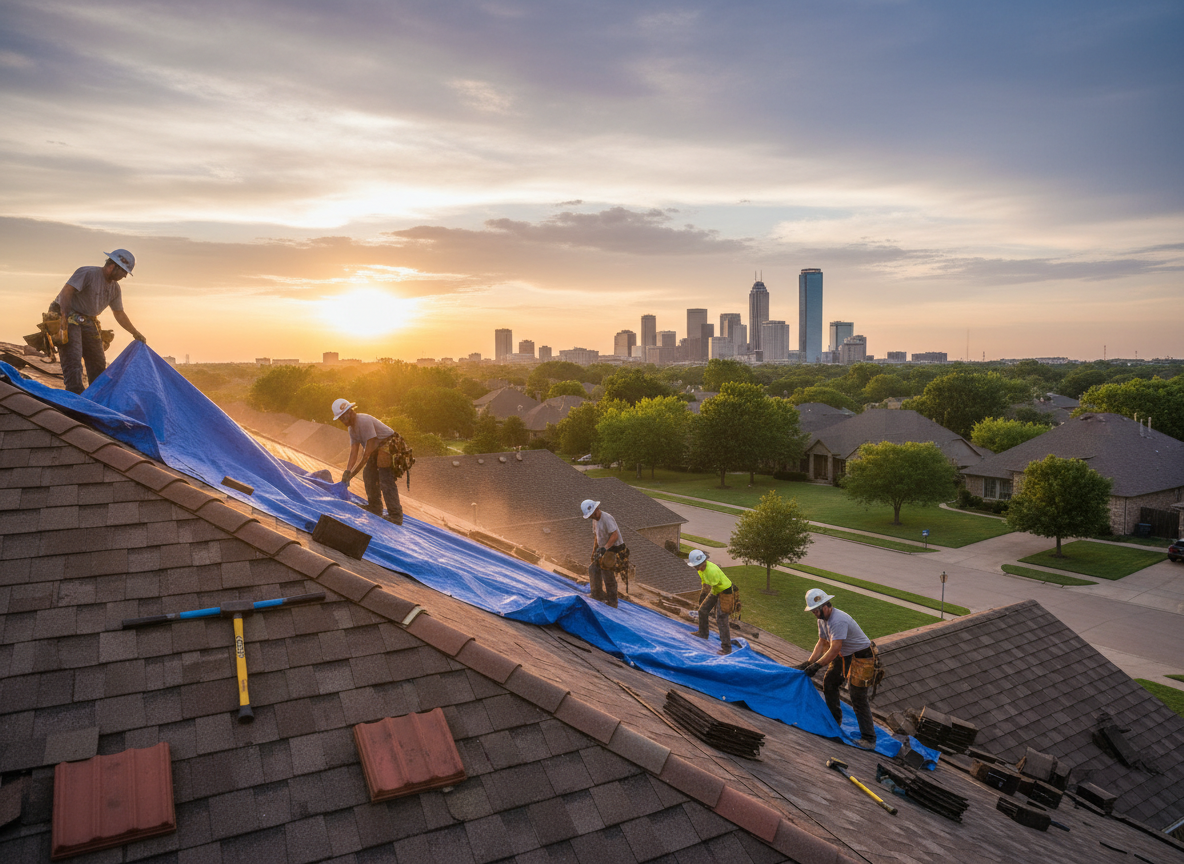
Montana is a large state with a small number of people in it, and its roofs reflect that. A working ranch house outside Miles City, a Victorian commercial block in Butte, a new build in Bozeman and a cabin above Seeley Lake are all Montana roofs, and almost nothing about the work is the same. What they share is a climate that is hard on edges and fastenings: wind that arrives without much warning, snow that sits for months, a short season in which to work, and a spring that alternates freeze and thaw until the details give up.
Roof repair in Montana is therefore a matter of reading the building and the site rather than applying a single state-wide answer. This page sets out what the weather does, how Montana roofs are built, the services available, the cities covered and how a job runs. If the roof is open, leaking or shedding where it should not, call (833) 406-0167.
Wind, and the chinook that arrives in January
Wind is the defining load across much of Montana. The Rocky Mountain Front, the passes, the high plains and the wide valleys all funnel it, and the gusts are strong enough to matter to every edge detail on a roof. Ridge caps, eave closures, vent hoods, gutter brackets and the perimeter fastening are the parts that go first, and they go in a way that is easy to miss from the ground.
The chinook is the local speciality: a warm, dry downslope wind off the mountains that can raise the temperature sharply in the middle of winter. For a roof it produces a rapid melt on a cold deck, which is the ideal condition for ice at the eave and for water finding its way under courses that were frozen solid the day before.
A chinook also strips snow from a roof in a hurry. On a metal roof that is a slide, and anything under the drip line — a doorway, a path, a lower roof, a parked vehicle — is in the way when it comes down.
Snow that stays, and the season that follows it
Mountain Montana measures snow in feet, not inches, and the valley towns measure it in tens of inches. Once it lands it tends to stay: temperatures stay low enough that the pack does not melt between storms, and the roof carries it for weeks at a time.
That makes snow load a live question rather than a design footnote, and it makes the roof's ability to shed the difference between an ordinary winter and a structural problem. Pitch matters. So does the condition of the deck, because a snow load is only ever carried by whatever is underneath the covering.
The melt is the second event. In March and April the pack releases over a short period, and the roof is tested with water rather than with weight: ice at the eave, water backing under the courses, valleys running full, and every flashing detail worked at once. A Montana roof that has been ignored for a decade usually announces itself in that fortnight.
Ice dams, frost and the cold-weather details
Ice at the eave forms where meltwater reaches a cold overhang and refreezes. The mechanism is the same everywhere, and the fix is the same: keep the deck cold and even with insulation and ventilation, and put ice and water membrane under the lowest courses as a second line of defence.
Montana adds a complication, which is that the melt can be sudden. A chinook can take a roof from frozen to running in an afternoon, and the water arrives faster than a gradual spring melt would deliver it. Eave membrane, valley lining and clear gutters matter more here for that reason.
Cold also affects the work itself. Sealants and adhesives have temperature limits, shingle needs to be flexible enough to lay without cracking, and membrane needs a surface it can actually bond to. A repair carried out in January in the wrong conditions is a repair that will be redone in June.
Hail on the eastern plains
Eastern and central Montana sit inside the northern plains hail corridor, and the storms that cross from the Rockies onto the plains in June, July and August can produce large stones. Billings, Miles City, Glendive, Sidney, Lewistown and the surrounding agricultural country see hail as a routine summer event.
The damage pattern is the plains pattern: bruised shingle mats, granule loss, dented ridge caps, damaged vents and gutters, and impact marks on any soft metal. It matters for two reasons. First, the damage may not leak for a season or more. Second, agricultural buildings and rural houses often carry older coverings where hail damage and ordinary wear are hard to separate after the fact.
That is why documentation is the first deliverable after a storm here: slope by slope, with the soft metals and the accessory items recorded, and dates attached.
Fire in the timber and the interface
Montana's wildfire season has become part of the roofing conversation in the western valleys and the interface areas around Missoula, Bozeman, Kalispell and Hamilton. The mechanism is the one that applies across the Mountain West: embers arrive ahead of the flame front, land on the largest horizontal surface the house has, and enter wherever there is an opening.
What reduces the risk is assembly rather than product marketing: a Class A covering, ember-resistant venting, metal flashing instead of plastic at exposed details, and gutters and valleys that are not holding needles. Some counties and fire districts have their own wildland-urban interface requirements, and those vary by jurisdiction.
After a fire, ash and debris load the roof, block the drainage and coat any reflective surface. On a low-slope roof in particular, that turns into a water problem at the first serious rain.
How Montana roofs are built
Standing seam metal. The default on rural houses, barns, shops and many newer builds. It sheds snow, handles freeze-thaw and lasts, and its weaknesses are at the fasteners, the seams, the penetrations and the paint system. Snow guards are a working detail wherever the slide lands somewhere it should not.
Through-fastened metal. Agricultural buildings, sheds and utility structures. Exposed fasteners with washers are the wear point, and they are replaced rather than ignored.
Asphalt shingle. Most of the town housing in Billings, Great Falls, Helena, Missoula and the smaller communities, plus the postwar subdivisions. In a Montana winter the shingle's flexibility and the underlayment's cold-weather performance matter as much as its rating.
Flat and low-slope membrane. Downtown commercial blocks, schools, shops and additions. These carry snow rather than shed it, so drainage, parapets and the roof's structural condition all get attention.
Older housing stock. Butte, Anaconda, Helena and the mining towns hold brick and masonry buildings with parapets, cornices and complex roof junctions. Those details — parapet flashing, chimney crickets, wall-to-roof — are where the water gets in, and they are rebuilt rather than patched.
Services available across Montana
Emergency roof repair
An emergency in Montana is often wind-driven: an edge opened, a ridge cap gone, a vent hood torn loose. In winter it can also be water backing up behind ice. The first visit secures the roof and protects the interior, and the permanent repair waits for workable conditions.
Emergency roof tarping
Tarping here has to survive wind first and rain second. Fixings are mechanical, the sheet is kept off sharp metal and lapped to drain, and the job is presented as temporary protection rather than a repair.
Roof leak repair
Leaks in Montana cluster at the cold details: eave edges, valleys, chimney and vent flashings, and the junction where a lower roof meets a wall. Tracing one usually means inspecting the attic side and reading the staining against the roof geometry.
Storm and hail damage repair
On the eastern plains this is impact documentation on shingle, metal and accessories. On the western side it is more often wind: lifted edges, missing caps and fastener failures at the perimeter.
Roof repair
The routine list is snow-country detailing: eave membrane, valley lining, flashing rebuilds at chimneys and dormers, snow guards, and the ventilation that keeps a deck cold.
Roof replacement
Replacement is usually driven by age, hail history or a covering that no longer sheds. The scope includes the ice barrier, the ventilation and the fastening package, because those decide whether the roof survives the next hard winter.
Roof installation
New roofs are specified for snow load, wind uplift and cold-weather performance: fasteners rated for the deck and the exposure, underlayment that stays flexible in cold, and edge metal detailed for the wind the site actually gets.
Shingle roofing
Shingle work covers most of the town housing. The questions are impact rating for the eastern plains, wind rating for the Front and the passes, and how the product behaves through a long freeze.
Tile roofing
Tile is uncommon in Montana and appears on specific buildings rather than across the stock. Where it exists, the work is underlayment and flashing with a tile relay, not tile supply.
Metal roofing
This is core Montana work: panel replacement, fastener and washer renewal, seam repairs, snow guard installation and repainting where the coating has chalked. Screw-down panels need their fasteners checked on a cycle.
Flat roof repair
Low-slope repair on commercial blocks and additions: membrane patching and replacement, parapet and drain work, and an honest look at whether the deck is carrying snow the way it was designed to.
Roof coating
Coating can extend a sound low-slope roof, but the window for applying it in Montana is narrow and the surface has to be dry and within the product's temperature range. Timing is part of the specification here.
Roof inspection
An inspection records the covering, the fasteners, the flashings, the snow and ice details and the attic side. In a state with a short working season, knowing what needs doing before the weather turns is the practical value.
What's included in a Montana roof repair
- Edge and perimeter details checked first, because wind damage here starts at the edges.
- Snow and ice details reviewed as part of any leak that appears during melt.
- Fasteners and washers inspected on metal roofs rather than assumed sound.
- Photographs of the failed detail and the surrounding assembly before anything is removed.
- A written scope that separates covering, flashing and snow management so the next winter has a baseline.
Cities covered in Montana
Coverage includes Billings, Laurel, Bozeman, Belgrade, Livingston, Helena, Great Falls, Missoula, Kalispell, Whitefish, Columbia Falls, Polson, Hamilton, Butte, Anaconda, Dillon, Miles City, Glendive, Sidney, Havre, Lewistown, Glasgow, Wolf Point and the surrounding rural counties.
These are coverage areas, not offices. The company is headquartered in Oklahoma City, Oklahoma, and works across Montana from that base. A ranch roof east of Billings and a cabin roof above Whitefish are different jobs, and the inspection starts from the site rather than from a template.
The rest of the Mountain West
Montana's snow, wind and fire exposure continues across the region, and the Mountain West region page covers the shared conditions. Every state covered is listed on the state index.
- Roof repair in Arizona
- Roof repair in Nevada
- Roof repair in Utah
- Roof repair in New Mexico
- Roof repair in Idaho
- Roof repair in Wyoming
From the first call to a finished repair in Montana
The call establishes the site. Valley town, mountain cabin, ranch building or commercial block — and the elevation, because it decides how much snow the roof is asked to carry.
The inspection happens in a workable window. Where snow or ice prevents a proper look, that is stated, and the visit is scheduled for a thaw rather than pretended through.
The scope names the season. Anything that has to be done before winter is listed first, and anything that can wait is listed separately, so the priority is clear.
The work is weather-planned. Cold-weather materials, adhesives rated for the temperature on the day, and staging that never leaves an open roof through a forecast storm.
The close-out is written down. Photographs, a debris sweep and a note of what was found but left alone — the details the next spring melt will test.
Talk to a roofer about a Montana roof
Wind, snow, chinook melt and hail leave different evidence, and most Montana roofs carry more than one. Call (833) 406-0167, describe the building and what the roof is doing, and the first step is working out which of those loads is responsible.
Around Montana
We regularly work near:
- 📍Glacier National Park
- 📍Yellowstone National Park
- 📍Flathead Lake
- 📍Going-to-the-Sun Road
- 📍Little Bighorn Battlefield
Roof Repair in Montana — Local Notes
- •Wind damage in Montana starts at the perimeter — ridge caps, eave closures, vent hoods and gutter brackets.
- •A chinook can take a roof from frozen to running in an afternoon, which is when eave ice and backup leaks appear.
- •Snow guards on a metal roof are a working detail wherever the slide lands on a door, path or lower roof.