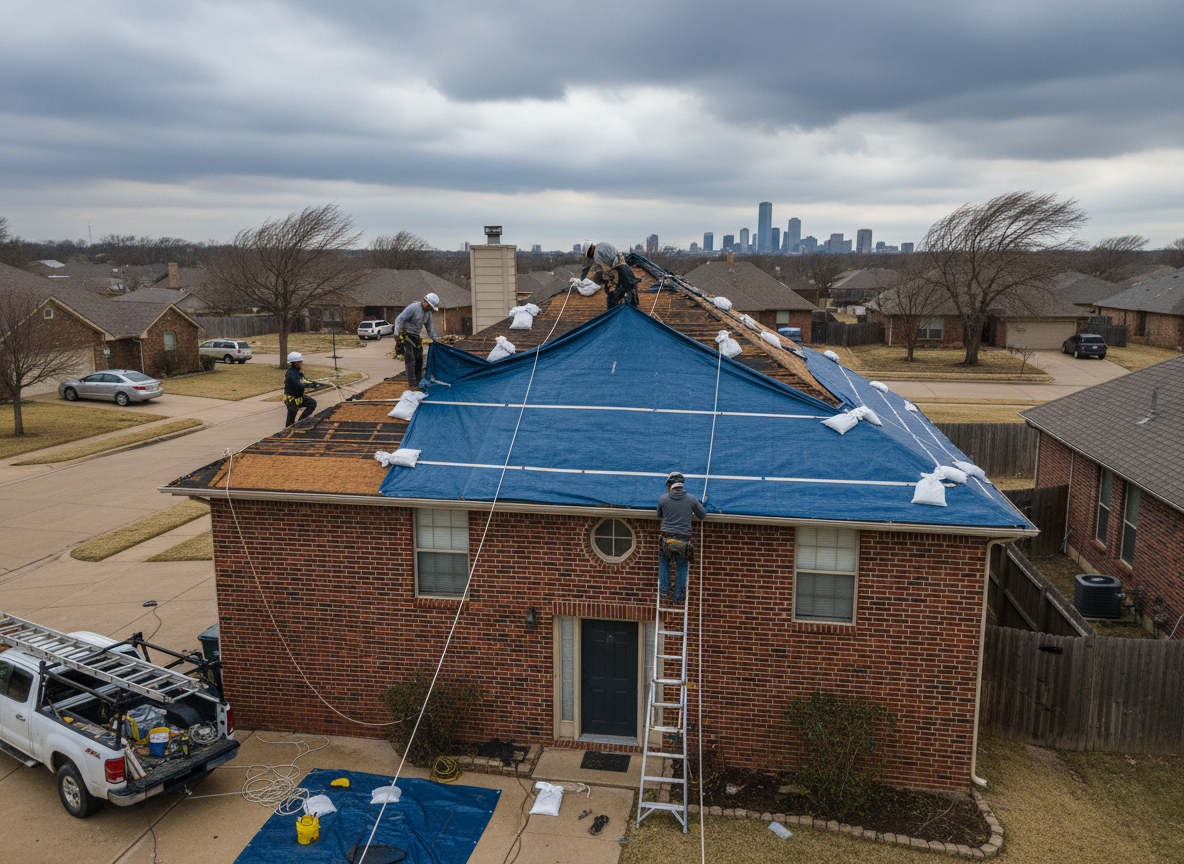
Wyoming has the smallest population of any state and the highest average elevation, and both facts shape what happens to a roof here. There are fewer buildings and they sit higher, more exposed and further from materials, and the wind that crosses the open country is not an occasional event but a permanent working condition. A roof in Cheyenne, Gillette, Rock Springs or Casper is fastened for uplift in a way that a roof in a sheltered river valley is not, and the details that fail first are the ones at the edges.
Add a short building season, deep snow in the mountains, hail on the eastern plains and a fire season in the ranges, and the roofing year in Wyoming is compressed and demanding. Roof repair in Wyoming is largely about exposure: getting the edges right, getting the snow details right, and doing the work in the months when it can actually be done properly. If the roof is damaged or leaking, call (833) 406-0167.
Wind as a permanent load
Wyoming wind is the first thing any roofer mentions, and it is not exaggeration. The state sits under a fast upper-level flow, the terrain funnels it through gaps and along corridors, and gusts over 60 mph are a routine part of winter and spring on the exposed routes. Sections of Interstate 80 close for wind and blowing snow most years.
For a roof, wind is an uplift problem before it is a rain problem. It works at the perimeter: ridge caps, hip and rake edges, eave closures, vent hoods, gutter hangers and the field fastening nearest the edge. Once an edge lifts, the roof is open to wind-driven rain and snow, and the damage spreads inward from there.
Wind-driven snow is the second effect. Fine snow travels like sand, and it will enter any gap that is not closed — a vent, a ridge detail, a flashing that has lifted a few millimetres. The result is often a ceiling stain in the middle of a house with no obvious opening above it.
Altitude, ultraviolet and a short summer
The mean elevation of Wyoming is around 6,700 feet, the highest of any state, and most of the population lives between 4,000 and 6,500. At that height the ultraviolet load is severe: asphalt oxidises, paint chalks, plastic vents and pipe boots embrittle, and sealant loses elasticity well before its nominal life.
Altitude also compresses the working year. A roofing season that runs comfortably from spring to autumn at lower elevations is shorter here, and the months at either end are unreliable: materials behave differently in the cold, adhesives will not cure, and a shingle that is stiff will crack rather than lay flat.
The snow country above the towns is a separate proposition again. In the Bighorns, the Medicine Bow, the Wind River Range and around Jackson, snow sits for months and the roof is designed to carry it and shed it, with the details that go with that: ice barrier at the eaves, steeper pitch, and metal where shedding matters most.
Snow load in the mountains, snow management in the towns
In the mountain counties, snow load is the governing design condition, and the local ground snow load varies dramatically between valleys and ridges over short distances. Buildings there range from engineered new construction to cabins and ranch structures built decades ago, and the difference in how they carry a heavy winter is significant.
In the towns, the snow problem is more often management than structure. A roof that sheds onto a walkway, a doorway or a lower roof creates a hazard and a maintenance issue, and metal roofs in particular release snow in slides rather than gradually. Snow guards, and the details around them, are part of the installation for that reason.
Ice at the eave appears wherever the deck is warmed from below. The mechanism is standard — warm attic, cold overhang, meltwater refreezing at the edge — and so is the fix: insulation and ventilation first, ice and water membrane as the second line.
Hail on the eastern side of the state
The eastern plains and the Front Range foothills along Wyoming's border see hail as a routine summer event, sometimes large. Cheyenne, Torrington, Wheatland, Douglas and the country around them sit in the northern hail belt, and the storms arrive in the same June-to-August window as on the plains further south.
Hail here is an impact problem: bruised shingle mats, granule loss, cracked tile on the few buildings that have it, dented ridge caps and gutters, and damaged vents. It is also a documentation problem, because a roof that has been through several seasons of wind and sun before a hail event is hard to assess afterwards without a record.
Wind usually accompanies the same storms, and the two together produce the pattern that matters most here: an impact-weakened field with a lifted edge, where the water gets in at the perimeter rather than through the field.
Fire in the ranges
Recent seasons have brought large fires to the Bighorns and the Medicine Bow, and the interface areas around Sheridan, Buffalo, Casper, Laramie and Jackson are now part of the wildfire conversation in the way mountain communities across the region are.
For roofs, the practical concern is embers rather than flame. Embers arrive ahead of a front, land on the largest horizontal surface the building has, and enter wherever there is an opening — a vent, a valley full of needles, a gap at a ridge. A Class A covering, ember-resistant venting and metal flashing at exposed details are the measures that matter, and some counties have their own wildland-urban interface standards.
After a fire, ash and debris load valleys and block drainage. On a low-slope roof that becomes a ponding problem at the next rain; on a pitched roof it becomes a blocked valley and a saturated deck.
What Wyoming roofs are made of
Standing seam metal. Common on rural houses, ranches, cabins and new construction in the mountain counties, and on commercial buildings. It sheds snow, resists wind when the clips and fasteners are right, and lasts. Snow guards, seam condition, fasteners and the paint system are the maintenance points.
Through-fastened metal. Barns, shops, sheds and agricultural buildings across the state. Exposed fasteners with washers are the wear item, and in this wind they are also the uplift item.
Asphalt shingle. The default in Cheyenne, Casper, Gillette, Rock Springs, Laramie and the subdivisions around them. Wind rating matters more here than in most states, and so does the fastening pattern at the perimeter.
Flat and low-slope membrane. Downtown commercial buildings, schools, shops and additions, carrying snow rather than shedding it. Parapets, drains and the structural condition of the deck all get attention.
Older housing stock. Cheyenne, Laramie, Sheridan and the railroad and mining towns hold early twentieth century buildings with steep roofs, dormers and masonry chimneys. Those junctions are where the water gets in, and they are rebuilt rather than patched.
Services available across Wyoming
Emergency roof repair
A Wyoming emergency is usually wind: an edge peeled back, a ridge cap gone, a vent hood torn off, with snow or rain following it in. The first visit closes the opening and secures the roof, and the permanent repair is scheduled when the wind allows it to be done properly.
Emergency roof tarping
Tarping in this wind is a mechanical job — battens, screws and a lap that will not lift — rather than a weighted one. It is temporary protection, stated as such, and it is expected to be re-checked after the next blow.
Roof leak repair
Leaks here are often at an edge, a ridge, a vent or a chimney flashing, and they frequently appear during wind-driven snow rather than rain. Tracing one means reading the attic and the staining pattern against the roof geometry, and testing the detail rather than replacing the field.
Storm and hail damage repair
On the eastern plains this is impact and uplift together: hail bruising documented slope by slope, and the perimeter checked for lifted fastening and displaced edge metal, because the storm that brings stones usually brings wind.
Roof repair
The routine work is edge and detail renewal: ridge and rake fastening, vent hoods, chimney flashing, snow guards and the sealant joints that wind works at continuously.
Roof replacement
Replacement is driven by age, hail history and wind damage that has been repaired more than once. The scope includes the fastening pattern, the edge metal and the ice barrier, because those are what the next winter will test first.
Roof installation
New roofs here are specified for uplift first, then snow and sun: fasteners rated for the deck and the exposure, edge metal detailed for the site's wind, ice and water protection at the eaves, and materials chosen for a short working season.
Shingle roofing
Shingle work across the towns is mostly replacement and wind repair. The questions are wind rating, fastening pattern at the perimeter, and impact rating on the eastern side of the state.
Tile roofing
Tile is rare in Wyoming and appears on individual buildings rather than across the stock. Where it exists, the work is underlayment, flashing and a tile relay rather than tile supply.
Metal roofing
Metal is central to the state's roofing: panel replacement, fastener and washer renewal, clip checks, seam repairs, snow guards and repainting where coatings have chalked at altitude.
Flat roof repair
Low-slope repair on commercial buildings and additions: membrane patching and replacement, parapet and drain work, and drainage corrected so meltwater leaves the roof instead of standing on it.
Roof coating
Coating can extend a sound low-slope roof, but the season for applying it is short and the surface has to be dry and within the product's temperature range. On a high, exposed building the wind is part of the scheduling too.
Roof inspection
An inspection records the covering, every edge and ridge, the fasteners, the flashings, the snow details and the attic side. In a state where the roof is worked on by wind all year, the photographic record of the edges is the most useful part.
What's included in a Wyoming roof repair
- The perimeter inspected before the field, because that is where wind damage starts and where water follows it in.
- Fastening and edge metal checked and recorded, not just the covering.
- Snow and ice details reviewed wherever a leak appears during melt or during blowing snow.
- Photographs of the opened detail before and after the repair, so the next event has something to compare against.
- A written scope that separates covering, edge metal, flashing and snow management.
Cities covered in Wyoming
Coverage includes Cheyenne, Laramie, Casper, Gillette, Sheridan, Buffalo, Douglas, Torrington, Wheatland, Rawlins, Rock Springs, Green River, Evanston, Riverton, Lander, Cody, Powell, Worland, Thermopolis, Jackson, Pinedale, Kemmerer and the surrounding rural counties.
These are coverage areas, not offices. The company is headquartered in Oklahoma City, Oklahoma, and works across Wyoming from that base. A Cheyenne shingle roof, a Gillette commercial roof and a Jackson cabin roof are three different jobs, and the inspection starts from the exposure rather than from a template.
The rest of the Mountain West
Wyoming shares the region's snow load, ultraviolet exposure and fire season, and its wind is the most severe expression of a pattern that runs across the Mountain West. The region page covers the shared conditions, and the state index lists every state covered.
- Roof repair in Arizona
- Roof repair in Nevada
- Roof repair in Utah
- Roof repair in New Mexico
- Roof repair in Montana
- Roof repair in Idaho
Working through a Wyoming roof job
Step one is the exposure. Town, plain, mountain valley or ridge — and the elevation. That decides whether the job is primarily about uplift, about snow load or about both.
Step two is the perimeter. Edges, ridges, hips, vents and gutters are inspected and photographed first, because that is where this climate does its damage and where a repair either holds or does not.
Step three is the interior story. The attic is read for staining, frost, condensation and any sign that snow has been entering rather than running off.
Step four is a scope built around the season. Work that must be closed before winter is listed first; work that needs a settled forecast is scheduled into a window rather than promised for a date.
Step five is the record. What was opened, what was found, what was replaced and what was left — written down, so the next storm is measured against evidence instead of memory.
Talk to a roofer about a Wyoming roof
Wind, snow, hail and altitude each leave their own marks, and on an exposed Wyoming roof they usually arrive together. Call (833) 406-0167, describe the building, the elevation and what the roof is doing, and the first step is identifying which of those loads is responsible.
Around Wyoming
We regularly work near:
- 📍Yellowstone National Park
- 📍Grand Teton National Park
- 📍Devils Tower
- 📍Bighorn Mountains
- 📍Flaming Gorge
Roof Repair in Wyoming — Local Notes
- •Wind is the governing load on most Wyoming roofs, and the damage almost always begins at the perimeter rather than in the field.
- •Fine wind-driven snow travels like sand and enters any unclosed gap, which is why a ceiling stain can appear with no obvious opening above it.
- •The building season is short at this elevation, so work that must be closed before winter is prioritised over work that can wait.