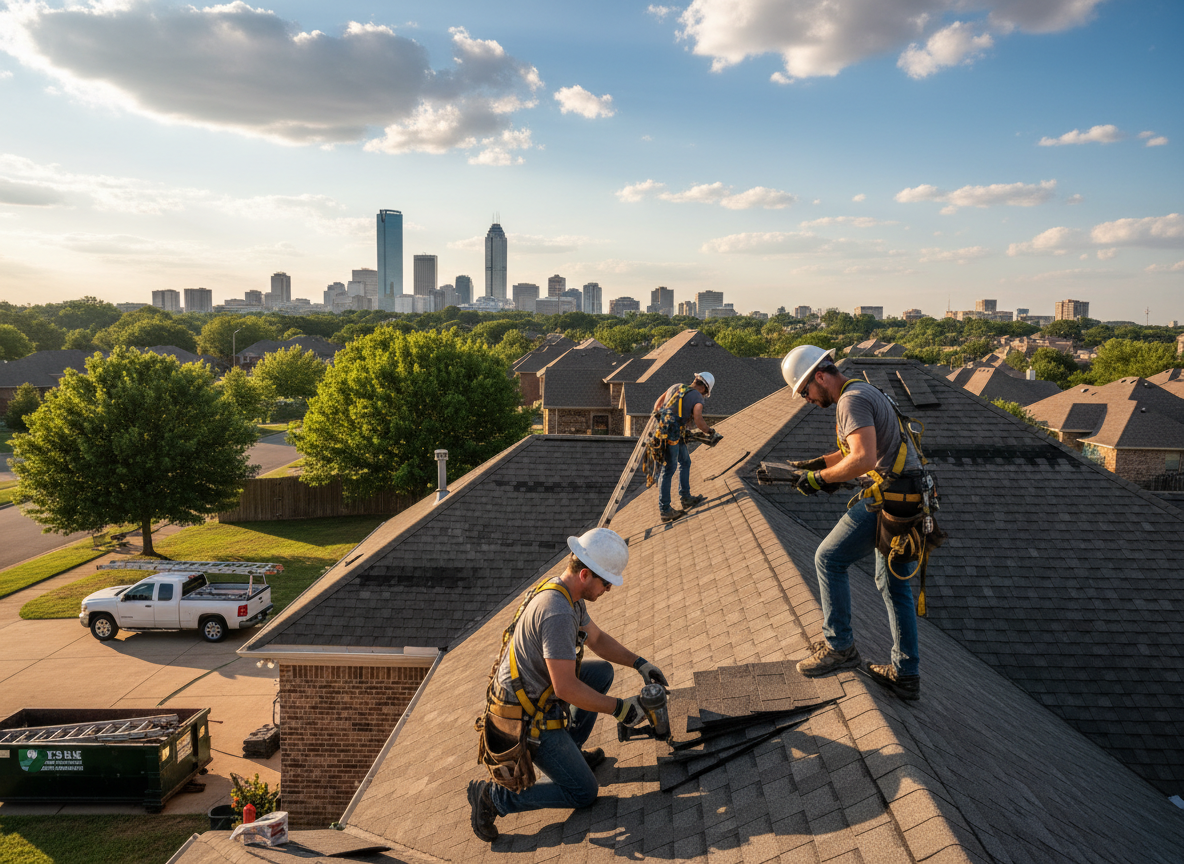
The winter of 2022–23 is the reference point for anyone who works on Utah roofs. Snowpack across the state set records, the Wasatch Front stayed cold enough to hold what fell, and roofs that had carried ordinary winters for decades were suddenly carrying something else: flat roofs sagged, carports and outbuildings came down, and a number of commercial and agricultural roofs failed outright under the weight. It was a reminder that in Utah, snow load is not a theoretical design input. It is the load the roof is actually asked to carry, sometimes all at once.
That is one half of the state. The other half is the same high-altitude sun that affects the rest of the Mountain West, working on a covering that is often asphalt shingle on a steep pitch, and a spring hail season along the Wasatch Front. Roof repair in Utah means holding all three in view at once. If the roof is leaking, sagging or holding snow it should be shedding, call (833) 406-0167.
Snow load, and what a record winter does to a roof
Wasatch Front valleys typically see several feet of snow across a winter; the mountains and the Cottonwood canyons see far more, with Alta averaging well over forty feet a season. Most of that load is carried without incident, because pitch sheds it and because the framing was designed for the local ground snow load — a figure that varies substantially between the valley floor, the benches and the mountain towns.
The problem is the margin. Wet snow is much heavier than cold dry powder, and a wet storm landing on an existing base can push a roof past what it was carrying comfortably the week before. That is what a record year does: it does not create a new defect, it finds the ones already there — a sagging purlin, a rotted sheathing panel, a connection that was never quite what it should have been.
The practical lesson is about observation. A ceiling that has begun to bow, a door that no longer closes squarely, new cracks at a wall-to-ceiling junction, or a roof line that visibly dips between supports are all reasons to stop adding load and get the structure looked at.
Ice at the eave, and why ventilation is the fix
Utah's melt-freeze cycle is the second half of the winter problem. The sun warms the upper field during the day, water runs down, and the cold overhang freezes it at the edge. Repeat that over a winter and an ice dam forms: a ridge of ice at the eave that backs water up under the courses and into the house.
The cause is usually warm air in the attic rather than the weather itself. A roof deck that stays cold and even will hold snow without melting its underside. A deck warmed by an under-insulated ceiling, an unsealed attic hatch or a bath fan venting into the attic will melt from below, and the water goes to the eave because that is where the cold is.
Ice and water membrane along the eaves and in valleys is the second line of defence, and it is standard on Utah roofs for good reason. It is not a substitute for ventilation. A roof with excellent membrane and a warm attic will still grow icicles and still back water up at the gutter line.
Hail on the Wasatch Front
Spring and early summer bring hail along the urban corridor from Ogden through Salt Lake, the south valley and Provo. It is not the sustained hail corridor of the Great Plains, but it is frequent enough that impact damage is a routine part of the roofing year, and it usually shows first on ridge caps, vents, gutters, downspouts and the soft metals rather than in the middle of a field.
The larger risk in Utah is that hail damage and snow damage get confused. A shingle field that has been bruised by hail and then worked by freeze-thaw through a winter can look like simple age by spring. A dated record taken after each event — slope by slope, with the soft metals photographed — is what separates one cause from another later on.
Sun, altitude and a shorter material life
Most of Utah's population lives between 4,000 and 6,000 feet, and the ultraviolet load at that elevation is significantly higher than at sea level. Asphalt oxidises, paint chalks, plastic vents and boots embrittle, and sealant loses elasticity years earlier than its service life would suggest.
It is uneven across a single roof. South and west slopes take the most sun and age first; north slopes stay colder and damper and grow moss or algae; shaded valleys hold debris and moisture. A repair scope written from one elevation of the house is usually wrong, which is why the inspection here is done slope by slope.
Lake-effect snow adds a local wrinkle east of the Great Salt Lake, where narrow bands can drop heavy snow on one corridor while neighbouring areas stay clear. A roof in Layton or Ogden can take a winter that a roof twenty miles away does not.
What Utah roofs are built of
Asphalt shingle on steep pitches. The default across the Wasatch Front and most of the state, on housing from the postwar subdivisions to the current ones. Pitches are steep because snow has to shed, and steep roofs put more demand on underlayment discipline at the eaves and in valleys, not less.
Concrete and clay tile. Common in St. George and the warmer southwest, and on higher-value housing along the corridor. Tile handles snow and hail well; the underlayment beneath it is the waterproofing and ages faster than the tile.
Metal, especially in the mountains. Standing seam on cabins, second homes and rural property, and on agricultural buildings. It sheds snow in slides, which is good for load and a hazard for whatever sits below, so snow guards are part of the detail.
Flat and low-slope. Mid-century commercial buildings, downtown Salt Lake and Ogden, and additions and porch roofs. These are the roofs that failed most visibly in the record snow year, because a flat roof has nowhere to shed to.
Older brick housing. Salt Lake, Ogden, Provo and the mining towns hold a lot of early twentieth century housing with masonry chimneys, dormers and parapets. Those junctions — chimney crickets, dormer cheeks, wall-to-roof — are where the leaks are.
Services available across Utah
Emergency roof repair
An emergency here is often structural rather than a simple leak: a ceiling bowing under snow, an ice dam backing water into a wall, or wind opening an edge on a mountain exposure. The first visit stabilises the situation and protects the interior, and the permanent repair follows once conditions allow.
Emergency roof tarping
Tarping in a Utah winter is difficult work and is described honestly as temporary. Fixings have to hold in frozen decking, the sheet has to be clear of ice at the eave, and the job is to keep water out until a proper repair can be scheduled.
Roof leak repair
Leaks in this state are frequently ice-driven, which makes them seasonal and misleading: the stain appears during a melt, not during a storm. Tracing one means examining the eave, the valley and the attic side rather than assuming the covering above the stain is at fault.
Storm and hail damage repair
Hail work along the Wasatch Front is a documentation exercise first: impact marks, granule loss, dented soft metals and the condition of vents and ridge caps, recorded slope by slope so that a later claim can be separated from winter wear.
Roof repair
The routine repair list in Utah is snow and ice detailing: eave membrane, valley lining, chimney and dormer flashing, and the ventilation that keeps the deck cold. These are the details that decide whether a winter is uneventful.
Roof replacement
Replacement decisions usually combine age, hail history and the condition of the snow-country details. A replacement scope here includes the ice barrier, the valley lining and the ventilation, because a new covering over old detailing will fail at the first hard winter.
Roof installation
New roofs are specified for snow load, for impact and for sun: correct pitch for shedding, full ice and water protection at the eaves, fasteners rated for the deck, and ventilation designed for a house that will be heated for six months of the year.
Shingle roofing
Shingle work is the bulk of the residential market along the corridor. The questions are impact rating, wind rating, and how the product performs through freeze-thaw cycles on a steep, sun-exposed plane.
Tile roofing
Tile in southern Utah is largely underlayment work: lift and relay, replace broken pans, rebuild the mortar at hips and ridges, and renew the flashing at valleys and wall junctions.
Metal roofing
Metal work includes panel and fastener replacement, seam repair, snow guard installation and recoating. Panels here move a long way between a July afternoon and a January night, and the details have to allow for it.
Flat roof repair
Low-slope repair on commercial buildings, downtown stock and residential additions: membrane patching and replacement, drain and scupper work, parapet flashing, and — after a heavy winter — an honest assessment of whether the deck has deflected.
Roof coating
Coating can extend a sound low-slope roof and reduce heat gain in summer, but it does nothing for a roof that has lost its slope or its structure. On a Utah flat roof the structural question is answered before the coating question.
Roof inspection
An inspection records the covering, the flashings, the attic side, the snow and ice details and the structural signs — deflection, staining, and the condition of the sheathing where it can be seen. After a record snow year, that record is worth having.
What's included in a Utah roof repair
- A slope-by-slope assessment, because sun, snow and hail do not treat a roof evenly.
- An attic inspection wherever a leak appears only during a melt or only in one season.
- Ice and water membrane reinstated at the eaves and in valleys wherever the repair exposes them.
- Ventilation checked as part of any ice-dam repair, since the ice is usually a symptom.
- A written scope that names the structural observation separately from the covering repair.
Cities covered in Utah
Coverage includes Salt Lake City, West Valley City, West Jordan, Sandy, Draper, South Jordan, Riverton, Herriman, Murray, Millcreek, Ogden, Layton, Clearfield, Bountiful, Farmington, Park City, Heber City, Provo, Orem, Lehi, American Fork, Spanish Fork, Springville, Payson, Logan, St. George, Washington, Cedar City, Moab and Vernal.
These are coverage areas, not offices. The company is headquartered in Oklahoma City, Oklahoma, and works across Utah from that base. A Park City roof, a Sandy roof and a St. George roof are three different problems, and the inspection reflects which one it is dealing with.
The rest of the Mountain West
Utah sits between the desert monsoon to the south and the deep snow of the northern Rockies, and the region page covers both. Every covered state is listed on the state index.
- Roof repair in Arizona
- Roof repair in Nevada
- Roof repair in New Mexico
- Roof repair in Montana
- Roof repair in Idaho
- Roof repair in Wyoming
- Mountain West region overview
What happens after you call in Utah
The call establishes the winter exposure. Elevation, the canyon or the valley, and whether the roof is flat or pitched all change the likely cause. A leak that appears in February is a different problem from one that appears in July.
The inspection is two-sided. The roof surface is walked where it is safe to do so, and the attic is read from underneath for staining, frost, condensation and deflection. Snow cover limits what can be seen, and where it does, the limit is stated rather than glossed over.
The scope separates structure from covering. Anything that suggests the framing has been overloaded is reported on its own, because that conversation should not be buried inside a shingle repair.
The work follows the weather. Cold-weather installation uses materials rated for it, adhesives that will cure at the temperature on the day, and staging that does not leave a roof open to a forecast storm.
The close-out is documented. Photographs, a debris sweep and a written note of anything observed but not repaired — particularly the details the next winter will test.
Talk to a roofer about a Utah roof
Snow load, ice at the eave, spring hail and high-altitude sun all leave different evidence, and a Utah roof usually carries more than one at a time. Call (833) 406-0167, describe what the roof is doing and when it does it, and the first step is identifying which of those loads is responsible.
Around Utah
We regularly work near:
- 📍Temple Square, Salt Lake City
- 📍Arches National Park
- 📍Zion National Park
- 📍Great Salt Lake
- 📍Park City
Roof Repair in Utah — Local Notes
- •Utah's ground snow load varies substantially between the valley floor, the benches and the mountain towns, and the roof details follow that.
- •Ice at the eave is usually a ventilation problem rather than a roofing-material problem.
- •Snow guards are a working detail on metal roofs here, not an accessory, wherever snow slides onto a path, door or lower roof.