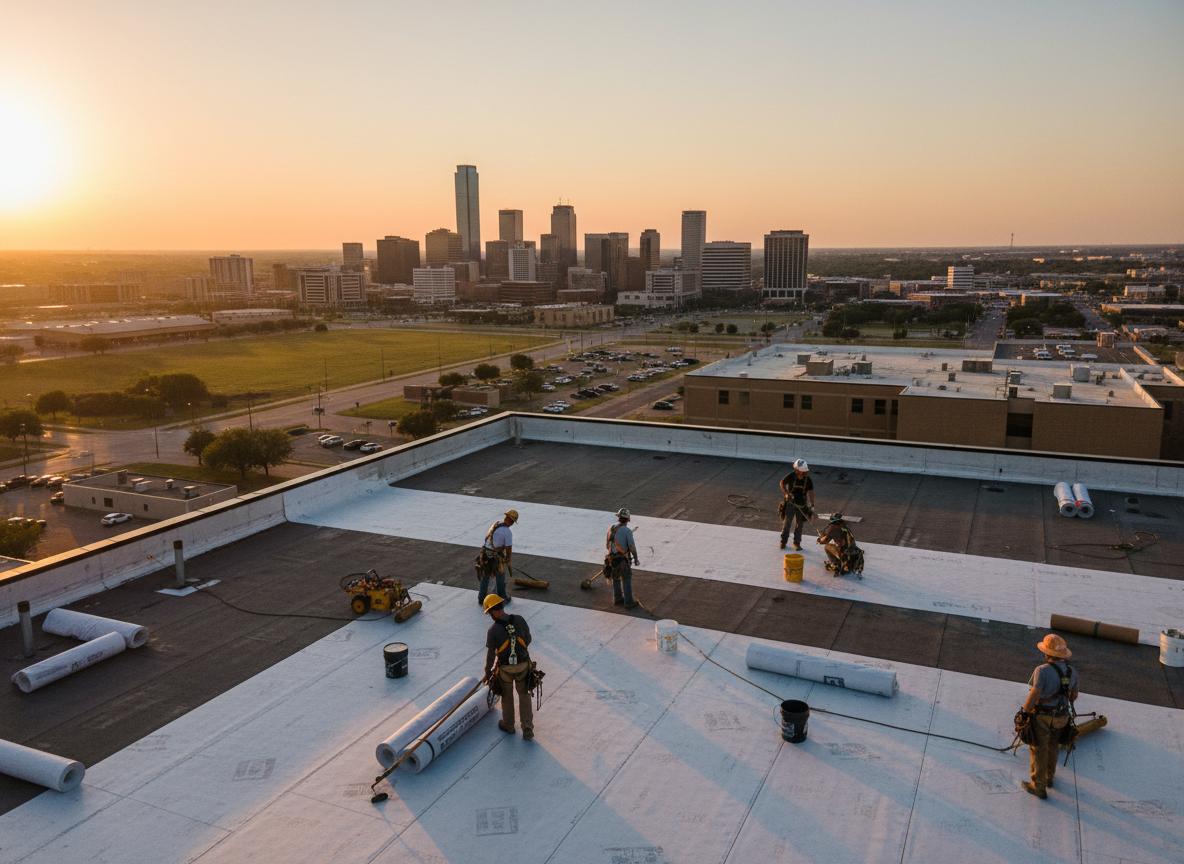
Nevada is two roofing markets wearing one name. In the south, Las Vegas sits in a basin where the annual rainfall is around four inches, summer temperatures reach the highest figures recorded anywhere in the United States, and a roof spends its life being cooked rather than soaked. In the north, Reno sits on the eastern slope of the Sierra Nevada at roughly 4,500 feet, takes real snow most winters, and shares more with the mountain states than with the Mojave.
What both halves have in common is aridity. Dry air is hard on sealants, on wood, on anything that needs to stay flexible, and it also hides failures: a small leak evaporates between storms and leaves no stain until it has been running for a long time. Roof repair in Nevada starts with looking for damage that the climate has deliberately made quiet. If water is coming in now, call (833) 406-0167.
Four inches of rain and a record-breaking thermometer
The Las Vegas Valley averages roughly four inches of precipitation in a year, which is less than many cities receive in a single month. Almost none of it arrives gently. What does fall tends to arrive in the monsoon window between July and September, or in a winter storm that crosses the desert in a few hours.
Heat is the more constant load. The valley regularly records spells above 110°F, and in July 2024 Las Vegas set its all-time record at 120°F. On a roof, the air temperature is only the starting point: a dark tile or shingle surface in full afternoon sun is far hotter, and a low-slope membrane without a reflective coating can be hot enough to be uncomfortable through a sole.
That combination — almost no rain, enormous heat — produces a specific failure pattern. Materials oxidise and embrittle long before they leak, so a Nevada roof often looks intact and behaves badly. The repair conversation is usually about how much of the assembly has aged, not about where the water came in.
Dry air is what actually breaks the details
In a humid climate, a roof is tested by water. In Nevada it is tested by the absence of it and by the swing between a scorching afternoon and a cold desert night. Sealant shrinks as it cures and then cannot stretch back. Mastic at a counterflashing cracks. Pipe boots harden and split at the top of the collar. Wood fascia dries and opens at the joints. None of that shows as a leak until rain finally arrives.
The same dryness is why leaks go undetected. A stain on a ceiling in Ohio appears after one storm; in Las Vegas the water may enter, run a short distance and evaporate, leaving a faint tide mark that is easy to dismiss. By the time a ceiling is visibly damaged, the opening is usually well established.
Dust is the other half of the story. Desert dust settles into valleys, gutters and scuppers through the dry months, and when a storm does arrive, the drainage that was clear in spring is no longer clear.
Monsoon rain in a city built on a wash
Southern Nevada gets the northern edge of the North American monsoon, usually from July into September. The storms are short, intense and localised: one side of the valley can take a downpour while the other stays dry, and the rain often arrives faster than the ground can absorb it.
For roofs, that means two things at once. Water arrives at a rate the drainage was never sized for, and it arrives carrying dust and debris that has been accumulating since the last storm. Flat and low-slope roofs pond, parapet corners fill, and scuppers that looked clear from the ground turn out to be packed.
Flash flooding in the valley is a well-known consequence of this pattern, and the same physics applies at roof level: water that cannot leave the roof will find the weakest detail instead. Clearing drainage before the season, rather than after the first ceiling stain, is the single most useful habit a southern Nevada building owner can keep.
The north is snow country
Reno sits at the foot of the Sierra Nevada and averages somewhere around twenty inches of snow in a season, with far more in the foothills and at Tahoe. Carson City, Minden, Gardnerville and the communities up the mountains all carry snow loads that a Las Vegas roof never sees.
Snow changes the work. Pitch matters because it sheds. Ice and water membrane at the eaves matters because meltwater refreezes at the cold overhang. Ventilation matters because a warm roof deck melts the underside of the snow and sends water to the eave, where it freezes again. Metal roofs are common and shed in slides, which is why snow guards appear above doorways, walkways and lower roofs.
The melt-freeze cycle in the Sierra foothills is relentless in a way the desert never is: water enters a joint in the afternoon, freezes that night, and widens it slightly. Repeat that through a winter and a flashing that was sound in October is open by March.
Wind, dust and fire on the Sierra front
Nevada wind is not a background condition. Gust fronts from monsoon storms and the strong downslope winds off the Sierra can strip ridge caps, lift light metal, and drive grit into every opening. Wind damage is concentrated at edges, ridges and corners, and it usually announces itself as a missing cap or a lifted eave rather than as a leak.
Wildfire is now part of the roofing conversation in the north. The Davis Fire burned into the Sierra foothills south of Reno in 2024, and the pattern across the region is the same: houses are lost to embers arriving ahead of a flame front, entering vents and lodging in valleys full of needles. A Class A covering, ember-resistant vents and clear gutters are the practical measures, and some counties and fire districts have their own construction standards for the wildland interface.
After a fire, ash and debris do the second round of damage: they load valleys, block drains and coat reflective surfaces, which turns a fire event into a water and heat problem at the next season.
What Nevada roofs are made of
Clay and concrete tile. The dominant residential covering in the Las Vegas Valley and Henderson, laid over underlayment on subdivisions built from the 1990s onward. The tile lasts; the underlayment does not, and the valley's heat shortens its life further.
Sprayed foam with an elastomeric coating. Everywhere on low-slope commercial and residential roofs in the south, and on a good number of older flat-roofed houses. Foam is well suited to a hot dry climate, provided the coating is renewed before it fails.
Asphalt shingle. Common on older Las Vegas neighbourhoods, on much of Reno and Carson City, and on the north's small towns. In the south, heat and attic ventilation decide its life; in the north, snow and ice detailing do.
Flat membrane and built-up roofs. Commercial boxes, mid-century flat-roofed housing and additions. The details that fail are parapets, scuppers, drains and penetrations — the same list as anywhere, worked harder by heat and dust.
Metal. Standing seam on rural and mountain property, and increasingly on custom homes in the north; through-fastened panels on agricultural and utility buildings. Coatings chalk under the ultraviolet load, and exposed fasteners need watching.
Services available across Nevada
Emergency roof repair
Nevada emergencies come in two shapes. In the south it is a monsoon downpour finding a blocked drain or a failed detail, with water crossing a ceiling within minutes. In the north it is wind or snow melt opening an edge. Either way the first job is to stop water reaching the interior, then to make the roof safe to work on.
Emergency roof tarping
A tarp on a Nevada roof has to survive wind as much as rain. It is fixed mechanically rather than ballasted, kept clear of sharp ridge metal and lapped so that water leaves the roof. It is a temporary protection and is described as one from the start.
Roof leak repair
Tracing a leak here often means finding evidence that has partly evaporated. Ceiling marks, attic staining and the pattern of the stain against the roof layout all matter, and the suspect detail is tested rather than guessed at.
Storm and hail damage repair
Hail is occasional in the valleys and more common at elevation in the north. Wind is the more frequent storm claim: ridge caps, edge metal, vent hoods and the fastening at the perimeter. Damage is documented edge by edge, because that is where the evidence is.
Roof repair
The routine work is detail renewal in a dry climate — sealant joints, pipe boots, counterflashing, parapet corners and drainage — carried out on a schedule rather than after a failure. In Nevada that schedule is set by the sun, not by the storm season.
Roof replacement
Replacement is driven by underlayment age under tile, coating exhaustion on foam, and heat-aged shingle. The scope covers ventilation, membrane and flashing, because in this climate those are the parts that decide the next twenty years.
Roof installation
New work in Nevada is specified for heat and for dust: reflective surfaces where they help, ventilation sized for a long cooling season, underlayment rated for high deck temperatures, and details that do not depend on a sealant staying elastic for decades.
Shingle roofing
Shingle work spans the older valley neighbourhoods and most of the north. The decisions are reflectivity and ventilation in Las Vegas, and ice detailing and pitch in Reno and the mountain towns.
Tile roofing
Tile work in the south is largely a membrane job with a tile relay on top: lift, inspect the underlayment, replace what has embrittled, renew the flashing at valleys and walls, and relay the sound tile with replacements for what broke on the way up.
Metal roofing
Metal repair covers fastener and washer replacement, panel replacement, seam work and recoating where the paint system has chalked. On the snow side of the state, snow guards and the details around them are part of the scope.
Flat roof repair
Low-slope repair on commercial buildings and older flat-roofed housing: membrane patching and recovery, parapet and scupper rebuilding, drain clearing, and ponding correction where the deck has settled.
Roof coating
Coating does two jobs here: it protects the foam beneath it and it drops the surface temperature. Both depend on preparation, and a coating applied over dust or a chalky surface will not bond, however reflective it is.
Roof inspection
An inspection records the covering, the membrane or coating condition, the drainage, the flashing and the attic side. Because this climate hides damage, the photographic record is often more useful than the summary.
What's included in a Nevada roof repair
- A dry-season inspection that looks for aged sealant and embrittled details, not just for active leaks.
- Drainage cleared and tested before any monsoon repair is signed off.
- Coating thickness and adhesion checked on foam before a recoat is recommended.
- Photographs of every detail opened, taken before the repair and after it.
- A written scope separating covering, membrane, flashing and drainage so the next season has a baseline.
Cities covered in Nevada
Coverage includes Las Vegas, Henderson, North Las Vegas, Boulder City, Summerlin, Enterprise, Spring Valley, Paradise, Mesquite and Laughlin in the south; and Reno, Sparks, Carson City, Fernley, Fallon, Minden, Gardnerville, Elko, Ely and Winnemucca in the north.
These are coverage areas, not offices. The company is headquartered in Oklahoma City, Oklahoma, and works across Nevada from that base. The two halves of the state need different work: a Henderson tile roof is judged on heat and underlayment, a Reno roof on snow, ice and melt.
Across the rest of the Mountain West
Nevada's desert south sits inside the region's ultraviolet and monsoon pattern, and its northern valleys sit inside the snow pattern. The Mountain West region page describes both. All forty covered states are listed on the state index.
- Roof repair in Arizona
- Roof repair in Utah
- Roof repair in New Mexico
- Roof repair in Montana
- Roof repair in Idaho
- Roof repair in Wyoming
How a Nevada job runs
First, which Nevada. The basin, the Sierra front and the high desert towns have different dominant loads. The address settles which inspection routine applies.
Second, the quiet damage. Aged sealant, dried boots, open fascia joints and coating wear are recorded even where nothing is leaking. In this climate those are the next failures, and they are cheaper to deal with before they open.
Third, drainage. Low points, scuppers and drains are cleared and photographed, because a monsoon repair that leaves the drainage blocked has not solved anything.
Fourth, the work itself. Heat governs the schedule in the south — early starts, materials staged in shade, adhesives rated for high surface temperatures. Snow governs it in the north, where some details cannot be completed until the roof is clear.
Fifth, the record. Photographs, a debris sweep and a written note of anything left alone and why, so the next inspection starts from evidence rather than memory.
Talk to a roofer about a Nevada roof
A roof in this state can be badly aged and completely dry at the same time, which is why the useful conversation is about condition rather than about the weather forecast. Call (833) 406-0167 and describe the roof, its age and where it sits, and the assessment starts from there.
Around Nevada
We regularly work near:
- 📍Red Rock Canyon, Las Vegas
- 📍Lake Tahoe
- 📍Hoover Dam
- 📍Great Basin National Park
- 📍Virginia City
Roof Repair in Nevada — Local Notes
- •Las Vegas averages around four inches of precipitation a year, so most roof damage here is heat ageing rather than water damage.
- •Nevada's dry air hides leaks: water can enter and evaporate between storms, leaving only a faint mark.
- •The Reno and Carson Valley side of the state carries real snow load and needs ice-dam detailing that the south never uses.