New Mexico has a roofing tradition that most of the country does not: the flat roof is not an afterthought here, it is the inherited form. Pueblo and Territorial buildings, adobe and its modern equivalents, and the low, parapet-edged houses of Albuquerque, Santa Fe, Taos and Las Cruces all share a shape that has to be waterproofed by membrane and drained by hand rather than shed by pitch.
That shape works well in a climate with nine inches of rain, provided the details are maintained. It works badly when a parapet flashing is left to the sun for fifteen years and a monsoon arrives in the same week. Roof repair in New Mexico is largely about membrane, parapet, penetration and drainage on a low roof, plus tile and shingle on the pitched houses that have been built alongside them. If water is entering, call (833) 406-0167.
High desert: strong sun, thin air, wide temperature swings
Albuquerque sits around 5,300 feet and Santa Fe around 7,200, which makes the capital the highest in the United States. At those elevations the ultraviolet load is severe, and the daily swing between afternoon heat and a cold desert night is wide enough to matter to every material on the roof.
A membrane expands through the day and contracts at night. Sealant at a parapet or a vent curb is asked to move with both sides of a joint that are moving in different directions. After enough cycles the sealant loses adhesion or tears, and the next rain finds it.
Altitude also means the sun does the work of drying a roof very effectively, which is a mixed blessing: a small leak can dry out between storms and leave almost no trace inside the building. In New Mexico, roof problems are often found by inspection rather than by a stain.
The monsoon, on a roof with nowhere to drain
New Mexico gets the core of the North American monsoon, typically from early July into September, and roughly half of the year's precipitation can arrive in those weeks. The storms are local and violent: an inch of rain in an hour on a flat roof with a single scupper is not a rain event, it is a drainage test.
Standing water is the immediate problem. A membrane that is sound will tolerate a short pond, but a membrane with a seam that has lifted or a blister that has opened will not. Water finds the low point of a deck that has deflected slightly over decades, sits there, and works at the same seam every season.
Parapets make it worse. Water that cannot leave the roof through a scupper will sit against the parapet wall, and the flashing at the base of that wall — the detail that was never very accessible — becomes the leak. On a New Mexico flat roof, drainage and parapet flashing are the two things worth checking before the season rather than after it.
The cooler on the roof
The evaporative cooler is a New Mexico institution, and it is also a roofing detail. A swamp cooler sits on a curb or a stand, penetrates the membrane, carries a water line and a drain, and is serviced by somebody standing on the roof twice a year.
Every one of those penetrations is a potential leak: the curb flashing, the line penetration, the drain, and the patch where a previous unit was removed. Units are replaced, moved and decommissioned, and the roof is not always closed properly afterwards. A surprising share of monsoon leaks in Albuquerque trace back to a cooler that was removed a decade earlier.
When a cooler is decommissioned, the opening has to be closed as a roof detail — decking, membrane and flashing — not sealed with mastic and hope. That is a small job that prevents a recurring one.
Snow in the north, hail on the east side
The popular image of New Mexico is desert, but Santa Fe, Taos, Los Alamos, Raton and the Sangre de Cristo mountains get real winter. Santa Fe averages around two and a half feet of snow a season, and the mountains above it get far more. There, the roof loads are the northern kind: snow sitting for weeks, ice at the eave, meltwater refreezing under the courses.
On the eastern side of the state, from Roswell and Clovis up to Raton, the exposure is hail. Eastern New Mexico sits on the western edge of the southern plains hail corridor, and spring storms produce stones large enough to bruise shingle, crack tile and dent soft metals.
Two hundred miles apart, the same state is dealing with ice dams and with hail damage in the same month. It is the reason a statewide roofing conversation has to start with where the house is.
Fire, ash and the year after
The Hermits Peak and Calf Canyon Fire in 2022 was the largest in New Mexico's recorded history, and it demonstrated the two-stage problem that wildfire creates for roofs. The first stage is embers: the roof is the largest horizontal surface a house presents, and embers entering a vent or lodging in a valley full of needles are how structures are lost while the fire front is still distant.
The second stage is what follows. Burned slopes above a community do not absorb rain, so the monsoon after a fire arrives as debris flows and flash flooding, and roofs carrying ash and sediment from the fire load their valleys and block their drains. A roof that survived the fire can fail in the first storm afterwards.
Practical measures are unglamorous: a Class A covering, ember-resistant venting, metal rather than plastic at exposed details, and gutters and valleys kept clear. Some counties have wildland-urban interface standards for new work and for repairs above a certain size, and those requirements vary by jurisdiction.
What New Mexico roofs are made of
Flat roofs with parapets. The dominant form, in built-up roofing, modified bitumen and single-ply membrane, often finished with a reflective elastomeric coating. The coating is doing real work here: it lowers surface temperature and it is the sacrificial layer that gets renewed.
Clay and concrete tile. Common on pitched houses in Albuquerque, Santa Fe and the south, and on newer construction that borrows the regional look. As everywhere, the underlayment is the waterproofing and the tile is the rain screen.
Asphalt shingle. The default on the subdivisions and on pitched houses outside the historic districts. At this altitude the shingle weathers fast on south and west planes, and attic ventilation decides how much of its life is lost from below.
Metal. Standing seam on rural and mountain property and farm buildings, often in a colour chosen to match the landscape. Coatings chalk under the ultraviolet load, and exposed fasteners need periodic attention.
Adobe and its modern equivalents. Traditional adobe walls move and settle, and a roof over them has to accommodate that movement without opening at the wall junction. Modern adobe-style construction with concrete or frame walls behaves differently, and the flashing detail has to match which one it is.
Services available across New Mexico
Emergency roof repair
A New Mexico emergency is usually a monsoon storm over a flat roof: water standing because a scupper is blocked, or running down a parapet wall because the base flashing has opened. The first visit stops the water and protects the interior, and the permanent repair follows once the roof is dry.
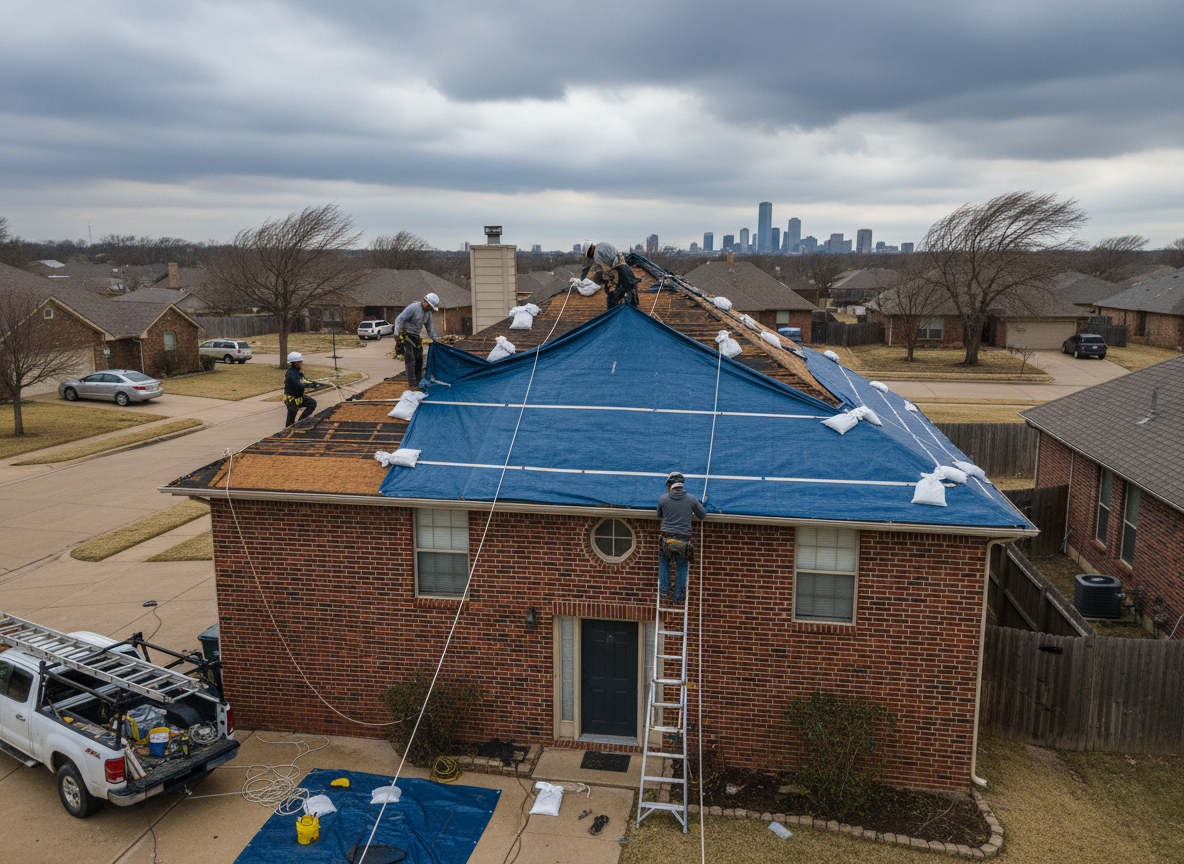
Emergency roof tarping
Tarping a flat roof is a different job from tarping a pitched one: the sheet has to be lapped and weighted so that water runs to a drain rather than sitting under it. It is temporary protection, and it is described that way.
Roof leak repair
Most leaks here are at a penetration, a parapet base, a scupper or a seam. Tracing one means reading the interior staining against the roof layout and testing the detail, which on a flat roof is often more accessible than the leak's location suggests.
Storm and hail damage repair
On the eastern plains this is hail documentation: impact marks, granule loss, cracked tile and dented soft metals, recorded slope by slope. On a flat roof, wind is the more common storm damage — lifted membrane at edges and at parapet terminations.
Roof repair
The routine work is flat-roof maintenance: parapet flashing, scupper and drain repair, penetration curbs, seam repairs and the recoating cycle. Done on schedule, these keep a low roof serviceable for decades.
Roof replacement
Replacement on a low roof usually means a membrane system with insulation and a new drainage arrangement, not just a new surface. On a pitched roof it means covering, underlayment, flashing and ventilation together.
Roof installation
New roofs here are specified for sun, for drainage and for altitude: membrane systems rated for high surface temperatures, slope built in rather than assumed, and flashings detailed for a climate with wide daily movement.
Shingle roofing
Shingle work covers the pitched subdivisions and the older pitched houses outside the historic districts. Impact rating matters on the east side of the state; reflectivity and ventilation matter everywhere at this altitude.
Tile roofing
Tile work is underlayment work: lift and relay, replace cracked pans, rebuild mortar at hips and ridges, and renew valley and wall flashing. Matching a regional profile on an older house is part of the job.
Metal roofing
Metal repair covers panel and fastener replacement, seam work, snow guards where snow slides, and recoating where the paint system has chalked at altitude.
Flat roof repair
The core service in this state: membrane patching and replacement, parapet flashing rebuilds, scupper and drain work, ponding correction, and cooler curb repairs on roofs where a unit has been removed.
Roof coating
An elastomeric or reflective coating is how a New Mexico flat roof is maintained between membrane replacements. Surface preparation decides the outcome, and a coating over dust or a chalky surface will fail early.
Roof inspection
An inspection records the membrane and coating condition, every penetration and curb, the drainage path, the parapet details and the attic or interior side. On a flat roof, the photographs of each penetration are the most useful part of the report.
What's included in a New Mexico roof repair
- A drainage assessment first, because standing water explains more leaks here than any single material failure.
- Every roof penetration checked and photographed, including cooler curbs and abandoned openings.
- Parapet base flashing inspected at the wall, not just at the roof surface.
- Coating condition recorded separately from membrane condition, so the repair does not confuse the two.
- A written scope naming the membrane, the flashing, the drainage and the coating as separate items.
Cities covered in New Mexico
Coverage includes Albuquerque, Rio Rancho, Bernalillo, Los Lunas, Belen, Santa Fe, Española, Los Alamos, Taos, Las Cruces, Mesilla, Alamogordo, Roswell, Carlsbad, Hobbs, Clovis, Portales, Farmington, Gallup, Silver City, Truth or Consequences and Raton.
These are coverage areas, not offices. The company is headquartered in Oklahoma City, Oklahoma, and works across New Mexico from that base. A flat roof in Albuquerque, a tile roof in Santa Fe and a shingle roof in Roswell are three separate conversations, and the inspection starts from that difference.
Elsewhere in the Mountain West
New Mexico's monsoon and ultraviolet exposure is shared with Arizona and southern Utah, and its snow with the northern Rockies. The Mountain West region page sets out the whole picture, and the state index lists every state covered.
- Roof repair in Arizona
- Roof repair in Nevada
- Roof repair in Utah
- Roof repair in Montana
- Roof repair in Idaho
- Roof repair in Wyoming
The sequence of a New Mexico repair
The call fixes the roof type. Flat with a parapet, pitched with tile, pitched with shingle — each leads to a different first question, and the answer is usually known by the owner.
The inspection starts at the drainage. Low points, scuppers, drains and the parapet line are checked before the field, because on a low roof that is where the water goes and where the failures collect.
Penetrations come next. Cooler curbs, vent stacks, skylights, satellite mounts and every abandoned opening are photographed and tested. A large share of leaks end here.
The scope is layered. Membrane, flashing, drainage and coating are listed separately, so a coating renewal is not sold as a replacement and a replacement is not avoided by re-coating a failed membrane.
The close-out records condition. Photographs, a drainage test with water, and a written note of anything left alone, so the next monsoon has a baseline to be judged against.
Talking through a New Mexico roof
Flat roofs fail quietly and then all at once, and the difference is usually maintenance. Call (833) 406-0167, describe the roof, its covering and what the water is doing, and the assessment begins with the drainage and the parapet.
Around New Mexico
We regularly work near:
- 📍Sandia Peak, Albuquerque
- 📍Santa Fe Plaza
- 📍Carlsbad Caverns National Park
- 📍White Sands National Park
- 📍Taos Pueblo
Roof Repair in New Mexico — Local Notes
- •Most New Mexico leaks begin at a roof penetration, a parapet base or a blocked scupper rather than in the middle of a sound membrane.
- •An abandoned evaporative cooler opening is a recurring leak site and should be closed as a roof detail, not sealed with mastic.
- •Reflective coating is a maintenance layer on low-slope roofs here, and its condition is separate from the membrane's condition.