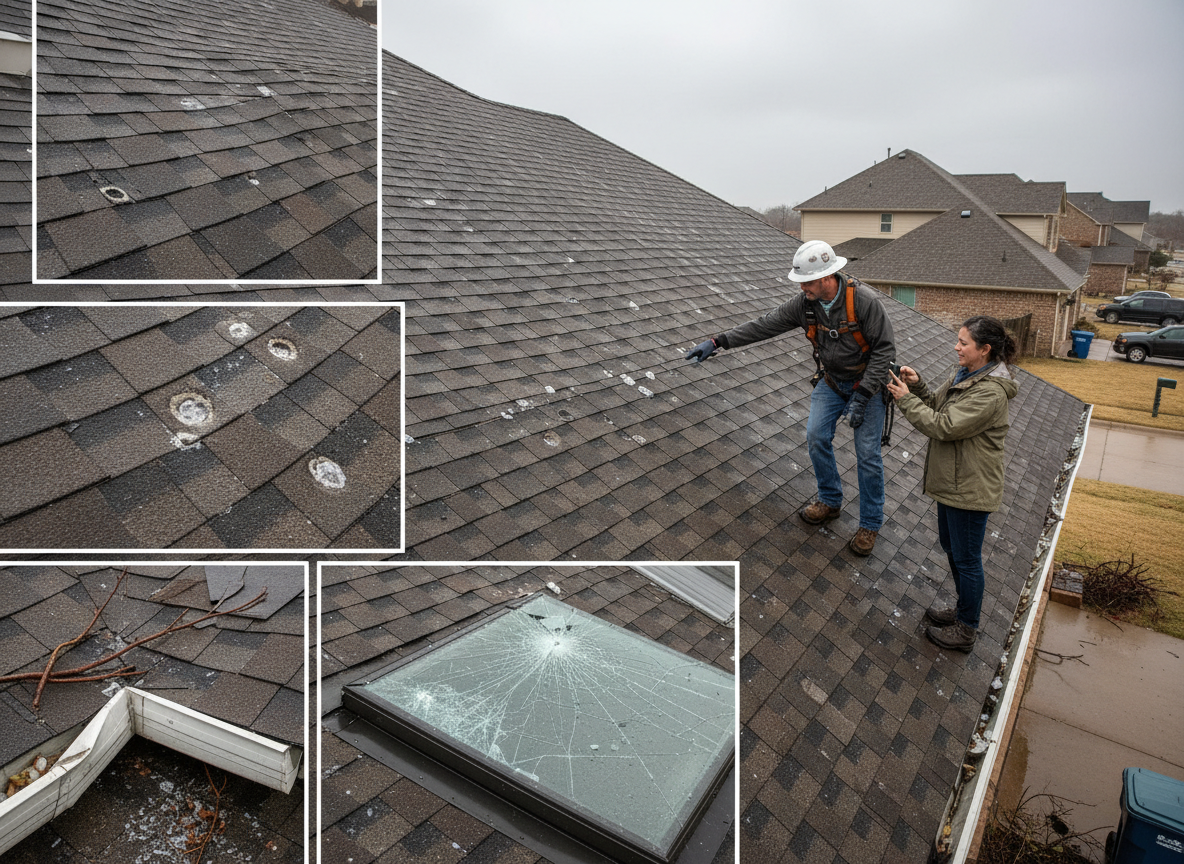
Alabama is a state where a roof has to answer to three different weather systems, and knowing which one has just hit is the first practical question after any storm. Mobile and the Baldwin County coast face the Gulf: hurricane wind, salt air and rain driven horizontally at walls. The centre of the state, around Birmingham and Tuscaloosa, faces violent spring thunderstorms and hail. The Tennessee Valley in the north faces a tornado record that runs deeper than most people outside the state realise, plus the occasional hard freeze.
That split shows in the roof itself. A coastal roof is judged on uplift and corrosion. A central Alabama roof is judged on impact and wind. A north Alabama roof is judged on how its edges and ridge hold when the wind gets underneath. Roof repair in Alabama is a matter of identifying which of those is in front of you before anything is ordered. This page covers the weather, the state's housing stock, the services available, the cities covered and how the work runs. If water is coming in, call (833) 406-0167 and describe where.
The Gulf coast: wind, salt and horizontal rain
Mobile and Baldwin counties sit at the northern end of the Gulf, and the roofing consequences are those of a coastal market. Named storms bring wind that works at the perimeter first — the rake, the eave, the ridge and the corners — and rain that arrives at an angle, entering at wall junctions, window heads and the joint where a porch roof meets the house.
Salt is the slow half of the problem. It attacks fasteners, valley metal, vents and the cut edges of any galvanised component, and it does that long before the covering itself shows wear. A coastal roof that is inspected only for missing shingles will miss the corrosion that eventually lets water in at a penetration.
The centre: thunderstorms, hail and wind
Birmingham, Tuscaloosa, Hoover, Vestavia Hills and the corridor between them sit in a thunderstorm belt that produces both hail and strong straight-line wind. Hail arrives in swaths, so neighbouring houses can carry very different damage from the same storm, and the National Weather Service counts a stone an inch across as severe. At that size the mat under a shingle can be bruised without the surface breaking, and the failure that follows is slow.
Straight-line wind does different work. It lifts ridge caps, creases tabs and drives water under shingles at the windward edge. The difference matters, because a wind repair is a fixing and sealing job while a hail assessment is a documentation exercise.
The Tennessee Valley: tornadoes and the hard freeze
North Alabama has a long record of violent tornadoes, including the systems of April 2011 that crossed the state and left damage paths through communities such as Hackleburg and Phil Campbell. For a roofer the lesson is not the exceptional event; it is what the ordinary severe thunderstorm does at the edges of a roof. Tornadic wind removes covering, ridge and edge all at once, and the houses around the path usually have lesser damage that is easier to overlook.
Winter in the valley is usually mild, but a hard freeze arrives often enough to matter. Water sits in a lap, behind a counter-flashing or in a valley, freezes overnight and opens the joint slightly. Repeated freezes do what one cold night cannot.
The Alabama housing stock, and why brick matters
Brick veneer is the default
Alabama builds in brick. A large share of the state's houses, from mid-century mill housing to new subdivision build, are brick veneer over wood frame with an architectural shingle roof. The brick changes roof repair in a specific way: there is no siding to tuck a flashing behind. Every wall junction, chimney and porch intersection is a masonry detail that has to be cut into the brick, sealed and counter-flashed, and a repair that relies on surface sealant will fail at the next expansion cycle.
Shingle dominance, and the metal exception
Architectural asphalt shingle covers most Alabama roofs, and it ages here from above and below: sun and heat on the surface, attic heat and humidity on the underside. Metal appears on rural property, farm buildings and a growing share of custom homes, and on the coast it is chosen as much for corrosion resistance and uplift performance as for appearance.
Coastal construction
Along the Gulf the stock changes. Condominium buildings and elevated houses use low-slope membrane assemblies, standing seam metal and, on some properties, tile. Elevation, wind-borne debris exposure and salt corrosion all shape what can be installed, and the fixing pattern matters more than the panel or tile chosen.
Older housing and the mill towns
Alabama's older housing is wood frame with a brick skirt or full veneer, often with a low-pitch roof that was designed for a cheaper era of materials. Those roofs have usually been re-covered at least once, which means the current covering sits on an older layer or on a deck that has been patched repeatedly. Opening one of those roofs is where the real condition of the house becomes visible.
Roofing services available in Alabama
Emergency roof repair
After a storm opens a roof, the immediate job is to close it and make it safe. On an Alabama roof that usually means securing a ridge or an edge that has lost its covering, isolating any ceiling that is at risk and photographing the opening before material is moved. The permanent repair is planned from that record.
Emergency roof tarping
A tarp is a temporary answer for a roof that is waiting on materials or cannot be worked safely. Alabama heat softens adhesive sheets quickly, so tarps are battened and tied mechanically, and they are treated as a short-term measure rather than a repair.
Roof leak repair
Leaks are traced from the stain back to the entry. On brick houses the entry is frequently at a wall junction, a chimney or a porch roof intersection rather than in the shingle field, and on coastal properties a corroded vent or fastener is often the cause. The diagnosis decides whether the repair is to the covering at all.
Storm and hail damage repair
The survey after an Alabama storm separates wind damage from impact damage. Wind shows at edges, ridges and hips as lifted or creased tabs. Hail shows in the field of the slope and on soft metals. A roof hit by both is documented slope by slope, because the two are repaired differently.
Roof repair
Day-to-day repairs cover failed pipe boots, cracked vent seals, step flashing pulled away from brick, valley metal that has rusted, and ridge caps displaced by wind. The goal is to restore the detail rather than to cover it.
Roof replacement
Replacement is usually driven by age, storm history and the number of repairs already made. Tear-off exposes the deck and the roof-to-wall connection, and on a re-covered roof it also reveals what the previous installation left behind.
Roof installation
New roofs are decided on specification: underlayment, ventilation for a hot humid climate, wind rating for the exposure, and on the coast a fixing pattern that suits uplift. Those decisions are hidden within a week of completion.
Shingle roofing
Shingle work covers patches, full slopes and whole roofs, including the correction of ventilation that has been throttling the covering from below for years.
Tile roofing
Tile is a smaller part of the Alabama market, concentrated on the coast and on some newer build. The work is underlayment-led: lift, replace the membrane, relay the tile, and match broken pieces as far as stock allows.
Metal roofing
Metal work covers fastener and washer replacement on profiled panels, seam and flashing repairs on standing seam, and coating work where the finish has chalked. Coastal metal needs corrosion-resistant fasteners, because the wrong ones fail first.
Flat roof repair
Low-slope work is seam, drain and penetration repair. Ponding is treated as a drainage fault, because a membrane under standing water will fail at its laps however well they were made.
Roof coating
A coating extends the life of a sound low-slope roof and reduces heat gain, but it cannot make a wet assembly dry. Moisture testing decides whether it is a repair or a postponement.
Roof inspection
An inspection produces a written condition record: covering, flashing, penetrations, drainage, the attic side, and photographs of each. It is what a homeowner uses to decide between repair and replacement, and what makes a storm claim legible later.
What's included in an Alabama roof repair
- A roof and attic assessment before any scope is written, with photographs of the failed detail and its surroundings.
- A written scope separating covering, underlayment, deck and flashing, so the invoice matches the agreement.
- Deck inspection wherever the covering is opened, since soft sheathing under a sound shingle is common after a slow leak.
- Masonry flashings cut and counter-flashed rather than surface-sealed, because brick moves.
- Cleanup with a magnet sweep and a final walkthrough with the photographs in hand.
When a landfall in Florida still reaches Alabama
Not every Alabama roof that fails in a storm was hit by a storm that made landfall in Alabama. Gulf systems routinely come ashore in the Florida Panhandle and track north-west into Mobile and Baldwin counties, then up through the state, and the wind and rain that arrive inland are still enough to open a roof that was already marginal.
The pattern is consistent. The coast takes wind and horizontal rain for a period measured in hours, and the tree cover and the low-lying ground do the rest. Inland, the system weakens into a rain event, but a rain event in Alabama means volume: valleys back up, gutters fill, and low-slope additions that were sound in ordinary weather are wet underneath before the day is out.
That is why the weeks after a coastal landfall produce a wave of repair calls a long way from the coast — a ridge cap that lifted in the wind, a flashing that was loosened and only began to leak under the sustained rain, a valley that could not carry a day of water. None of those are dramatic failures, and all of them are cheaper to repair before the next system than after it.
Alabama cities and metros covered
Coverage in Alabama includes Birmingham, Hoover, Vestavia Hills, Homewood, Tuscaloosa, Northport, Montgomery, Prattville, Auburn, Opelika, Huntsville, Madison, Decatur, Florence, Gadsden, Anniston, Dothan, Enterprise, Mobile, Daphne, Fairhope, Foley, Gulf Shores, Orange Beach, Selma, Demopolis and Tuskegee.
These are coverage areas, not offices. The company is headquartered in Oklahoma City, Oklahoma, and works across Alabama from that base. What changes between them is the exposure: a Gulf Shores roof is judged on uplift and salt, a Birmingham roof on hail and storm wind, a Huntsville roof on how the edges hold when wind gets under them.
How an Alabama roof repair runs
Taking the call. You describe the symptom and when it started, and the address and covering are confirmed. An active leak, an open roof and a question about an ageing shingle roof are routed differently from the first minute.
Assessing the roof. The roof is walked where it is safe and the attic is inspected from inside. Photographs cover the failed detail, the surrounding field and the soft metals, and on brick houses the junctions and chimney get as much attention as the slope.
Writing the scope. The repair is described in parts: what is removed, what is replaced, what is reused, what is left alone. Where there is a genuine choice between a sectional repair and a replacement, both are set out.
Doing the work. Materials are staged, the deck is checked as it is exposed, and anything additional is reported before it is covered. Storm work is sequenced so the documentation photographs are taken first.
Handing over. The finished repair is reviewed with you, the photographs are handed across, and the roof is checked for fasteners and debris. Anything found but not repaired is written down, so the next decision starts from a record.
The rest of the region
Alabama is one of eight states in the Southeast region, and the shared hurricane and humidity exposure is described on the region page. Every state we cover is listed on the state index.
- Roof repair in Florida
- Roof repair in Georgia
- Roof repair in South Carolina
- Roof repair in North Carolina
- Roof repair in Tennessee
- Roof repair in Mississippi
- Roof repair in Louisiana
- Southeast region overview
Talk to a roofer about an Alabama roof
An Alabama roof can be damaged by wind, by hail, by salt or by the slow movement of a brick wall, and the four repairs look nothing alike. Call (833) 406-0167, describe what you are seeing and where on the house it appears, and the first step is working out which of them applies.
Around Alabama
We regularly work near:
- 📍Mobile Bay
- 📍Gulf State Park
- 📍Little River Canyon
- 📍Dismals Canyon
- 📍Cheaha State Park
Roof Repair in Alabama — Local Notes
- •Brick veneer is the default wall on Alabama houses, so flashings are masonry details rather than siding details.
- •The Gulf coast carries uplift and salt exposure; the centre carries hail; the north carries tornado wind.
- •Re-covered roofs are common on older housing, which is where the deck condition is usually discovered.