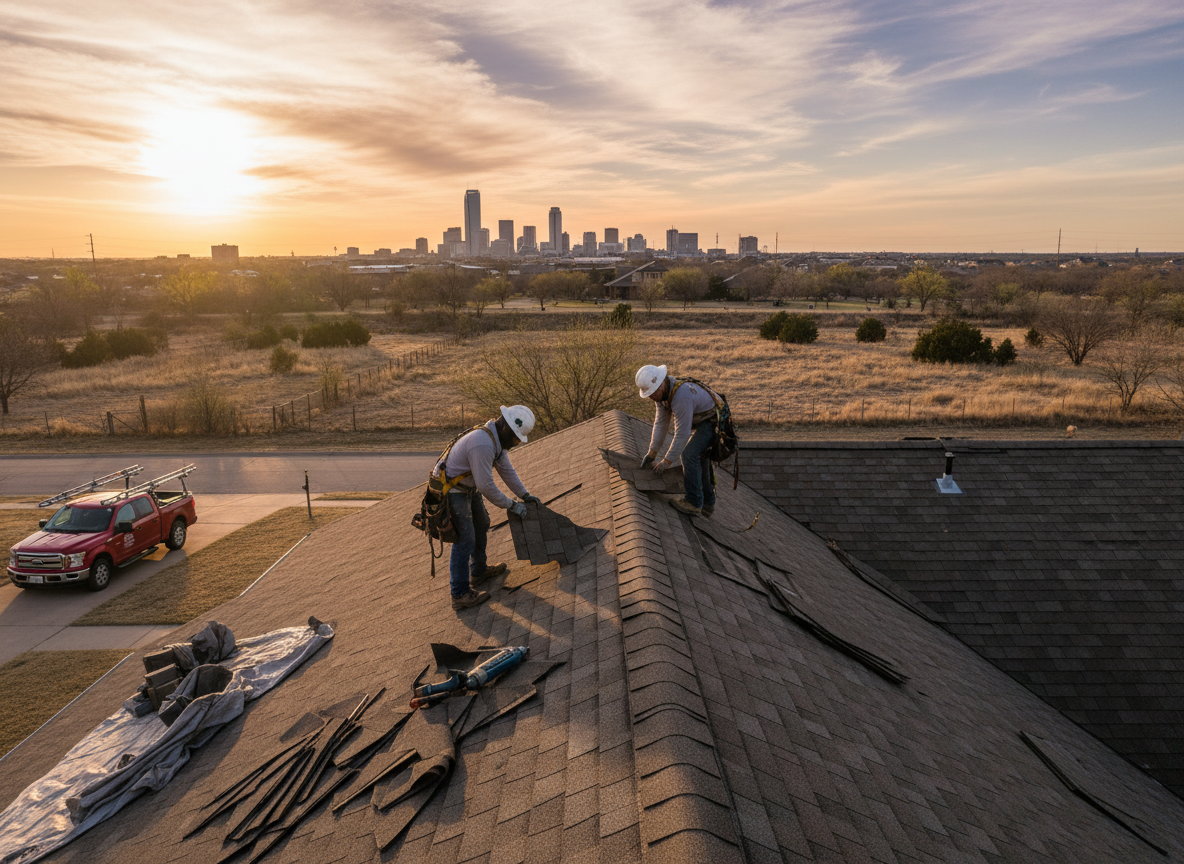
Tennessee is a long state, and the roof at one end of it works in different conditions from the roof at the other. Memphis, in the west, sits on the Mississippi lowlands in heat and humidity that lasts most of the year. Nashville and the middle of the state sit in a basin that catches severe thunderstorms and hail. Knoxville and the eastern mountains take ice, snow and the freeze-thaw that comes with them.
What unites the three is water and wind arriving in short, violent episodes rather than in a seasonal pattern, and a housing stock that is overwhelmingly brick with an asphalt shingle roof on top. Roof repair in Tennessee is usually about finding the one detail that failed during a storm that lasted twenty minutes and then left the state humid for a week. This page covers the weather, the roof types in use, the services available, the metros covered and how the work runs. If water is coming in, call (833) 406-0167 and describe where.
Three grand divisions, three roof climates
West Tennessee and Memphis
The western end of the state is low, green and humid, with the Mississippi River as its boundary. Summer heat holds for months, and the roof is loaded from above by sun and from below by an attic that rarely dries out. Memphis also builds on loess, a wind-deposited silt that erodes and settles, and a house that has moved slightly shows it at the roof-to-wall junction and around the chimney.
Severe thunderstorms and tornadoes cross the western counties, and because the terrain is flat the wind arrives without anything to slow it down.
Middle Tennessee and the basin
Nashville sits in a basin ringed by higher ground, and the geography shapes the weather: storms that move into the basin can stall and drop a great deal of rain, and the surrounding ridges funnel wind. The March 2020 tornado that crossed the city is the reference event for many homeowners in the middle of the state, and its damage pattern — roofs stripped at the edges, ridges gone, trees through decks — is the one that shapes how storm work is planned here.
Middle Tennessee also gets hail, sometimes in the same system, and hail in a swath leaves neighbouring houses with very different roofs.
East Tennessee and the mountains
Knoxville, the Smoky Mountains and the ridge country to the north-east take winter as ice more often than as deep snow. Freezing rain coats the covering, fills the gutters and freezes at the eaves, and meltwater behind the ice finds the deck. The freeze-thaw cycle then works on every flashing and valley through the winter, opening joints that were sound in autumn.
The mountains also produce steep roofs and a large share of metal covering, because a steep pitch sheds ice and a metal surface lets it go.
The storms that matter most
Tornadoes and straight-line wind
Tennessee sits in a region where tornadoes can occur in any month, and the state's record includes significant events in winter as well as spring. The March 2020 tornado in Middle Tennessee and the long-track storm that crossed into the state in December 2021 are the two that most homeowners in the affected counties remember.
For a roof, the distinction between tornado damage and straight-line wind damage matters for how a repair is sequenced. Tornadic wind removes covering, edge and ridge together and often opens the structure. Straight-line wind lifts edges and drives rain underneath, leaving the covering largely in place but compromised.
Hail
Hail in Tennessee is a spring and early summer event, and it falls in swaths. The National Weather Service treats a stone an inch across as severe, and at that size the mat under a shingle can be bruised without the surface breaking. The failure that follows is slow enough to be missed and certain enough to matter.
Ice and the freeze-thaw cycle
Ice is the eastern third's defining winter problem, but it is not unknown in the middle of the state either. The mechanism is the same everywhere: water gets into a lap, a valley or a counter-flashing, freezes overnight, expands, and opens the joint slightly. Repeated cycles widen it until the detail that was marginal becomes a leak.
Heat, humidity and the attic
Tennessee summers are humid enough that an attic which cannot move air will hold moisture against the underside of the deck. That shows up as condensation that mimics a leak, as soft sheathing under a covering that looks sound, and as a roof that ages faster than its surface suggests.
Roof coverings on Tennessee houses
Shingle over brick
The standard Tennessee house is brick veneer with an architectural shingle roof, and it has been that way for sixty years. The brick makes every roof-to-wall junction a masonry detail: there is no siding to tuck a membrane behind, so flashings have to be cut into the wall and counter-flashed.
Metal in the east and on the farm
Metal covers a large share of east Tennessee roofs and most agricultural buildings statewide. On mountain houses the panel and its details are chosen for ice shedding; on farms the choice is usually durability and cost, and the panels are profiled rather than standing seam.
Low-slope and commercial
Downtown commercial buildings, warehouses and flat-roofed additions use modified bitumen, TPO and EPDM assemblies. They fail at seams, drains and penetrations, and in a state that gets short intense rain, a drain that cannot move volume is a leak waiting for the next storm.
Older housing and the second covering
Much of the state's older housing has been re-roofed at least once, often over the original covering. Those roofs hide their condition until opened, and the deck, the old underlayment and earlier flashing work are all discovered together.
The thirteen services, ordered by when they are needed
The service list does not change from Memphis to Mountain City. The order it gets used in does, and thinking in that order makes the first decision easier.
In the first hours
Emergency roof repair is about closing the building: securing what is open, isolating a ceiling that is at risk, and photographing the damage before anything is moved. Emergency roof tarping covers the case where the roof cannot be worked safely or is waiting on materials, fixed with battens because adhesive fails in this heat.
In the weeks after
Storm and hail damage repair turns the event into a record: which slopes took wind, which took impact, which soft metals show fresh marks. Roof leak repair deals with what the storm exposed, tracing water from the stain back to the detail that let it in.
Over the following seasons
Roof repair handles the ordinary failures that accumulate on any Tennessee roof: a lifted ridge cap, a pipe boot that has cracked, step flashing pulled from a brick wall, valley metal that has rusted through. Shingle roofing extends that to full slopes. Metal roofing covers fasteners, seams and coating on the eastern and rural stock. Tile roofing is occasional here, and always underlayment-led. Flat roof repair is seam, drain and penetration work on low-slope buildings.
Before the next decision
Roof inspection produces the condition record that decides repair against replacement, including the attic side and any movement below. Roof replacement follows when the record justifies it, and tear-off is where the deck and the wall connection are finally seen. Roof installation is the forward-looking version: underlayment, ice barrier in the east, ventilation for a humid climate. Roof coating is the low-slope option when the assembly is dry and the covering has life left in it.
What is included in a Tennessee repair
The roof and attic are assessed before a scope exists, and the photographs of the failed detail go into the record with the rest. The scope separates covering, underlayment, deck and flashing so nothing arrives on the invoice that was not agreed. The deck is checked as the covering comes up, the masonry flashing is cut in rather than sealed over, and the site is swept for fasteners before the walkthrough.
Tennessee cities and metro areas covered
Coverage in Tennessee includes Memphis, Germantown, Collierville, Bartlett, Jackson, Dyersburg, Union City, Nashville, Franklin, Brentwood, Murfreesboro, Smyrna, Clarksville, Columbia, Cookeville, Chattanooga, Cleveland, Knoxville, Maryville, Oak Ridge, Sevierville, Gatlinburg, Johnson City, Kingsport, Bristol and Morristown.
These are coverage areas, not offices. The company is headquartered in Oklahoma City, Oklahoma, and works across Tennessee from that base. The exposure changes with the address: a Memphis roof is judged on heat, humidity and loess movement, a Nashville roof on storm wind and hail, a Knoxville roof on ice at the eaves.
From the first ring to the final walk round
The ring. What the roof is doing, when it started and what covers it. That is enough to place the call: an active leak, an open roof, or a question that can be answered before a visit is booked.
The visit. The covering is walked where it can be walked and the attic is inspected from underneath. Photographs cover the failed detail, the field around it and the soft metals, and in the east the valleys and penetrations get a second look for ice damage.
The scope. Four lists: what comes off, what goes back, what is reused, what is left alone. Where a section repair and a replacement are both credible, both are written down.
The build. Materials are on site before the covering is opened. The deck is checked as it appears, additional rot or flashing failure is reported before it is covered, and storm damage is photographed before removal.
The walk round. The finished repair is reviewed on the roof or from the ground, the photographs are handed over, and fasteners and debris are cleared. Anything noted and not repaired goes into the record.
How a storm crosses the state
Tennessee's shape matters to a roofer. The state runs roughly eight hundred miles from the Mississippi River to the Blue Ridge, and a single weather system can produce different damage at each end of it.
A line of thunderstorms that forms west of the river arrives in Memphis first, usually as wind and heavy rain, and crosses the western lowlands quickly because there is nothing to slow it. By the time it reaches the Highland Rim and the Nashville basin the line has often reorganised, and the basin's shape can hold a cell in place long enough to drop a great deal of rain in one place. That is the pattern behind the flash flooding that recurs in Middle Tennessee.
East of the plateau the same system meets different air. In winter that is where the state's ice comes from: warm moist air riding over cold air trapped against the mountains, producing freezing rain rather than snow. The result is a coating on the covering, an ice dam at the eaves, and a slow opening of every flashing detail through the melt-and-refreeze cycle that follows.
The practical value of thinking this way is in the inspection. A roof in Memphis after a storm should be checked for wind and rain entry. A roof in the basin should be checked for the drainage capacity that a stalled cell exposes. A roof in the east after a winter event should be checked at the eaves, the valleys and every penetration where ice has been sitting.
It also explains why damage reports from a single storm can seem contradictory. Three roofs, one system, three different failures, and none of them wrong.
The rest of the region
Tennessee is one of eight states in the Southeast region, and the shared storm and humidity picture is set out on the region page. Every state we cover is listed on the state index.
- Roof repair in Florida
- Roof repair in Georgia
- Roof repair in Alabama
- Roof repair in South Carolina
- Roof repair in North Carolina
- Roof repair in Mississippi
- Roof repair in Louisiana
- Southeast region overview
Talk to a roofer about a Tennessee roof
A Tennessee storm can strip a ridge in twenty minutes and leave a humid week behind it to find every opening it made. Call (833) 406-0167, describe what the roof is doing and where, and the first step is working out whether the damage is wind, impact, ice or age.
Around Tennessee
We regularly work near:
- 📍Great Smoky Mountains National Park
- 📍Graceland
- 📍Lookout Mountain
- 📍Fall Creek Falls State Park
- 📍Reelfoot Lake
Roof Repair in Tennessee — Local Notes
- •Tennessee divides into three roof climates: humid west, storm-prone middle, ice-prone east.
- •Brick veneer with shingle is the state's standard house, so flashings are masonry details.
- •Ice arrives as freezing rain in the east and opens joints a little at a time.