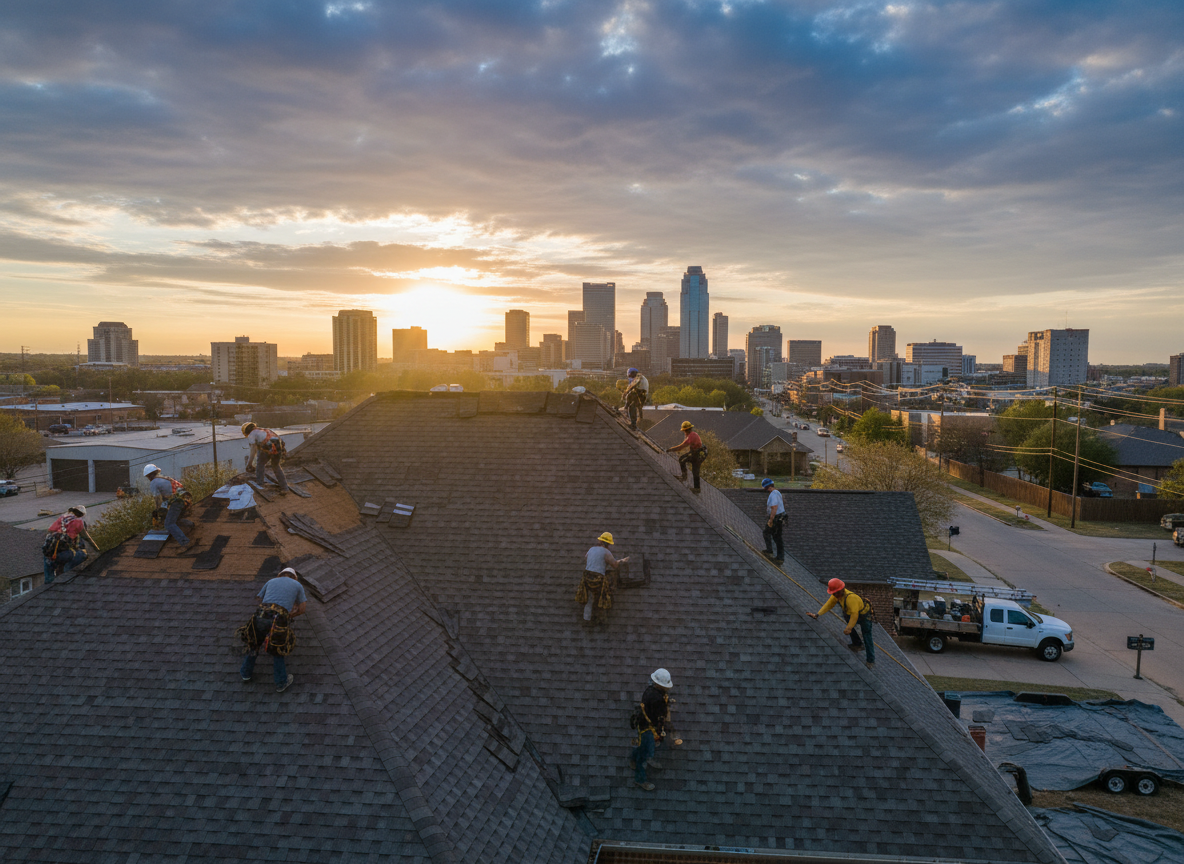
A Louisiana roof is built above ground that is still settling, in air that is close to saturated for most of the year, in a state that has been rebuilt after repeated landfalls. That combination makes the roof the most exposed part of the building and the part most often repaired at the margin, because everything below it has already been dealt with.
The housing stock matters as much as the weather. Raised houses on piers, shotgun and camelback cottages, historic buildings in the French Quarter and mid-century brick ranches all meet a storm differently, and a roof repair that suits one can be wrong for another. This page sets out what water does here from above and below, the storm record that shapes how roofs are detailed, the coverings the state uses, the services available and how a repair runs. If water is entering now, call (833) 406-0167 and describe where it is showing.
Water from above, and water from below
Rain volume and the drainage limit
South Louisiana gets rain in heavy convective bursts through a long warm season, and the roof is judged on how fast it can move water off. Valleys, gutters, downspouts and the drains on any low-slope section are the limiting components, and when they cannot carry the volume, water backs up under the covering and enters at the deck rather than through a hole.
The practical consequence is that a leak in Louisiana is often a capacity problem. Replacing shingles over a valley that is undersized does not solve it, and a drain that has been throttled by debris will defeat a new membrane.
Subsidence and the roofline
Much of the state's inhabited ground is settling, and a building that settles unevenly shows it at the roofline. A ridge that has opened along its length, a chimney that has leaned away from the slope, a wall junction that has cracked in a stair-step pattern: these are structural signals rather than covering failures.
Repairing them as though they were covering failures is a common and expensive mistake. The flashing has to be detailed to accept movement, and the record has to note what is happening below, because a joint that is sealed tight against a moving wall opens again within a season.
The storm record
The state's roofing practice has been shaped by named storms. Katrina in 2005 removed roofs across the New Orleans area and the Mississippi border parishes. Laura in 2020 struck the south-west around Lake Charles and left a region rebuilding roofs in a market short of materials. Ida in 2021 came ashore at Port Fourchon and crossed the state with wind that stripped covering across a wide area, then left hundreds of thousands of buildings without power for days in the heat that followed.
Each of those storms taught the same lesson in different ways: the failures begin at the edges, the ridges and the wall junctions, and the water that follows the wind does the rest.
Heat and humidity
The warm season is long enough that a roof ages from both sides. Sun and ultraviolet break down the surface while an attic that cannot move air holds moisture against the underside of the deck. Moss and algae settle on the shaded slopes, and the humidity keeps a wet deck wet long after the rain has passed.
Historic districts and the French Quarter
New Orleans and several surrounding municipalities regulate exterior work in historic districts, and the French Quarter has its own review process for changes that are visible from the street. Roof materials are part of that review: slate, clay tile and standing seam metal are the historic coverings, and a proposal to replace one with a modern shingle can be refused even where it would perform adequately.
For a roofer the practical point is sequencing. What is permitted is settled before materials are ordered, and the repair is then designed around the covering that has been approved rather than around the one that is easiest to source.
Roof coverings on Louisiana houses
Metal on raised houses and historic buildings
Standing seam metal is the historic covering on much of the older stock and remains common on raised houses, where a low mass and a shedding surface suit the climate. On these roofs the details that matter are the seams, the pan flashing at a wall and the fastening at the eave, because wind gets its first grip there.
Shingle on mid-century and suburban housing
Architectural asphalt shingle covers most of the post-war housing across the state, and it is what most storm repairs touch. It ages from above and below in this climate, and its performance in wind is decided at the edges and the ridge rather than in the field.
Slate and tile on the historic stock
Slate and clay tile appear on the oldest buildings in New Orleans and on some churches and public buildings elsewhere. Both are long-lived coverings whose failure is usually in the fastening or the underlayment beneath, and both require a repair that matches the original rather than one that merely stops the leak.
Low-slope and commercial
Commercial buildings, schools and flat-roofed additions use modified bitumen, TPO and EPDM. They fail at seams, drains, scuppers and penetrations, and in a state where rain arrives in volume, drainage capacity is the difference between a membrane that lasts and one that does not.
Termites and the deck
The Formosan subterranean termite is established in south Louisiana, and it attacks the wood in a roof structure as readily as the wood in a wall. A roof that has been damp for a season is a roof that invites them, which is one more reason a slow leak is worth fixing rather than monitoring.
The thirteen services, and the Louisiana question behind each
A roof here is asked to do three things at once: move a large volume of water, stay attached in wind, and keep working on a building that is settling. Every one of the thirteen services answers one of those, and which is needed usually becomes clear within the first few minutes of a conversation.
Water is the first route. Roof leak repair follows the stain back to the entry, and on a raised house that entry is frequently a wall junction, a chimney or the point where a porch roof meets the main slope. Flat roof repair is the same work on a horizontal surface, where the failure is nearly always a seam, a drain or a penetration rather than the membrane itself. Where the assembly is sound and the aim is to buy years rather than to rebuild, roof coating is considered, and only after moisture testing shows the roof is dry.
Wind is the second route, and it begins at the perimeter. Emergency roof repair closes a building that a storm has opened and records the damage before anything moves. Emergency roof tarping holds the roof when it cannot be worked safely, and in this climate it is tied rather than glued. Storm and hail damage repair then turns the event into a record: which slopes lost covering to wind, which took impact, which soft metals show fresh marks.
The covering itself is the third route. Roof repair covers the ordinary failures — a ridge cap, a pipe boot, pan flashing at a wall, valley metal that has rusted through. Shingle roofing takes that from a patch to a full slope. Metal roofing is fasteners, seams and coating, and on a raised house the eave fixing is the detail that decides how the roof behaves in wind. Tile roofing is material-matched work on the historic stock. Roof replacement is the decision those four tend to lead to, and tear-off is where the deck and the structure below it are finally seen.
Two services sit either side of the decision. Roof inspection produces the condition record, including any settlement visible below the roofline. Roof installation is the forward-looking version: underlayment, ventilation, drainage sized for the rainfall, and a wind-rated assembly in the coastal parishes.
What a Louisiana repair includes
An assessment of the covering and the attic before any scope is written, with photographs of the failed detail and the field around it. A scope that separates covering, underlayment, deck and flashing, so each part can be agreed rather than assumed. A deck check wherever the covering opens, since a damp deck here is also an invitation to termites. Flashings detailed to accept movement, because a settling building will open a joint that was sealed tight. A swept site and a walkthrough with the photographs at the end.
Louisiana cities and metro areas covered
Coverage in Louisiana includes New Orleans, Metairie, Kenner, Gretna, Harvey, Marrero, Slidell, Mandeville, Covington, Hammond, Houma, Thibodaux, Baton Rouge, Denham Springs, Gonzales, Zachary, Lafayette, New Iberia, Opelousas, Lake Charles, Sulphur, Alexandria, Pineville, Monroe, West Monroe, Shreveport, Bossier City and Natchitoches.
These are coverage areas, not offices. The company is headquartered in Oklahoma City, Oklahoma, and works across Louisiana from that base. The exposure changes with the address: a New Orleans roof is judged on rain volume, settlement and historic review, a Lake Charles roof on hurricane wind, a Shreveport roof on storm wind and hail.
Six questions that settle the job before it starts
Most of the difficulty in a Louisiana repair is resolved by answering these in order, and each one changes what the next looks like.
What covers the roof, and what is it sitting on? A standing seam panel on a raised house, a shingle field on a 1960s ranch and a slate roof in a historic district are three different jobs before any damage is considered.
Where does the water actually enter? A stain is the end of a path. The entry is found by tracing from the deck and the attic, not by looking at the ceiling.
Is the building moving? A ridge that has opened along its length or a chimney leaning away from the slope points to settlement, and a repair that ignores it will fail in the same place.
Is the address in a regulated district? In the French Quarter and the surrounding historic districts, the material is settled before it is ordered.
What closes the roof tonight? If the answer is a tarp, that happens first and the permanent scope is planned from the photographs taken before it goes on.
What does the finished repair look like? The scope names what is removed, replaced, reused and left alone, so the walkthrough at the end has something to be measured against.
What settlement looks like from the roof
A roof is the easiest place to see a building move, because it is long, flat in plan and fixed at both ends. When the ground beneath a Louisiana house settles unevenly, the roofline records it before anything inside the house does.
The first sign is usually a ridge that has opened along part of its length. Ridge caps separate, the sealant strip lets go and a gap appears that no amount of wind would explain. The second is the chimney: masonry is stiff and the roof frame is not, so a chimney that has rotated a fraction shows a widening gap at its counter-flashing on one side while the other side stays tight.
The third sign is a stair-step crack in the brick at the roof-to-wall junction, following the mortar rather than the roof. It appears where the wall has moved away from the frame, and it grows through a wet season and closes again in a dry one.
None of those is fixed by roofing alone, and none of them should be presented as if it were. What roofing can do is detail the joint so that movement does not tear the flashing: a counter-flashing cut into the masonry, a pan or a cricket where water collects, and a flexible membrane under the metal rather than a bead of sealant over it. The record then notes that the movement is being watched, so the next person to look at the roof knows what was already there.
What roofing cannot do is stop the ground. Where settlement is significant, the sequence is structural assessment first and covering work second, and a repair that skips the first step is money spent twice.
The rest of the region
Louisiana is one of eight states in the Southeast region, and the shared hurricane and humidity exposure is set out on the region page. Every state we cover is listed on the state index.
- Roof repair in Florida
- Roof repair in Georgia
- Roof repair in Alabama
- Roof repair in South Carolina
- Roof repair in North Carolina
- Roof repair in Tennessee
- Roof repair in Mississippi
- Southeast region overview
Talk to a roofer about a Louisiana roof
In Louisiana a roof can be sound and still leak, because the water arrives faster than the roof can move it, and a building can be sound and still open a flashing, because the ground beneath it is moving. Call (833) 406-0167, describe what you are seeing and where, and the first step is deciding which of the two you are dealing with.
Around Louisiana
We regularly work near:
- 📍French Quarter
- 📍Jean Lafitte National Historical Park
- 📍Avery Island
- 📍Poverty Point
- 📍Cane River National Heritage Area
Roof Repair in Louisiana — Local Notes
- •Much of the state's inhabited ground is settling, so roof cracks are often structural rather than covering failures.
- •Drainage capacity decides many Louisiana leaks: valleys, gutters and drains before shingles.
- •Historic districts review roof materials, and the French Quarter has its own process.