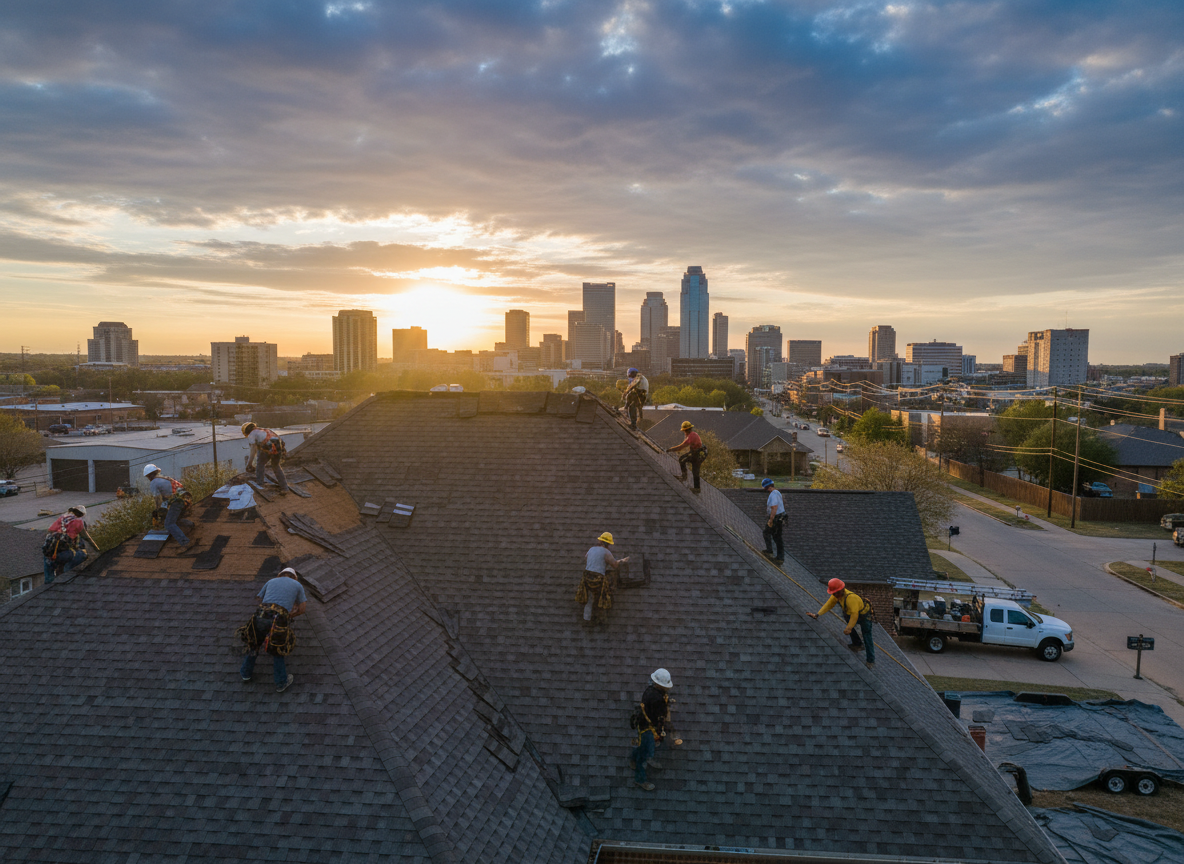
North Carolina is the state where a roof's exposure is decided by which end of it you are standing on. The Outer Banks and the southern coast take ocean wind, salt and overwash. The mountains in the west take snow, ice and, in September 2024, a flooding event that changed how the region thinks about water arriving from above and from the ground at the same time. The Piedmont between them, from Charlotte through the Triad to Raleigh, takes hail, severe thunderstorms and the red clay that moves under a house when the water table changes.
That range is why roof repair in North Carolina cannot be a single service description. A metal roof on a mountain cabin, a shingle roof on a Charlotte subdivision house and a low-slope roof on a Wilmington commercial building are three different assemblies with three different failure patterns. This page sets out the exposures, the coverings the state uses, the services available, the cities covered and how the work runs. If water is coming in, call (833) 406-0167 and describe where it appears.
The coast: wind, salt and a low, flat shoreline
The Outer Banks are a chain of low barrier islands, and a roof there is exposed in a way that an inland roof never is. Wind arrives unobstructed, salt is carried in the air, and overwash from a storm can put salt water against the lower parts of a building. Roofs on the Banks are inspected at the edges, the fasteners and the penetrations first, because that is where the exposure does its work.
Further south, Wilmington and the Cape Fear coast have their own reference storm. Hurricane Florence in 2018 stalled near the coast and produced extreme rainfall across the region, and the roofing consequence was less about wind than about water volume: valleys, gutters, drains and every penetration that had been marginal for years.
The mountains: snow, ice and steep pitches
Western North Carolina builds steep roofs, because a steep pitch sheds snow and because the architecture suits it. The covering is usually metal — standing seam on newer houses, profiled panels on older ones — with shingle on a large share of the valley and foothill housing. Ice is the recurring problem: water melts during the day, runs into a lap or behind a flashing, and refreezes at night. Over a winter the joint opens.
The September 2024 flooding in the mountains, driven by the remnants of a hurricane that came ashore far to the south, was a reminder that water is not always the roof's only problem in the west. Landslips, undermined footings and saturated ground moved houses and their roofs, and repairs in the region have since had to consider the structure below the roofline as well as the covering.
The Piedmont: hail, wind and red clay
Charlotte, Concord, Gastonia, Hickory, Winston-Salem, Greensboro, Durham, Chapel Hill and Raleigh sit in a band that gets frequent severe thunderstorms. Hail falls in swaths, so two houses on one street can carry different damage from the same cell, and the National Weather Service classes a stone an inch across as severe. At that size the mat under a shingle can be bruised without the surface breaking, and the slow failure that follows is easy to miss.
Wind from the same storms lifts ridge caps and edge tabs and drives rain under the windward shingles. And the Piedmont's red clay moves with moisture, which shows up on a roof as a crack along a wall junction, a chimney that has rotated slightly, or a ridge that has opened along its length.
Winter across the middle of the state
Ice is not confined to the mountains. A Piedmont ice storm coats the covering, fills the gutters and freezes at the eaves, where an ice dam holds meltwater against the deck until it finds a way inside. Those events are infrequent enough that a house can go a decade without one, which is exactly why the damage they do tends to be discovered late.
Roof coverings used in North Carolina
Shingle on the Piedmont and the coast
Architectural asphalt shingle covers the majority of the state's housing, from brick ranches to new subdivision build. It ages from both sides here: sun and heat on the surface, attic heat and humidity underneath. The visible signs are granule loss, cupping and a flat colour, but the more useful test is at the edges, where wind takes its first grip.
Metal in the mountains
Metal roofing dominates the mountain counties and is common on farms and rural property across the state. Standing seam with concealed fixings is the usual choice on new build, and the details that matter are at the valleys, the penetrations and the snow guards, not in the panel itself.
Brick veneer and the masonry detail
Brick is the standard wall on a large share of North Carolina houses, which makes every roof-to-wall junction a masonry detail. There is no siding to tuck a flashing behind, so a repair has to be cut into the brick and counter-flashed rather than dressed over the surface.
Coastal and low-slope assemblies
On the coast, elevated houses and condominium buildings use standing seam metal, low-slope membranes and, on some properties, tile. Low-slope assemblies also cover commercial buildings and flat-roofed additions throughout the state, and they fail at seams, drains and penetrations rather than in the field.
Older and manufactured housing
A meaningful share of the state's housing is older wood-frame or manufactured, often with a low pitch and a covering that has been replaced once already. Opening those roofs is where the deck condition, the previous flashing work and the real scope of a repair become visible.
The thirteen services, read against North Carolina's three exposures
The same thirteen services are offered everywhere in the state. What changes is which of them a roof needs, and that follows the exposure rather than the postcode.
On the coast
Wind and salt decide the order of work. Emergency roof repair closes an opening after a system passes and records it before anything moves. Emergency roof tarping holds the roof while materials or weather are against you, and it is tied rather than adhered. Metal roofing on coastal property is largely about fasteners and seams, because corrosion reaches them before it reaches the panel face. Roof inspection after a named storm starts at the perimeter.
In the Piedmont
Hail and thunderstorm wind set the agenda. Storm and hail damage repair is a slope-by-slope record that separates impact marks from wear. Roof leak repair follows water back from the stain, which on brick housing often means a wall junction rather than a shingle. Shingle roofing covers patching, full slopes and the ventilation correction that stops a roof ageing from underneath.
In the mountains
Ice, snow and steep pitches change what a repair is. Roof installation here is a snow-shedding specification. Roof repair is valley, penetration and flashing work on a pitch that has to be worked carefully. Roof replacement on a steep metal roof is a panel and fastening job as much as a covering job.
Statewide
Roof replacement is decided by age, storm history and the number of earlier repairs, and tear-off is where the deck and the wall connection become visible. Tile roofing is a small share of the market, concentrated on coastal and resort property. Flat roof repair is seam, drain and penetration work on commercial buildings and flat-roofed additions. Roof coating extends a sound low-slope roof but cannot dry a wet one.
What a repair on a North Carolina roof includes
The assessment comes first and covers the attic as well as the covering, with photographs of the failed detail and the field around it. The scope is written in parts — covering, underlayment, deck, flashing — so that each can be agreed or declined. Where the covering is opened the deck is examined, and on brick housing the flashing is cut in and counter-flashed instead of dressed over the surface. Fasteners are swept up at the end, and the finished work is walked through with the photographs.
North Carolina cities and metro areas covered
Coverage in North Carolina includes Charlotte, Concord, Gastonia, Huntersville, Mooresville, Hickory, Asheville, Hendersonville, Boone, Blowing Rock, Waynesville, Sylva, Winston-Salem, Greensboro, High Point, Burlington, Durham, Chapel Hill, Raleigh, Cary, Apex, Fayetteville, Southern Pines, Wilmington, Leland, Jacksonville, New Bern, Greenville, Rocky Mount and the Outer Banks.
These are coverage areas, not offices. The company is headquartered in Oklahoma City, Oklahoma, and works across North Carolina from that base. The exposure changes with the address: an Outer Banks roof is judged on wind and salt, a Raleigh roof on hail and storm wind, an Asheville roof on ice, snow and the ground beneath it.
The sequence of a repair, from enquiry to handover
Enquiry. The symptom, when it began and what covers the roof are recorded first. That decides whether the job is urgent, routine or a question that can be answered before anyone climbs.
Survey. The roof is walked where it is safe and the attic is inspected from below. Photographs document the failed detail, the surrounding field and the soft metals, and in the mountains the valleys and penetrations are examined for ice damage as well as water.
Scope. What is removed, replaced, reused and left alone, set out in parts. Where there is a genuine choice between a sectional repair and a replacement, both are described rather than one being recommended in the abstract.
Build. Materials arrive before the covering is opened, the deck is checked as it appears, and anything found underneath is reported before it is covered over again. Storm jobs photograph the damage before removal.
Handover. The repair is reviewed on site, the photographs are handed across, and the roof is checked for fasteners and debris. Anything noted but not repaired is written down for the next decision.
Trees, wind and the debris problem
North Carolina is heavily wooded, and a large share of the roof damage reported after a storm is not wind damage at all in the ordinary sense. It is the consequence of a tree: a limb through a deck, a branch stripping the covering from a slope, or a trunk that has taken the ridge and part of the structure with it.
That changes the assessment. A roof that has lost shingles to wind is a covering repair. A roof that has taken a limb is two problems, because the impact that removes covering can also crack a rafter, puncture the sheathing or move the structure the roof is fixed to. The visible repair is the smaller half of the work, and the check underneath is what decides how it is built.
Debris has a slower effect as well. Needles, leaves and small branches collect in valleys, behind chimneys and against any change of pitch. They hold water against the roof long after the rain has passed, they block the drainage that the roof depends on, and over a season they turn a sound detail into a damp one. In the pine country this is the ordinary maintenance item that decides whether a valley lasts.
The mountain flooding of September 2024 added a third category. Where ground saturated and slipped, buildings moved, and a roof repair on a structure that has shifted is work done in the wrong order. That assessment belongs before any covering is ordered, not after.
For a homeowner the practical version is simple: after a wind event, look for what the wind did at the edges; after a tree event, look underneath as well as on top.
The rest of the region
North Carolina is one of eight states in the Southeast region, and the shared hurricane and humidity exposure is described on the region page. Every state we cover is listed on the state index.
- Roof repair in Florida
- Roof repair in Georgia
- Roof repair in Alabama
- Roof repair in South Carolina
- Roof repair in Tennessee
- Roof repair in Mississippi
- Roof repair in Louisiana
- Southeast region overview
Talk to a roofer about a North Carolina roof
Wind on the coast, hail in the Piedmont and ice in the mountains each leave a different mark, and the repair that follows should match the cause. Call (833) 406-0167, describe what you are seeing and where it appears, and the first step is identifying which of the state's exposures is doing the damage.
Around North Carolina
We regularly work near:
- 📍Cape Hatteras National Seashore
- 📍Great Smoky Mountains National Park
- 📍Blue Ridge Parkway
- 📍Pisgah National Forest
- 📍Biltmore Estate
Roof Repair in North Carolina — Local Notes
- •The state has three distinct exposures: barrier-island wind and salt, Piedmont hail, and mountain snow and ice.
- •Brick veneer is the standard wall across much of the state, so flashings are masonry details.
- •Steep metal roofs dominate the mountain counties; shingle covers most of the Piedmont and coast.