Mississippi gets wet, and it gets wet in a way that a roof notices. The state sits in the humid subtropics with a Gulf coastline, a pine belt across the south and centre, and the flat agricultural country of the Delta in the north-west. Rain arrives in heavy convective bursts through a long warm season, and the roof is asked to move a large volume of water quickly and then dry out in air that is itself close to saturation.
Then there is the wind. The coast has the hurricane record, including Camille in 1969 and Katrina in 2005, and the interior has a tornado record that includes the March 2023 storm that struck the Delta. Roof repair in Mississippi is therefore mostly about water management and wind resistance, with a foundation problem underneath that shows up at the roofline. This page covers the weather, the coverings the state uses, the services available, the cities covered and how a repair runs. If water is already coming in, call (833) 406-0167 and describe where.
The coast: surge, wind and salt
The three coastal counties hold the state's densest concentration of wind exposure. Biloxi, Gulfport, Bay St. Louis, Long Beach, Pass Christian, Ocean Springs and Pascagoula have all been rebuilt after named storms, and the roofing stock reflects it: newer houses elevated, newer roofs detailed to resist uplift, and a lot of standing seam metal where the exposure justifies it.
Salt is the constant. It attacks fasteners, vents and the cut edges of metal panels long before the covering shows wear, and it does it fastest on the seaward elevation. A coastal roof that is inspected only for missing shingles will miss the corrosion that eventually lets water in at a penetration.
Storm surge is a separate matter from the roof, but it decides what a roof repair is worth. A house that has taken water to the wall plate has a structural question before it has a covering question, and the order of work matters.
Rain: the defining exposure
Mississippi is one of the wetter states in the country, and the practical consequence is that a roof's drainage is judged as hard as its covering. A summer thunderstorm can deliver a large volume in under an hour, and the roof's weakest points under that load are the valleys, the gutters, the downspouts and the drains on any low-slope section.
Where a valley cannot carry the volume, water backs up under the covering and enters at the deck rather than through a hole. Where a gutter is undersized or blocked, water goes behind the fascia. Neither is a covering failure in the ordinary sense, and neither is fixed by replacing shingles.
Heat, humidity and what grows
The warm season is long, and humidity stays high through most of it. An attic that cannot move air will hold moisture against the underside of the deck, and the covering above ages from both sides. Moss and algae establish on the shaded slopes, and in the pine belt the needles that collect behind a chimney or in a valley hold water against the roof long after the rain stops.
Wind inland: the Delta and the pine belt
The north-west Delta is flat and open, and wind crosses it without obstruction. Straight-line wind from thunderstorms lifts ridge caps and edge tabs, and tornadoes in the region have produced the kind of damage that removes a roof's covering entirely along a narrow path. The March 2023 tornado through the Delta is the reference event for many homeowners in that part of the state.
In the pine belt, wind damage often arrives with debris: limbs, needles and whole trees. A limb that punctures a deck is a different repair from a limb that strips shingles, and the two are frequently found on the same roof after the same storm.
Yazoo clay and the roofline
Central Mississippi builds on expansive clay, and the movement that follows is one of the state's distinctive housing problems. A house on a footing that moves will show it at the roof-to-wall junction, at the chimney and along the ridge. Cracks that follow the line where the roof meets a wall, or a chimney that has rotated away from the slope, are usually movement rather than covering failure.
Sealing those cracks without addressing the movement produces a repair that fails in the same place within a season. The durable answer is a flashing that is cut into the wall and detailed to accommodate movement, and a note on the record that the movement is being monitored.
Roof coverings on Mississippi houses
Shingle over brick or wood frame
Architectural asphalt shingle covers the majority of the state, on brick veneer houses, wood-frame homes and new subdivision build. It ages from both sides in this climate: sun and heat above, attic heat and humidity below. The visible signs are granule loss, cupping and a colour that has gone flat.
Metal on the coast, the farm and the pine belt
Metal is common on agricultural buildings, rural houses and a growing share of coastal property. Profiled panels dominate the older stock and standing seam appears on newer work, where concealed fixings and a designed fastening pattern suit the uplift exposure better.
Elevated coastal construction
On the coast, elevated houses and condominium buildings use standing seam metal, low-slope membrane assemblies and, on some properties, tile. The fixing pattern and the corrosion resistance of the fasteners matter more than the appearance of the covering.
Low-slope and commercial
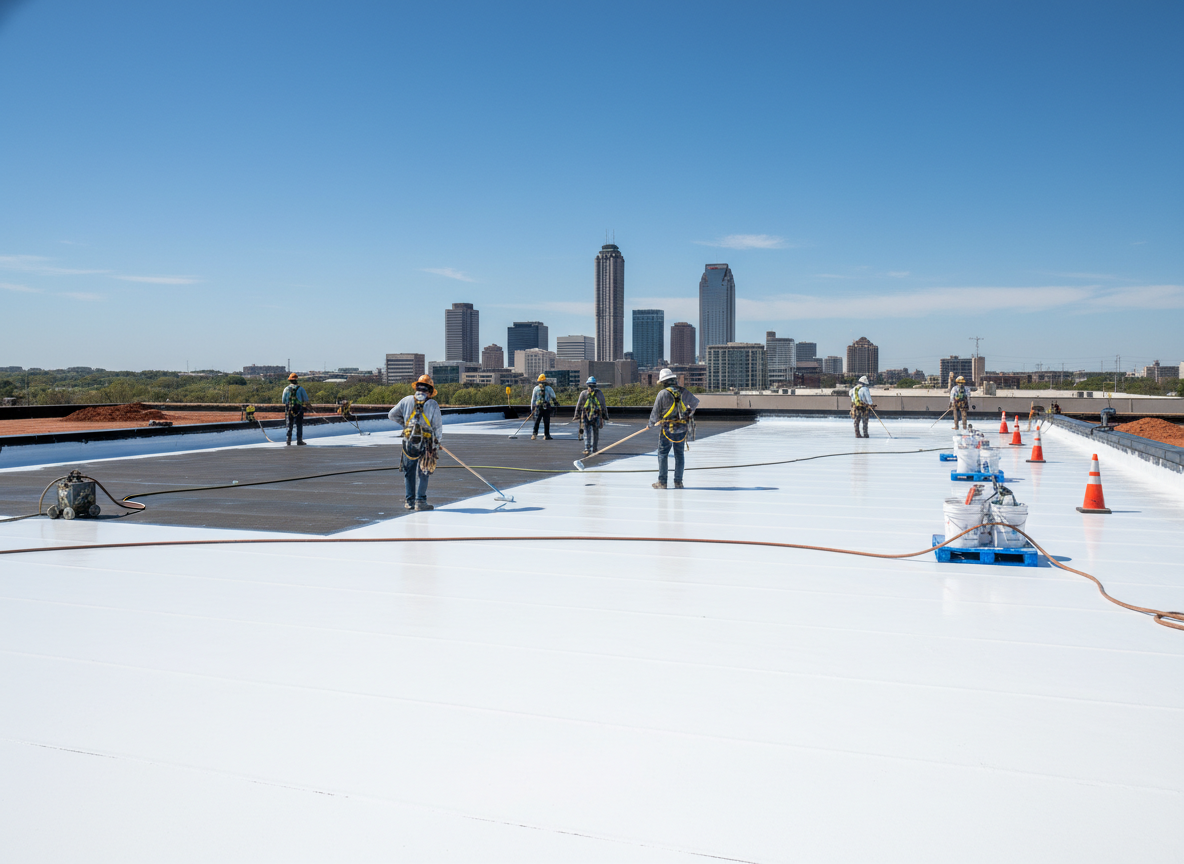
Downtown commercial buildings, schools, warehouses and flat-roofed additions use modified bitumen, TPO and EPDM. They fail at seams, drains, scuppers and penetrations, and in a state that gets short intense rain, a drain that cannot move volume becomes a leak in the first storm of the season.
Older housing and re-covered roofs
A large share of Mississippi housing has been re-roofed at least once, often after a storm and often over the existing covering. Those roofs conceal their condition until opened, and the deck, the previous underlayment and earlier flashing work are discovered together.
The thirteen services, one line each, in Mississippi terms
Each of these exists for a reason that is specific to how a Mississippi roof fails. Read together, they describe the order a repair usually takes.
- Emergency roof repair — close the building first, isolate any ceiling at risk, and photograph the opening before anything is moved.
- Emergency roof tarping — hold the roof while materials or weather are against you; battened and tied, never relied on as a covering.
- Roof leak repair — trace from the stain back to the entry, which is often a wall junction, a chimney or a drain rather than a shingle.
- Storm and hail damage repair — a slope-by-slope record separating wind damage from impact and from debris.
- Roof repair — the ordinary failures: ridge caps, pipe boots, step flashing, valley metal, displaced shingles.
- Roof replacement — the decision tear-off confirms, because the deck and the wall connection are only visible once the covering is off.
- Roof installation — specification work: underlayment, ventilation, drainage sized for the rainfall, wind rating on the coast.
- Shingle roofing — patching, full slopes, and the ventilation correction that stops a roof ageing from below.
- Tile roofing — underlayment-led work on the small coastal and custom share of the market.
- Metal roofing — fasteners, seams and coating, with corrosion-resistant fixings on anything within reach of salt air.
- Flat roof repair — seam, drain and penetration work, with ponding treated as a drainage fault.
- Roof coating — for a sound low-slope assembly only; moisture testing comes before any coating is proposed.
- Roof inspection — the written condition record, including the attic side and any movement below the roofline.
What a Mississippi repair includes
An assessment of the roof and the attic before a scope is written, with photographs of the failed detail and its surroundings. A scope that keeps covering, underlayment, deck and flashing in separate parts, so each can be accepted or declined. A deck check wherever the covering comes up, because wet sheathing under an intact shingle is the normal finding after a long leak. Masonry flashings cut into the wall and counter-flashed rather than sealed over. A swept site and a walkthrough with the photographs at the end.
Mississippi cities and metro areas covered
Coverage in Mississippi includes Jackson, Madison, Ridgeland, Flowood, Pearl, Brandon, Clinton, Vicksburg, Meridian, Hattiesburg, Laurel, Petal, Gulfport, Biloxi, Long Beach, Pass Christian, Bay St. Louis, Ocean Springs, Pascagoula, Moss Point, Picayune, Tupelo, Oxford, Starkville, Columbus, Greenville, Cleveland, Clarksdale and Natchez.
These are coverage areas, not offices. The company is headquartered in Oklahoma City, Oklahoma, and works across Mississippi from that base. The exposure changes with the address: a Gulfport roof is judged on wind, salt and surge history, a Jackson roof on rain volume and clay movement, a Tupelo roof on storm wind and hail.
The order of work, from the first call
In practice a Mississippi repair runs in five moves, and the first two decide whether the last three are worth doing.
One: the call. Symptom, timing, covering type, address. An active leak is handled differently from a roof that is simply old, and saying so at the start saves a visit.
Two: the look. The roof is walked where it can be, the attic is inspected from inside, and photographs are taken of the failed detail, the field and the soft metals. On the coast the fasteners and vents join the list.
Three: the scope. What is removed, what is replaced, what is reused, what is left. Where the choice between a section repair and a replacement is genuinely open, both are written down and both are costed in terms of work rather than numbers on the phone.
Four: the work. Materials staged first, deck checked as it opens, additions reported before they are covered. Anything storm-related is photographed before removal.
Five: the close. The repair is reviewed with the owner, the photographs change hands, and the site is swept. Anything found and not repaired is recorded rather than remembered.
What half an hour of rain exposes
A Mississippi thunderstorm does not need to be severe to find a roof's limit. Thirty minutes of heavy rain is enough to show which parts of the assembly were already marginal, and the pattern of what fails is fairly consistent.
The first casualty is a valley. Water arrives from two slopes at once, and a valley that was built for an ordinary rain will back up under the covering when the volume doubles. The stain that follows appears at the ceiling below the valley rather than at the valley itself, which is why the leak is so often mislocated.
The second is the gutter and its outlets. A gutter that is undersized, or that has a downspout blocked by pine needles, fills and then sends water behind the fascia and into the wall. That is not a roof leak in the ordinary sense, but the repair is on the roof's drainage and the diagnosis starts there.
The third is the low-slope section: a porch roof, an addition, a commercial building where a drain or scupper cannot take the flow. Water stands, finds a lap, and the membrane that was sound in dry weather is wet underneath by evening.
The fourth is the penetration. A vent boot that has cracked, a pipe flashing that has lifted, a chimney counter-flashing that has pulled away — each of them holds through ordinary rain and fails when the rain is driven.
The lesson is that a leak reported after a heavy storm is a drainage and detailing question before it is a covering question. Replacing shingles over a valley that cannot carry the water is a repair that repeats itself.
The rest of the region
Mississippi is one of eight states in the Southeast region, and the shared hurricane and humidity exposure is set out on the region page. Every state we cover is listed on the state index.
- Roof repair in Florida
- Roof repair in Georgia
- Roof repair in Alabama
- Roof repair in South Carolina
- Roof repair in North Carolina
- Roof repair in Tennessee
- Roof repair in Louisiana
- Southeast region overview
Talk to a roofer about a Mississippi roof
In Mississippi the roof usually fails for one of two reasons: the water came faster than the roof could move it, or the wind got under an edge that was already tired. Call (833) 406-0167, describe what you are seeing and where it appears, and the first step is deciding which of those happened.
Around Mississippi
We regularly work near:
- 📍Natchez Trace Parkway
- 📍Vicksburg National Military Park
- 📍Gulf Islands National Seashore
- 📍Petrified Forest near Flora
- 📍Tishomingo State Park
Roof Repair in Mississippi — Local Notes
- •Rain volume is the state's defining exposure, so valleys, gutters and drains are judged as hard as the covering.
- •Expansive clay in central Mississippi shows up as movement at roof-to-wall junctions and chimneys.
- •Coastal roofs need corrosion-resistant fasteners, not just a wind-rated covering.