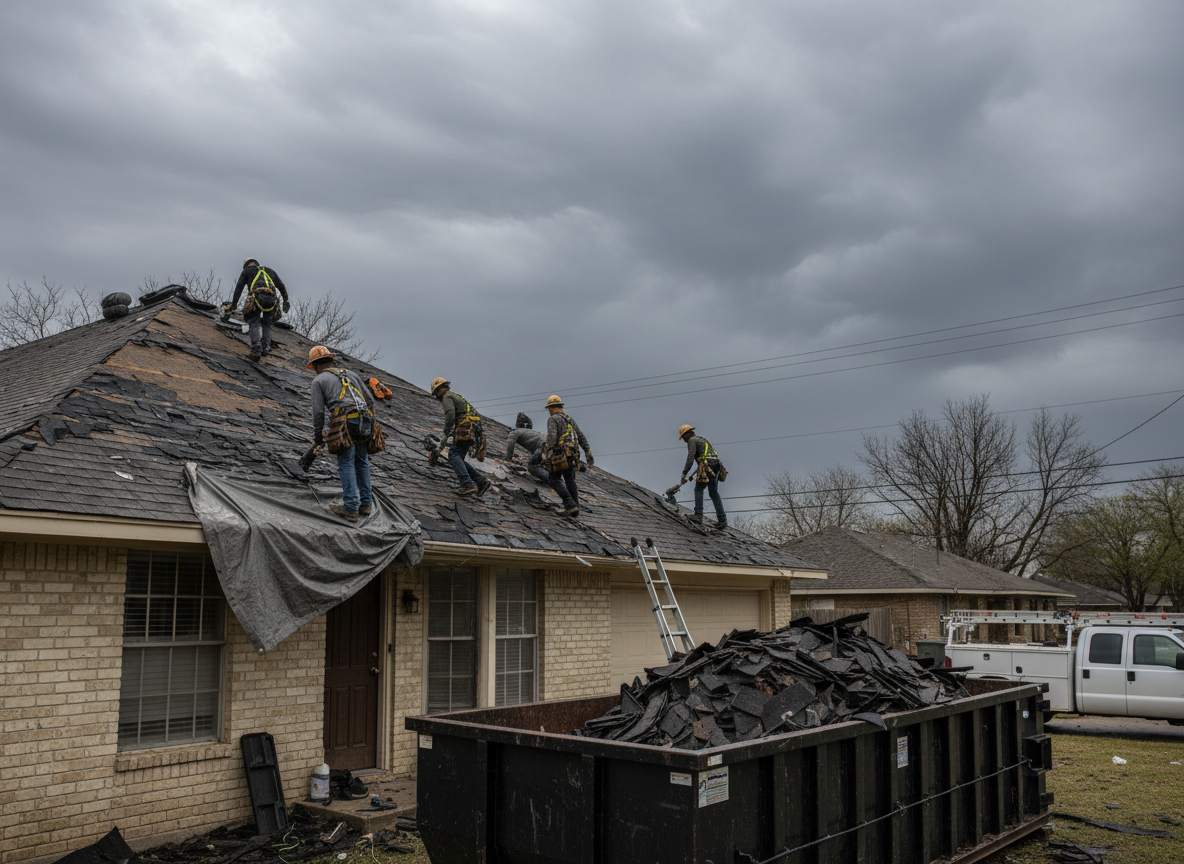
Florida gives a roof two different kinds of year. From the first week of June until the last week of November the state sits inside hurricane season, and any week in that stretch can bring a named system, a tropical depression or a training band of thunderstorms that parks over one neighbourhood for an hour. From December to May the pressure arrives from the other direction: clear sky, strong sun, warm air holding water, and a slow bake working on sealant, coating and the layer underneath the tile.
A repair written for one half of that year is usually wrong for the other. A storm repair that re-secures an edge while the underlayment beneath it is at the end of its life will be back in the same place after the next blow. A leak chased in February, when the roof is dry and the attic is at its coolest, can look solved until the first afternoon storm of summer pushes water sideways into a wall. The sections below follow the order the work is actually approached in: which route the wind or the water is using, what the code demands of the assembly, how each covering fails on this coast, what the repair consists of, and how a job runs from the first call. If water is inside the house now, call (833) 406-0167 and say where it is showing and when it began.
Four ways wind and water get past a Florida roof
Pressure at the perimeter, where storm damage begins
A roof under a hurricane is loaded from both faces. Air forced under the deck pushes upward while flow across the surface pulls away, and the widest gap between those two forces sits at the rake, the eave, the ridge and the corner returns. Damage therefore starts at an edge far more often than in the middle of a slope, and a roof can pass a look from the driveway while its drip edge has already lifted a few millimetres.
The practical consequence is that a storm assessment is a search for the first failure. Tabs that have lifted but not split can sometimes be re-adhered. Where the sealant strip has cracked through, the tab will not hold again, and a single missing cap at the end of a hip is usually the visible end of a fastening run that has worked loose along its whole length.
Rain pushed at the wall instead of dropped on the roof
Much of the water that enters a Florida house never touches the field of the roof. A squall line drives rain almost horizontally, and the pressure differences around a building draw it into window heads, stucco cracks, the junction where a porch roof or screen enclosure meets the wall, vent stacks and the tops of sliding door frames. The roof can be watertight while the house still takes water.
This is the most frequently misread leak in the state. A stain blooms on a ceiling close to an exterior wall, someone looks at the slope above it, finds sound covering, and proposes work in a place that was never wet. The detail at that elevation is what failed, and the repair belongs there.
Sun and heat, working on the materials between storms
Ultraviolet light is the slow agent. It oxidises the asphalt in a shingle until the surface chalks, dulls and eventually powders a painted metal finish, and hardens mastic and sealant until they crack instead of stretching. The deck below gets its own version of the same treatment from attic heat, so a roof cooked from underneath ages faster than its exposure from above would suggest.
Inland Florida adds a daily rhythm to this. Summer thunderstorms build through the afternoon, deliver a large volume of rain in a short window and are gone; what fails is the valley, gutter or scupper sized for gentler rain. Microbursts inside the same storms leave small patches of damage that look tornadic and are often described that way, and a lightning strike at a ridge or chimney detail can start something small that only shows later as charred framing.
Humidity, algae, and damp with nowhere to go
The dark streaks on a north or west slope are algae feeding on the limestone filler in asphalt shingles. They travel on air, settle where shade lasts longest, and are a cosmetic problem rather than a structural one. Lichen and moss are a different matter: they hold water against the covering, work beneath the exposed edge of a shingle as they spread, and keep the sheathing damp long after the surface has dried.
Where an attic cannot exchange air, the same humidity condenses on the underside of the deck and runs down to appear as a leak with no entry point above it. Replacing the stained ceiling board without dealing with ventilation, or with the leak feeding that moisture, means doing the same job again next wet season.
What Florida requires of the assembly
Approved products, and the repair treated as a system
Florida operates a statewide approval process for roof coverings and their components. A product placed on a Florida roof has to be approved for the use and installed in the manner its approval describes. That test bites harder at a partial repair than at a full replacement: a covering that looks identical to what is already up there is not automatically interchangeable with it, because the difference between two products is measured in testing and documentation rather than in appearance.
Miami-Dade and Broward: the stricter wind zone
Those two south-eastern counties sit inside the High-Velocity Hurricane Zone. Coverings and components there are approved for that zone specifically, and installation has to follow an approved system with a stated fixing pattern and fastener schedule. A repair inside the zone is treated as seriously as a new roof, since a patch outside the approved assembly lowers the rating of the material around it.
Across the rest of the state the wind provisions of the Florida Building Code still govern how the assembly is designed, and coastal counties carry exposure conditions that inland counties do not. Requirements for permits, inspections and sign-off are handled locally and differ between cities and counties.
Records a homeowner can actually use
Insurers in Florida ask for wind mitigation detail, and everything that matters is physical: how the roof structure is tied to the wall, how the sheathing is fastened, whether a secondary water barrier sits below the covering, and what the covering is made of. A condition record built around those four items is worth more than a general report, because an underwriter can read it as readily as a roofer can.
The certificate that follows an inspection attaches to the installation rather than to a company, so it is worth confirming what a particular address will need before work is booked.
The coverings, and how each one fails here
Tile: a wear layer over a waterproof layer
Clay and concrete tile cover a large part of the Florida roofscape, most heavily in the south and along the Atlantic and Gulf coasts. The material outlives the waterproofing beneath it by decades, which is the single most useful fact about it. Tile takes the sun and sheds most of the rain; the underlayment below is what keeps the interior dry, and it ages out of sight on its own timetable.
An old tile roof can therefore be flawless to look at and finished as a roof. Where a ceiling stains beneath a tile field with no cracked, slipped or displaced tile above it, the underlayment is the first thing to examine, and the answer is usually a tile uplift and relay rather than new tile.
Metal, salt air and thermal movement
Profiled 5V crimp panels are common on older houses, workshops and agricultural buildings, while standing seam with concealed fixings appears on newer custom homes and on coastal builds where the wind exposure justifies it. Salt carried on onshore wind attacks fastener washers, vent collars, valley metal and cut edges before the panel face shows anything, and it does so fastest within a few miles of the beach.
Metal also moves. Panels expand and contract across the day, and every fixing and flashing detail has to accommodate that travel. A fastener driven hard against a panel that then grows in the sun will either back out or enlarge its own hole, and that is where a metal roof begins to leak.
Shingle through the interior and the north
Laminated asphalt shingle covers most inland and northern Florida housing, from mid-century block homes to recent subdivision build, and it is the covering most storm repairs involve. Its enemies here are heat from above, attic heat from below, algae on shaded slopes and wind at the edges. Impact damage is less common than on the plains, though spring squall lines do produce hail and wind-borne debris delivers its own version of the same damage.
Flat and low-slope assemblies
Membranes cover commercial property, condominium buildings and the flat-roofed additions made to many older houses. They fail at seams, drains, scuppers and penetrations rather than in the middle of the field, and standing water is usually involved. In Florida the extra pressure is thermal and biological: heat cycling opens laps, and organic growth holds moisture against the surface.
Repair work, grouped by what it has to achieve
Make the house dry tonight
Emergency roof repair comes first when a storm has opened the roof. The immediate tasks are to stop water reaching the interior, to make the area safe to inspect, and to photograph the opening before anything is moved. In Florida that frequently means re-securing an edge or a ridge that has lost its covering, containing a ceiling that is close to failing, and isolating the rooms below it.
Emergency roof tarping is the temporary layer for a roof that cannot be worked safely or is waiting on material. Adhesive-backed sheets give up quickly in Florida heat and wind, so the sheet is fixed mechanically with battens, and the battens are set where they will not rub through the shingles that are still sound.
Trace the water back to the detail that let it in
Roof leak repair begins indoors at the wet point and works outward to the failed detail. Water follows rafters, battens and top plates, so the opening is rarely directly above the stain. An attic inspection and moisture readings narrow the field, and a controlled water test is used where conditions allow, so the entry is confirmed before anything is opened.
Storm and hail damage repair is a directional survey in Florida: edges, ridge and hip caps, vents, valleys and each slope recorded separately, so that wind damage, impact damage and old wear are not merged into a single verdict. That separation is what makes a later claim or repair decision legible.
Restore the covering that is already on the roof
Shingle roofing covers repair, replacement and the correction of failed detail on a roof that is otherwise sound. The questions are the wind rating of the product, the state of the deck underneath, and whether the attic above it can dry itself between storms.
Tile roofing is mostly work beneath the tile, plus careful handling of the tile itself. Sections are lifted, numbered and stacked so they can go back in order, the old membrane is stripped, soft sheathing is replaced, new underlayment goes down with the laps the slope requires, and the field is re-laid with broken pieces swapped out and hip and ridge tiles reset.
Metal roofing covers fastener replacement on profiled panels, seam and flashing work on standing seam, and recoating where salt and sun have taken the finish. Because panels move, fixings and flashings are detailed to allow that movement rather than to resist it.
Flat roof repair is seam, drain and penetration work. Ponding is handled as a drainage question before it is treated as a membrane question, since a sheet that stays under water will fail at its laps however well they were closed.
Roof coating can add years to a sound low-slope assembly and cut heat gain into the rooms below, but it cannot rescue a wet one. Moisture testing and surface preparation decide whether a coating belongs on a particular roof at all.
Weigh a section against the whole roof
Roof repair covers the ordinary failures: a slipped tile, a split pipe boot, valley metal corroded through, a ridge cap lifted by wind, counter-flashing pulled away from a stucco wall. The aim is to put the detail back to doing what it was designed to do, rather than to bury it in sealant.
Roof replacement is usually decided in Florida by storm history, the age of the underlayment and how much of the roof has already been patched. Tear-off is the point at which the deck and the roof-to-wall connection are exposed, which is where the wind rating of the assembly is either confirmed or found wanting. Secondary water barrier, underlayment and ventilation are settled at the same time, because none of them can be reached once the covering is back down.
Roof installation puts the risk into the specification: product approval for the address, uplift resistance for the exposure, and a fixing pattern that matches the approved system. What goes under the tile or the shingle is what decides how the roof behaves a decade later, long after the visible layer has been judged.
Put the roof's condition on paper
Roof inspection produces a condition record: covering, underlayment where it can be seen, flashing, penetrations, drainage, the attic side, and photographs of each. It is the document that lets a homeowner choose between repair and replacement, and the one that makes a storm claim readable a year later.
What a Florida scope puts in writing
A scope here is built in layers, because the parts of a Florida roof fail on different schedules and get confused with one another inside a single lump description.
- The route the water took, traced from the interior stain or the damaged edge back to the detail that failed, with photographs of that detail and of the field around it.
- A separation of the work into its parts — covering, underlayment, sheathing repairs, flashing — so that a membrane replacement is never quietly invoiced as a tile repair, and nothing appears at the end that was not agreed at the start.
- The deck, opened and looked at. Soft sheathing beneath a sound tile field, or under a shingle roof that has leaked slowly for a season, is common and only becomes visible with the covering off.
- Flashing rebuilt rather than coated where a detail has gone at a stucco wall, a chimney, a valley or a change of pitch.
- The wind-zone system named where the address sits inside the High-Velocity Hurricane Zone, including the fixing pattern the repair will follow.
- A closing walk with the photographs in hand, a magnet sweep of the working area for fasteners, and a written note of anything found and left alone.
From the first call to the handover
First contact. You describe what the roof is doing — a stain that spreads, tile in the yard, granules in the gutter, a ridge cap missing, a ceiling starting to sag — and roughly when it began. The address and the covering are confirmed, and the call is sorted: active water and a maintenance question are not the same job and are not scheduled the same way.
The visit. The roof is walked where walking it is safe, and the attic is inspected from inside. Photographs cover the failed detail, the surrounding field and the soft metals. On tile, the assessment stays at the surface unless the evidence points below it, because opening a tile field is a commitment rather than a look.
The scope. The repair is set out in parts: what comes off, what goes back, what is reused, what is left alone. Where there is a real choice — a section against a slope — both are described rather than one being assumed.
The work. Material is staged, the deck is examined as it is exposed, and anything further found is reported before it is closed up. Storm work is ordered so that the documentation photographs happen before damaged material is removed, and it is sequenced around the forecast, with temporary protection where a repair cannot be finished in one visit.
The handover. The finished roof is reviewed with you, the photographs change hands, and the roof is checked for fasteners and debris. Whatever was found and not repaired goes into writing, so the next decision starts from a record rather than a recollection.
Where the work is carried out in Florida
The state is covered from the Keys north to the Panhandle, including Miami, Fort Lauderdale, Hollywood, Boca Raton, West Palm Beach, Jupiter, Port St. Lucie, Vero Beach, Melbourne, Palm Bay, Orlando, Kissimmee, Lakeland, Tampa, St. Petersburg, Clearwater, Sarasota, Bradenton, Fort Myers, Cape Coral, Naples, Ocala, Gainesville, Daytona Beach, Jacksonville, St. Augustine, Tallahassee, Pensacola, Fort Walton Beach, Panama City and the Space Coast.
That list describes travel coverage rather than branch locations; the business is based in Oklahoma City, Oklahoma, and reaches Florida from there. What changes from one metro to the next is the exposure a roof is judged against. A Broward address is assessed inside the hurricane zone and against its approved systems, a Tampa address against rain driven in from the Gulf and a daily summer storm, and an Orlando address against heat, humidity and the condition of the deck under the covering.
Florida within the wider coverage
Florida belongs to the eight states grouped as the Southeast, where hurricane wind and warm, wet air are the shared conditions; the region page sets out how those pressures shift from one state to the next. Every state covered is listed on the state index.
- Roof repair in Georgia
- Roof repair in Alabama
- Roof repair in South Carolina
- Roof repair in North Carolina
- Roof repair in Tennessee
- Roof repair in Mississippi
- Roof repair in Louisiana
- Southeast region overview
Talk to a roofer about a Florida roof
The useful questions about a Florida roof are rarely answered from the street. Whether an edge has begun to lift, whether the membrane under a tile field is finished, and whether a stain is fed by rain pushed at a wall are three separate findings, and each leads to different work. Call (833) 406-0167 with a description of what the roof is doing, and the conversation starts by working out which of those findings applies.
Around Florida
We regularly work near:
- 📍Everglades National Park
- 📍Biscayne National Park
- 📍St. Augustine Lighthouse
- 📍Sunshine Skyway Bridge
- 📍Florida Caverns State Park
Roof Repair in Florida — Local Notes
- •On a tile roof the membrane beneath the tile is the waterproofing; the tile above it is only the wear layer.
- •Rain driven at wall junctions, window heads and stucco cracks gets in without any opening in the field of the roof.
- •Miami-Dade and Broward sit in the High-Velocity Hurricane Zone, where coverings and components are approved for that zone.
- •Salt carried on onshore wind reaches fasteners and cut edges long before a metal panel face shows wear.