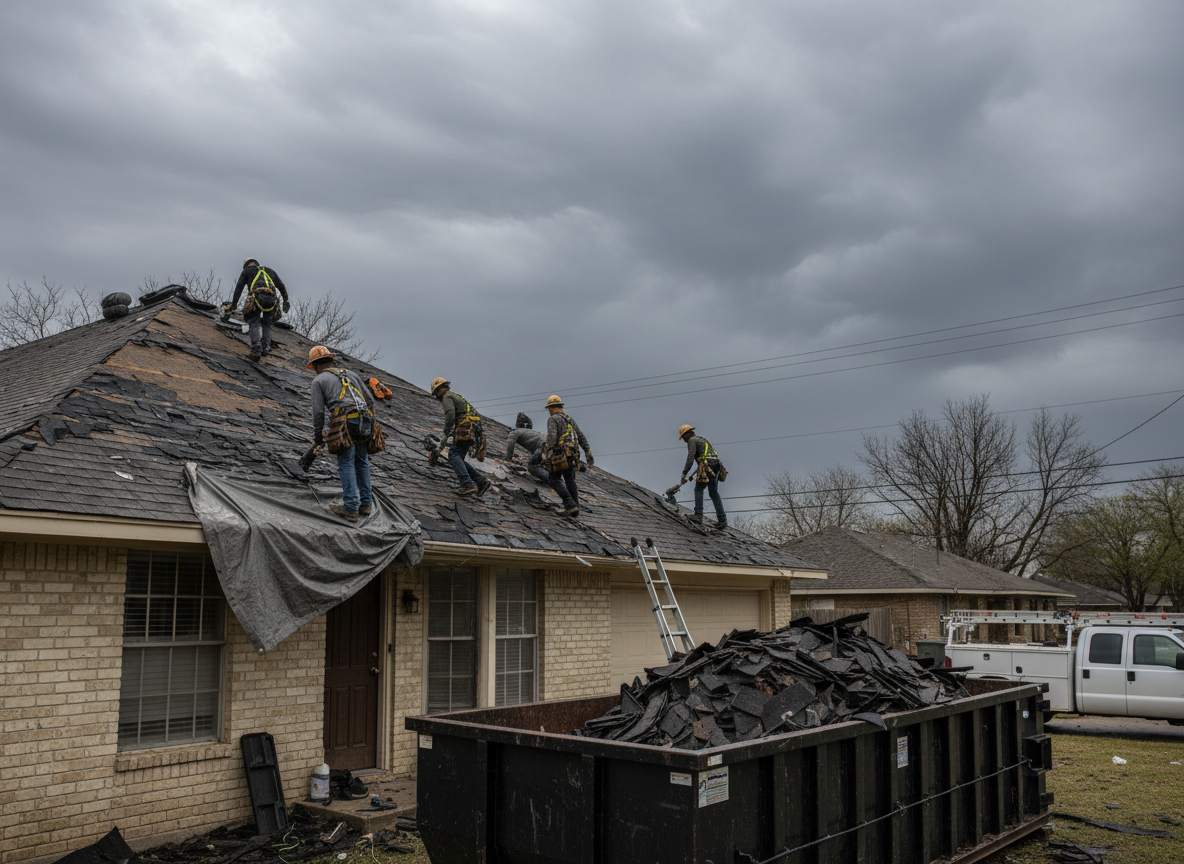
Georgia roofs are damaged in two directions at once, and the difference shows up in the repair. From the coast at Savannah and Brunswick, tropical systems push rain horizontally into walls and drive wind under the edges. Inland, from Atlanta up through the Piedmont and into the mountains, the damage arrives vertically as hail and wind, then sits and rots because the state stays humid for most of the year.
The other Georgian factor is under the roof rather than on it. Red clay soil moves with moisture, brick veneer walls crack at their joints, and a chimney that has leaned a fraction of an inch opens the flashing around it. Roof repair in Georgia therefore involves reading the house as well as the covering. This page covers the weather, the roof types the state's housing actually uses, the services available, the metros covered, and how a job runs from the first call. If water is coming in now, call (833) 406-0167 and describe where it appears.
What Georgia weather does to a roof
Summer storms are the main event
Georgia's thunderstorm season is long and its storms are heavy. A summer cell can drop a large volume of rain in under an hour, and the roof is judged on whether its valleys, gutters and downspouts can carry that volume away before it backs up under the covering. Straight-line wind from the same storms lifts ridge caps and edge shingles, and every few years a downdraft does damage along a path that looks exactly like a tornado track.
Because the storms are frequent rather than spectacular, damage accumulates in small increments. A shingle lifted and re-sealed by the next hot day is invisible until the seal fails for good, and by then the tab has usually cracked.
Hail belongs to the north of the state
Hail in Georgia is concentrated across the northern third: the Atlanta metro, the Piedmont north of it, and the ridge country toward the Tennessee line. The National Weather Service treats a stone one inch across as severe, and stones of that size can bruise the mat of an asphalt shingle without breaking the surface. North Georgia also sees the larger events, when a supercell tracks for fifty miles and leaves a swath of impact damage that crosses several counties.
The consequence is that two houses on the same street can carry very different damage, because hail falls in swaths rather than evenly.
The mountains bring ice, not just snow
In the north Georgia mountains around Blue Ridge, Ellijay, Dahlonega and Clayton, winter arrives as ice more often than as deep snow. Freezing rain coats the covering, then melts into the laps and refreezes at the eaves, where an ice dam holds meltwater against the deck until it finds a way inside. The damage is rarely visible from the ground and almost always shows up first as a stain on the ceiling below an eave.
The coast and the tropical track
Savannah and the barrier islands sit in the path of Atlantic systems, and the state as a whole has been crossed by hurricanes that made landfall elsewhere. The 2018 storm that came ashore in the Florida Panhandle and tracked north-east across south-west Georgia as a hurricane is the reference point for many homeowners in Albany and the surrounding counties: a reminder that inland Georgia is not sheltered from a landfall.
Red clay, movement, and the chimney problem
Piedmont soil expands and contracts with the water table, and a house on a shallow footing will move with it. Roofs show that movement at the junctions: a crack that follows the line where the roof meets a brick wall, a chimney that has rotated slightly away from the slope, a ridge that has opened along its length. None of those is a covering failure, and re-sealing them without addressing the movement is a repair that fails in the same place within a season.
Roof types on Georgia houses
Brick veneer and the ranch house
The dominant Georgia house is a single-storey or split-level ranch in brick veneer with an architectural shingle roof, built between the 1950s and the 1990s. The brick changes how flashings work: there is no siding to tuck a membrane behind, so every wall junction, chimney and porch roof intersection is a masonry detail that has to be cut, sealed and counter-flashed.
Shingle, and how it ages here
Architectural asphalt shingle covers most of the state, and it ages from both sides in this climate: sun and heat above, attic heat and humidity below. The visible signs are granule loss, cupping at the tabs and a colour that has gone flat, but the more useful measure is how the shingle behaves at the edges, where wind gets its first grip.
Metal on farms and in the mountains
Metal roofing is common on agricultural buildings and rural houses, and increasingly on mountain cabins and custom homes where snow and ice shedding matters. Profiled panels dominate the older stock; standing seam appears on newer work, and on the mountain houses the choice is usually driven by ice rather than by heat.
Historic districts and the older coastal stock
Savannah and Augusta hold large historic districts where the roofs are part of the streetscape: standing seam metal, slate on the churches and public buildings, and clay tile on a smaller number of houses. In these areas exterior changes can require review by a local historic board before work begins, and the review covers materials as well as appearance.
Low-slope and commercial
Downtown commercial buildings, warehouse conversions and the flat-roofed additions on older houses use modified bitumen, TPR and EPDM assemblies. They fail at seams, drains, scuppers and penetrations, and Atlanta's summer storms find any drain that cannot move water fast enough.
Services available across Georgia
Emergency roof repair
A roof opened by wind or a fallen limb needs to be closed before the next storm, and in Georgia the next storm is usually a day or two away. The immediate work is to stop water entering, isolate any ceiling at risk and photograph the opening, so that the permanent repair is planned from evidence rather than recollection.
Emergency roof tarping
Tarping is a holding measure for a roof that cannot be worked safely or is waiting on materials. Because Georgia heat softens adhesive-backed sheets, the tarp is fixed mechanically with battens, and it is treated as temporary from the day it goes on.
Roof leak repair
Leak tracing starts inside at the stain and follows the water back up the roof. On a brick house the entry is often at a wall junction or a chimney rather than in the shingle field, and on a low-slope addition it is usually a seam or a drain. The diagnosis decides whether the repair is a covering repair at all.
Storm and hail damage repair
After a hail event the survey is directional: soft metals first, then ridge caps, vents and valleys, then the field of each slope. Separating new impact marks from weathering and from earlier repairs is the part that matters, because a claim and a maintenance decision need different answers.
Roof repair
Everyday repairs cover lifted ridge caps, cracked pipe boots, failed step flashing at a chimney, valley metal that has rusted through and shingles displaced by wind. The aim is to put the detail back to what it was designed to do, not to bridge it with sealant.
Roof replacement
A Georgia replacement is usually decided by age, storm history and how many repairs the roof has already absorbed. Tear-off reveals the deck, the roof-to-wall connection and the condition of the old underlayment, which is where the decision between repair and replacement is usually confirmed.
Roof installation
New roofs are a specification exercise: underlayment, ice barrier at the eaves for mountain counties, ventilation for a humid climate, and a covering whose wind rating suits the exposure. Those choices are made once and hidden afterwards.
Shingle roofing
Shingle work covers the full range from a patch to a full slope, including the correction of inadequate ventilation and the replacement of failed step flashing at masonry walls.
Tile roofing
Tile is a smaller share of the Georgia market but appears on older coastal houses and on some new build. The work is underlayment-led: the tile is lifted, the membrane replaced and the tile relaid, with broken pieces matched as closely as the available stock allows.
Metal roofing
Metal work covers fastener replacement on profiled panels, seam repairs on standing seam, and the repainting or coating of panels whose finish has chalked. On mountain houses the detailing at valleys and snow guards matters as much as the panel itself.
Flat roof repair
Low-slope repair is seam, drain and penetration work, with ponding treated as a drainage problem first. A membrane that stands under water will fail at its laps regardless of how well they were installed.
Roof coating
A coating can extend the life of a sound low-slope roof and reduce heat gain, but it cannot rescue a wet assembly. Moisture testing decides whether a coating is a repair or a delay.
Roof inspection
An inspection produces a written condition record with photographs: covering, flashing, penetrations, drainage, attic side, and any sign of movement in the structure below. It is the document that makes a repair decision, or a storm claim, legible to someone who was not on the roof.
What's included in a Georgia roof repair
- An assessment of the roof and the attic before a scope is written, with photographs of the failed detail and what surrounds it.
- A written scope that separates the covering, the underlayment, the deck and the flashing, so the invoice matches what was agreed.
- Deck inspection wherever the covering is opened, because soft sheathing under an intact shingle is common after a slow leak.
- Masonry flashings rebuilt rather than sealed, since a brick wall will not hold a bead of sealant the way siding will.
- Cleanup with a magnet sweep for fasteners, and a walkthrough at the end with the photographs in hand.
Georgia metros and cities covered
Coverage in Georgia includes Atlanta, Sandy Springs, Marietta, Alpharetta, Roswell, Johns Creek, Decatur, Douglasville, Lawrenceville, Gainesville, Athens, Augusta, Columbus, Macon, Warner Robins, Rome, Dalton, LaGrange, Newnan, Savannah, Pooler, Brunswick, St. Marys, Valdosta, Albany, Thomasville, Statesboro and Blue Ridge.
These are coverage areas, not offices. The company is headquartered in Oklahoma City, Oklahoma, and works across Georgia from that base. The exposure changes across the state: an Atlanta roof is judged on hail and summer storm wind, a Savannah roof on tropical rain and salt, an Albany roof on inland hurricane wind, and a Blue Ridge roof on ice at the eaves.
From the first call to a finished Georgia repair
The first conversation. You describe what the roof is doing and when it started, and the address and covering are confirmed. A leak that is active, a roof that is open, and a question about a nineteen-year-old shingle roof are routed differently.
Looking at the roof. The roof is walked where it is safe and the attic is inspected from inside. Photographs cover the failed detail, the surrounding field and the soft metals. On a brick house the wall junctions and the chimney are inspected as closely as the slope.
The written scope. The repair is set out in parts — what comes off, what goes back, what is reused, what is left alone — with the options named where there is a real choice between patching a section and replacing a slope.
The work itself. Materials are staged, the deck is checked as it is exposed, and anything additional is reported before it is covered. On storm work the documentation is photographed before damaged material is removed.
The handover. The finished repair is reviewed with you, the photographs are handed over, and the roof is checked for fasteners and debris. Anything found but not repaired is written down so the next decision starts from a record.
The rest of the region
Georgia is one of eight states in the Southeast region, and the shared hurricane and humidity picture is set out on the region page. Every state we cover is listed on the state index.
- Roof repair in Florida
- Roof repair in Alabama
- Roof repair in South Carolina
- Roof repair in North Carolina
- Roof repair in Tennessee
- Roof repair in Mississippi
- Roof repair in Louisiana
- Southeast region overview
Talk to a roofer about a Georgia roof
A Georgia roof rarely fails in a way that is obvious from the driveway. It fails at a chimney, in a valley, under a ridge cap, or at the point where a brick wall meets a slope that has moved a little. Call (833) 406-0167, describe what you are seeing and where, and the first step is deciding which of those you are dealing with.
Around Georgia
We regularly work near:
- 📍Stone Mountain
- 📍Okefenokee National Wildlife Refuge
- 📍Chattahoochee National Forest
- 📍Savannah Historic District
- 📍Tallulah Gorge
Roof Repair in Georgia — Local Notes
- •Brick veneer wall junctions and chimneys are the most common flashing failures on Georgia houses.
- •North Georgia carries the state's hail exposure; the coast carries the tropical rain.
- •Mountain counties see freezing rain at the eaves more often than deep snow.