South Carolina is a small state with three roof climates in it. The coast from Hilton Head through Charleston to Myrtle Beach takes the hurricane track and the salt, and its barrier islands take both at their worst. The midlands around Columbia take heat, heavy summer storms and the flooding that follows them. The upstate around Greenville and Spartanburg takes hail, ice and the kind of wind that comes with a line of thunderstorms moving down out of the mountains.
A roof on the coast and a roof in the upstate are rarely the same assembly, and the repair that works on one is often wrong for the other. This page sets out what each part of South Carolina does to a roof, the housing stock and coverings the state actually uses, the services available, the cities covered and how a repair runs from first contact. If water is already inside the house, call (833) 406-0167 and describe where it is showing.
Three exposures, one state
The coast and the barrier islands
From the North Carolina line down through the Grand Strand, Charleston Harbor and the Sea Islands, the exposure is hurricane wind, storm surge, salt spray and blown sand. Wind works at the perimeter first, and on an island property the perimeter is where the whole roof is most vulnerable, because there is nothing upwind to break the flow.
Salt is the quieter problem. It corrodes fasteners, vents, valley metal and the cut edges of panels, and it does it fastest on the windward side of a house. A coastal roof that has never had its fasteners checked is a roof with a hidden schedule of failures.
The midlands
Columbia and the surrounding counties sit far enough inland to avoid most landfall wind but close enough to feel the rain. Tropical systems that come ashore elsewhere can stall over the midlands and drop enormous volumes in a short period, and the roof's job shifts from resisting wind to moving water away. Valleys, gutters, downspouts and the drainage on a low-slope addition all become the limiting factor.
The midlands also get ordinary summer thunderstorms, and those bring hail, lightning and downdrafts that produce very local damage.
The upstate
Greenville, Spartanburg, Anderson and the corridor along the interstate face a continental pattern: spring hail, strong straight-line wind, and winter ice that arrives as freezing rain. The ice matters more than the snow. Water runs into a lap, freezes overnight and opens the joint, and after several winters a flashing that has never been touched begins to leak.
Hail in the upstate behaves the way hail does anywhere: it falls in swaths, so the damage is uneven across a neighbourhood and a single street can hold houses with very different roofs.
Hurricane Hugo, and what the coast learned
The storm that shapes how coastal South Carolina thinks about roofs made landfall at the Isle of Palms in September 1989 as a major hurricane and tracked inland across the state. It removed roofs, stripped forest across the coastal plain and demonstrated something that still governs repair decisions: the failures began at the edges, the ridges and the wall junctions, and a roof that lost its edge lost the rest quickly.
That lesson shows in how coastal roofs are inspected today. The first pass is not across the field of the slope; it is along the rake, the eave, the ridge and the hips, then at the wall junctions, then at the penetrations. A coastal roof with a sound field and a compromised edge is a roof waiting for the next system.
Roof coverings on South Carolina houses
Shingle, brick and the mill house
Architectural asphalt shingle covers most of the state, on brick veneer ranches, mill-village houses and new subdivision build. In this climate the covering ages from both sides: ultraviolet and heat above, attic heat and humidity below. The brick veneer wall changes how flashings work, because there is no siding to tuck a membrane behind and every junction is a masonry detail.
Charleston and the historic roof
Charleston's historic districts hold roofs that are part of the streetscape: standing seam metal on the single houses, slate on churches and public buildings, and clay tile on a minority of properties. Because those districts are regulated, exterior changes can require review before work begins, and the review covers materials as well as appearance. A repair that would be routine elsewhere can need approval here.
Metal on the coast and on the farm
Metal is common on agricultural buildings, rural houses and, increasingly, on coastal homes where uplift and longevity justify the cost. On the barrier islands the fastening and the coating matter as much as the panel: a standing seam system with concealed fixings performs differently from a through-fastened panel, and a coastal installation needs fasteners that will not corrode before the roof has finished its first decade.
Tile and low-slope
Tile appears on resort and condominium buildings along the coast and on some newer custom homes. Low-slope membranes cover commercial property, condominium buildings and flat-roofed additions, and they fail at seams, drains and penetrations rather than in the field.
Older housing and the second roof
A large amount of South Carolina housing has already been re-roofed at least once, often over the original covering. Those roofs hide their condition until the covering is opened, and the deck, the old underlayment and the previous flashing work are all discovered at once.
How the thirteen services divide on a South Carolina roof
The service list is the same across the state, but a roof here rarely needs one of them in isolation. What follows groups the thirteen by the problem they solve, which is how a repair decision is usually made.
Storm work: closing the roof first
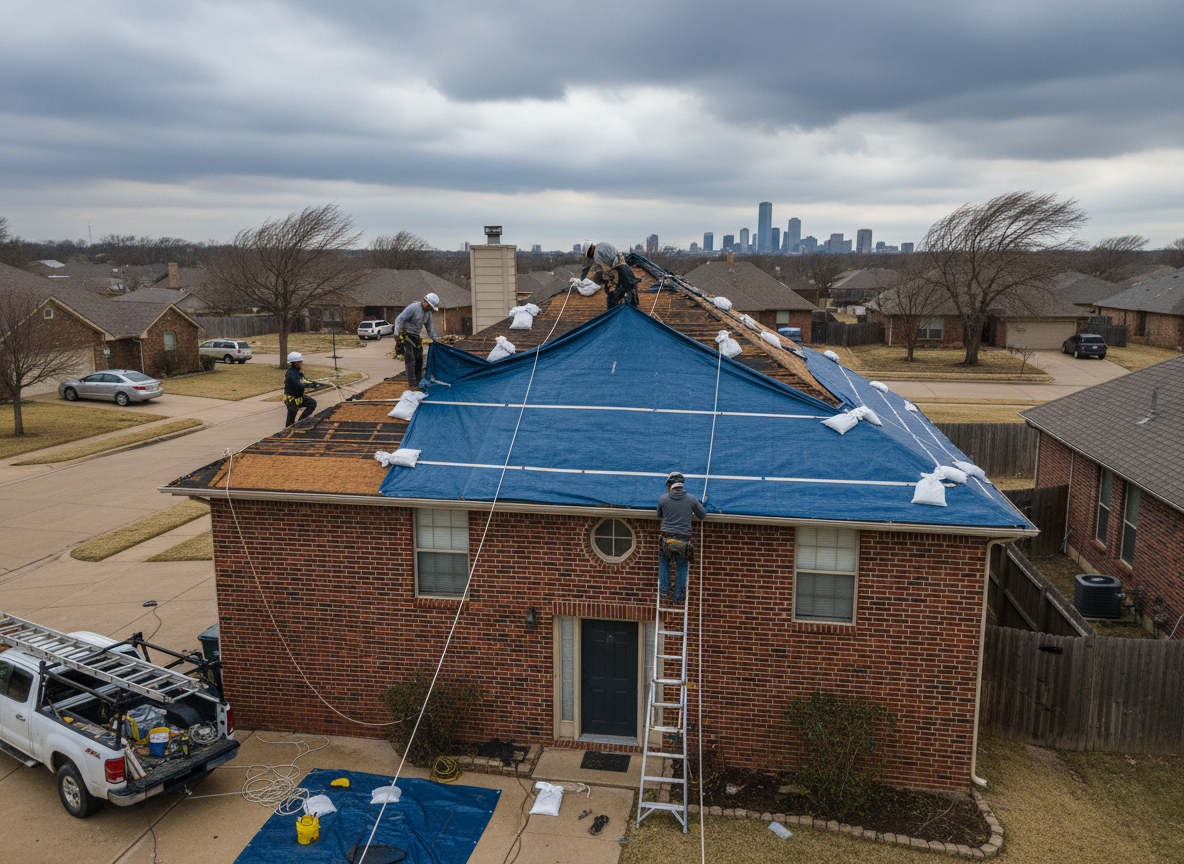
Emergency roof repair comes before anything else when a storm has opened a slope. Its job is to stop water, isolate any ceiling at risk and record the opening before material is moved. Emergency roof tarping holds a roof that cannot be worked safely or is waiting on materials, and it is battened rather than stuck down, because heat and wind defeat adhesive sheets here. Storm and hail damage repair is the slower part: a directional survey that separates wind damage at the edges from impact damage in the field, so the two are not confused in one report.
Water work: finding where it entered
Roof leak repair starts at the stain and works back to the entry, which on a brick house is usually a wall junction or a chimney, and on a low-slope addition is a seam or a drain. Flat roof repair treats ponding as a drainage fault before any membrane is touched, because one that stands under water fails at its laps however well they were made. Roof coating belongs where the assembly is dry and the aim is to extend a sound low-slope roof rather than to rescue a wet one.
Covering work: repair, replace or relay
Roof repair covers the everyday failures: a lifted ridge cap, a cracked pipe boot, step flashing pulled away from brick. Shingle roofing takes that from a patch to a full slope. Tile roofing is underlayment-led work on the coastal and resort stock. Metal roofing is fasteners, seams and coating on panels that have spent a decade in salt air. Roof replacement is the decision the other four tend to lead to, and tear-off is where the deck and the roof-to-wall connection are finally seen.
Installation and assessment
Roof installation is specification work: underlayment, ice barrier in the upstate, wind rating on the coast. Roof inspection is the document that settles repair against replacement, and on the coast it covers the edges and fasteners as well as the covering.
What a South Carolina repair includes
Every job begins with an assessment of the roof and the attic before a scope is written, with photographs of the failed detail and what surrounds it. The written scope separates covering, underlayment, deck and flashing so the invoice matches the agreement, and the deck is examined wherever the covering comes up. Masonry flashings are cut into the brick rather than sealed over it, because brick moves and a bead of sealant does not. The working area is swept for fasteners at the end, and the finished repair is walked through with the photographs in hand.
South Carolina cities and metro areas covered
Coverage in South Carolina includes Charleston, Mount Pleasant, North Charleston, Summerville, Isle of Palms, Folly Beach, Hilton Head Island, Beaufort, Bluffton, Myrtle Beach, North Myrtle Beach, Conway, Georgetown, Columbia, Lexington, Sumter, Orangeburg, Aiken, Greenville, Spartanburg, Anderson, Greer, Rock Hill, Florence, Rock Hill and Clemson.
These are coverage areas, not offices. The company is headquartered in Oklahoma City, Oklahoma, and works across South Carolina from that base. The exposure changes between them: a barrier island roof is judged on wind and salt, a Columbia roof on rain volume and drainage, an upstate roof on hail and ice.
What happens between the first call and the finished repair
Before anyone arrives. The call establishes the symptom, its timing and the covering type. That is enough to know whether the job is an active leak, an open roof or a maintenance question, and each of those is scheduled differently.
On the roof. The covering is walked where walking is safe and the attic is examined from underneath. Photographs are taken of the failed detail, the field around it and the soft metals. On coastal property the edges and the fasteners are part of that survey.
The scope. What comes off, what goes back, what is reused and what is deliberately left alone, written in those parts so a decision can be made on each. Where a sectional repair and a replacement are both realistic, both appear.
The work. Materials are staged before the covering comes up, the deck is checked as it is exposed, and anything else found is reported before it is covered again. Storm work puts the documentation photographs first.
The close-out. The repair is reviewed with the owner, the photographs are handed over and the roof is checked for fasteners and debris. Anything found and not repaired is recorded so the next decision is not made from memory.
Salt, sand and the barrier-island cycle
A roof on the barrier islands is not maintained on the same cycle as one inland, and the difference is not only wind. Salt settles on every surface, and the wind that carries it also carries sand, which abrades the edges of metal and the exposed surfaces of a shingle over years rather than storms.
The practical consequence is that a coastal roof needs looking at more often and in more places. The fasteners on a metal panel, the vents, the valley metal and the cut edges are all part of the condition of the roof, and a covering that reads sound from the driveway can be a covering with two seasons left in its fixings.
Salt also changes what a repair means. Replacing a component with the same specification that was used inland introduces a part that will corrode faster than the roof around it. Matching the exposure is the point of the repair, not matching the catalogue.
Wind-driven sand contributes the second problem. It collects on the windward slope, fills the gutters on that elevation and works into the laps of a profiled panel. None of that shows as damage in a photograph, and all of it changes how long the roof lasts.
Farther inland the cycle stretches out. A Columbia or Greenville roof can go years between inspections and still be sound, because the exposure that ages it is heat and rain rather than salt and abrasion. The mistake is to apply the coastal schedule inland, or the inland schedule on the coast.
The rest of the region
South Carolina is one of eight states in the Southeast region, and the shared hurricane and humidity exposure is set out on the region page. Every state we cover is listed on the state index.
- Roof repair in Florida
- Roof repair in Georgia
- Roof repair in Alabama
- Roof repair in North Carolina
- Roof repair in Tennessee
- Roof repair in Mississippi
- Roof repair in Louisiana
- Southeast region overview
Talk to a roofer about a South Carolina roof
Coastal wind, upstate ice and midlands rain volume each leave a different signature on a roof, and the repair that follows should match the cause rather than the address. Call (833) 406-0167, describe what you are seeing and where it appears, and the first step is identifying which exposure is doing the damage.
Around South Carolina
We regularly work near:
- 📍Charleston Historic District
- 📍Congaree National Park
- 📍Caesars Head State Park
- 📍Hunting Island State Park
- 📍Table Rock State Park
Roof Repair in South Carolina — Local Notes
- •Barrier island roofs are inspected at the edges and fasteners first, because that is where wind and salt do their work.
- •Historic districts such as Charleston's can require review before roof materials are changed.
- •Upstate ice arrives as freezing rain, which opens flashings a little at a time.