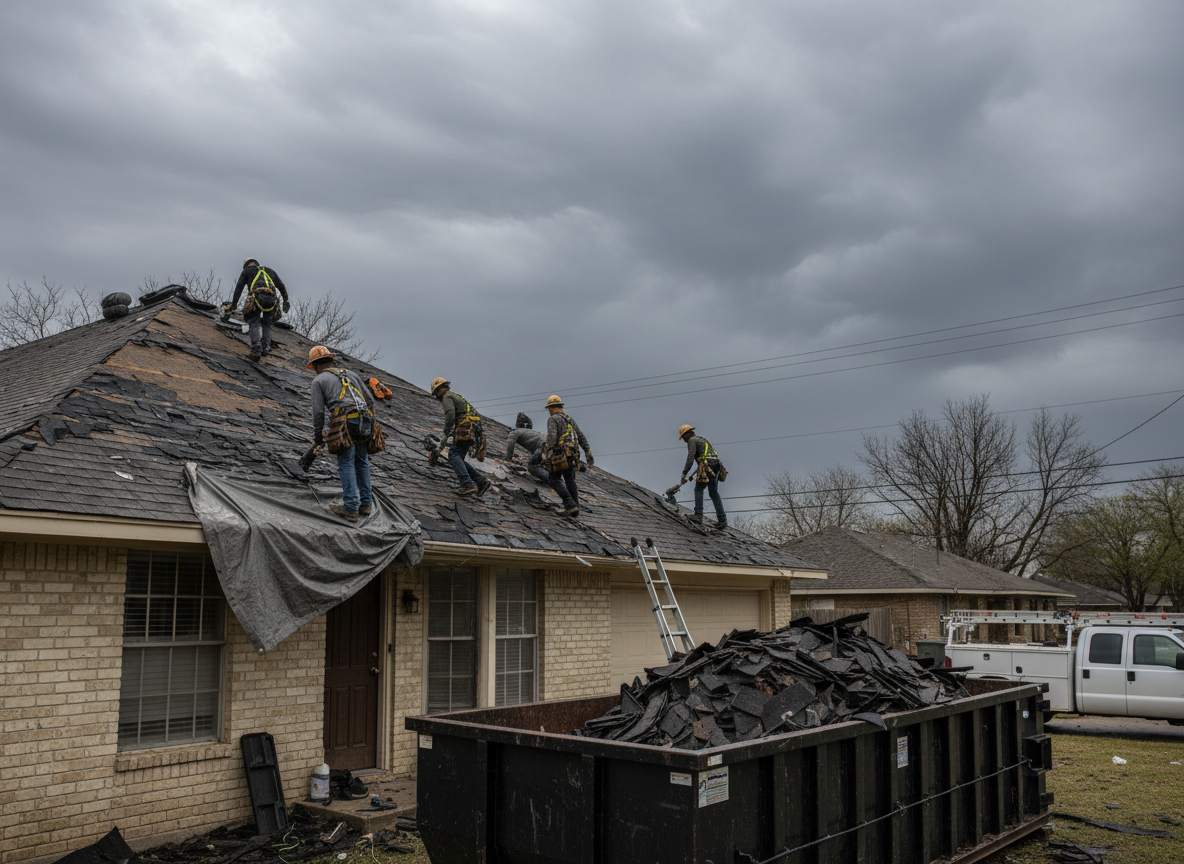
An Illinois roof is usually two roofs wearing one set of shingles. On a Chicago two-flat the front slope is a steep shingle plane over a living space, and forty feet behind it the rear section runs almost flat over a porch, a kitchen extension or a garage, edged by a masonry parapet that holds water against the wall until a scupper clears. The two halves fail on different clocks and in different ways, and the repair that fixes one has nothing to teach the other. Downstate the split is seasonal instead: a long, wet spring that arrives with hail, a summer of heat and heavy thunderstorms, and a winter that parks snow on the north slope for weeks at a time.
What follows is written that way — the weather first, then the housing stock, then where the failures actually begin, then what the thirteen services look like when they are carried out here. If water is inside the building now, call (833) 406-0167 and describe where it is showing, which floor, and whether it started during rain, during a thaw, or after wind.
What an Illinois roof is asked to do
Snow that stays, then leaves in a hurry
Northern Illinois holds snow on the ground for a stretch of weeks most winters, and a roof that carries it sits under load for far longer than the storm that delivered it. The load is not only depth: snow that is rained on and then refreezes becomes several times denser, so a modest accumulation after an ice event can weigh more than a deeper dry snowfall. Older framing was not always built to the same margin as modern construction, and the first evidence of an overload is rarely the roof itself — it is a door that stops latching, a crack across a ceiling, or a ridge line that has begun to sag.
The exit is where the trouble usually starts. Snow melts from the bottom against a warm deck, the meltwater runs down to the cold eave, and there it refreezes into a ridge of ice. Water backed up behind that ridge has nowhere to go but under the courses and into the roof assembly, and it appears indoors as a stain on the ceiling close to an exterior wall. That detail — heat escaping, an eave that stays below freezing, and no path for the water — is a ventilation and insulation problem that presents as a roofing one. Clearing the ice buys time; keeping the eave cold and the attic dry is what stops the call coming back every January.
Spring hail, summer wind, and the tornado corridor
Illinois sits in the part of the country where severe thunderstorms are a seasonal expectation rather than a surprise. Spring and early summer bring hail, and hail is the quiet damage: it bruises the mat under an asphalt shingle without necessarily breaking the surface, knocks the granules off in a pattern that reads clearly from above and invisibly from the ground, and dents soft metals at vents, valleys and caps. A slope can look intact from the driveway and still have lost years of life across a hundred square feet.
Straight-line wind does the more visible damage, and tornadoes in the state have historically been most frequent through the central and southern counties rather than along the lake. The pattern of wind damage matters more than the label attached to the storm: lifted tabs at the rake and eave, missing ridge caps, a lifted edge that lets the next rain in sideways, and debris punctures that are small on the surface and open beneath it.
Lake-effect snow in the north-east corner
The Chicago area sits at the western end of the Lake Michigan snow belt, and the lake's influence is real but uneven. Cold air crossing open water picks up moisture and delivers it as narrow bands, so one suburb can take a heavy fall while a neighbourhood fifteen miles inland gets a dusting. The lake also moderates temperature near the shore, which changes how quickly snow melts off a roof and how often the freeze-thaw cycle repeats at the eaves in a single week.
Ice in the southern third
Southern Illinois is a different climate wearing the same state name. Winters are shorter and milder, but the region sits where cold air from the north meets moisture from the Gulf, and that meeting produces ice storms rather than deep snow. A quarter inch of ice adds weight to every branch over a roof and turns a downed limb into a puncture; more than that takes gutters off the fascia and pulls the edge of the roof with them. Ice also seals a roof's drainage, so the water from the melt that follows has to find another way in.
The buildings, and the coverings already on them
Masonry buildings with parapets and flat rear sections
Chicago's residential stock includes a large number of two-flats, three-flats and courtyard buildings built between the 1890s and the 1930s, and most of them share a construction logic: masonry walls carried up past the roofline to form a parapet, a steep front slope in shingle or tile, and a low-slope rear roof over the back rooms, porch and garage. The parapet is the detail that decides how the building behaves in water. It is a wall, not a curb, and the roof membrane has to turn up against it and be capped in a way that keeps water out of the masonry. When that cap fails, water enters the wall rather than the room, travels down inside the brick, and shows up as a damp patch two floors below the roof.
The rear low-slope sections are usually where the water goes first. They drain through scuppers cut into the parapet, through interior leaders, or through a roof drain, and any of those can clog with leaves and grit. Standing water then works at the laps and at the base of the wall until the membrane lets go.
Clay tile and slate on the older buildings
Some of the city's older apartment buildings and churches still carry the original clay tile or slate, and both materials outlast the waterproofing under them. A tile roof can be structurally sound and completely finished as a roof at the same time, because the tile sheds most of the water and the underlayment does the rest. Where the ceiling stains beneath an unbroken tile field, the tile is not the part that failed. Repairs on these roofs are a matter of lifting and numbering the pieces, replacing the membrane beneath, replacing broken units from salvage or matched stock, and re-laying in order — a different trade from shingle work and one that punishes impatience.
The Chicago bungalow and the hipped roof
The bungalows built across the city's outer neighbourhoods and inner suburbs in the 1910s and 1920s carry low hipped roofs with wide overhangs and deep eaves. That overhang protects the wall, but it also shades the eave, keeps it cold, and makes it the first place ice forms. The shallow pitch means the roof sheds water slowly, so a lifted shingle or a blocked gutter matters more here than it would on a steep plane.
Suburban shingle and rural metal
Beyond the older core, asphalt shingle covers most of the state's housing — subdivision roofs from the 1960s onward, steep gable and hip planes, and a great deal of it now in its second or third layer. In the rural counties, ribbed metal and standing seam cover farm buildings, machine sheds and a growing number of houses, and the failures there are fasteners, washers, cut edges and the flashing where a panel meets a masonry wall.
Where an Illinois roof fails first
At the parapet cap. The metal or stone coping over a masonry wall is where water enters a building without ever touching a roof plane. Lifted or cracked coping, a failed seal behind it, or a membrane that was turned up but never properly terminated lets water into the wall cavity, and the interior symptom appears well below the roof.
At a scupper or a roof drain. Drainage is the first thing to check on any low-slope section and the last thing most people think of. A scupper that has silted up turns the whole rear roof into a pond, and a pond finds every weak lap in the membrane.
At the eave during a thaw. The ice-dam stain near an exterior wall is a January and February classic, and it is usually the same two or three feet of roof every year.
At a chimney or a skylight. Masonry chimneys move independently of the roof, and the flashing at the joint is where the two separate. Counter-flashing set into a mortar joint that has since cracked is a slow, patient leak that appears as a ceiling stain a metre away from the chimney.
In the valleys. Where two planes meet, the volume of water is doubled and the detailing is unforgiving. A valley that was woven or cut short, or one whose metal has corroded, is the most common source of a leak that only appears in heavy rain.
The thirteen services, as they are carried out here
Stop the water tonight
Emergency roof repair is the first call when a storm has opened a roof or a limb has come through it. On a Chicago building that often means making a rear low-slope section safe to walk, containing a ceiling that is close to collapsing, and photographing the opening before anything is moved. Emergency roof tarping is the temporary layer for a roof that cannot be worked on safely or is waiting on material; in Illinois wind, adhesive sheets are unreliable, so the tarp is fixed with battens and the battens are placed where they will not abrade sound shingles.
Find the detail that let the water in
Roof leak repair starts at the wet point indoors and works outward, because water follows rafters and top plates and the entry is rarely directly above the stain. Attic inspection, moisture readings and, where conditions allow, a controlled water test confirm the entry before anything is opened. Storm and hail damage repair is a slope-by-slope survey that keeps impact damage, wind damage and ordinary wear in separate columns, since a hailstorm arriving on a fifteen-year-old roof produces a different scope from the same storm on a new one.
Work with the covering that is up there
Shingle roofing covers repair, replacement and the correction of failed detail on a roof that is otherwise sound, and it is the work most Illinois houses need. Tile roofing is the older-building trade described above — lift, number, strip, re-membrane, re-lay. Metal roofing covers fastener and washer replacement on ribbed panels, seam work on standing seam, and recoating where the finish has chalked. Flat roof repair handles the rear sections, porch roofs, commercial buildings and additions, and it is seam, drain, scupper and penetration work rather than field work. Roof coating can extend the life of a sound low-slope assembly, but it is a decision made after moisture testing, never instead of one.
Decide between a section and the whole roof
Roof repair covers the ordinary failures: a lifted ridge cap, a split pipe boot, a corroded valley, a parapet cap that has come loose, counter-flashing pulled out of a mortar joint. Roof replacement is usually decided here by the age of the covering, how many times the same slope has been patched, and what the tear-off reveals about the deck. On a Chicago building the tear-off is also the moment when the roof-to-wall detail and the parapet can be corrected, and neither is reachable once the new covering is down. Roof installation puts the risk into the specification: the ice-barrier requirement at the eave, the underlayment, the ventilation, and the fastening pattern for the wind zone.
Put the condition on paper
Roof inspection produces a record of covering, underlayment where visible, flashing, drainage, the parapet, the attic side, and photographs of each. It is the document that makes a repair-or-replace decision reviewable six months later, and the one an insurer can read without translation.
What's included in an Illinois scope
A scope written for an Illinois building is assembled in layers, because the parts of the roof fail on different schedules and a single lump description hides which one is being paid for.
- The route the water took, traced from the stain or the damp wall back to the detail that failed, with photographs of that detail and of the roof around it.
- The work separated into its parts — covering, underlayment, deck repairs, flashing, drainage — so a rear membrane replacement is never invoiced as a shingle repair, and nothing appears at the end that was not agreed at the start.
- The deck, opened and looked at. Soft sheathing under a shingle field that has leaked slowly, or a rusted pan under a low-slope section, is common and only becomes visible with the covering off.
- Flashing rebuilt rather than sealed at the parapet, chimney, valley and wall junctions, since a bead of sealant over a failed counter-flashing is a delay rather than a repair.
- Drainage restored — scuppers cleared and re-set, leaders checked, ponding addressed as a slope question before it is treated as a membrane question.
- Ventilation and the eave detailed together, because ice dams are solved at the attic and the eave rather than at the icicle.
- A written sequence for anything that has to happen in a particular order: tear-off, deck repair, membrane, flashing, covering, then the final inspection of the details.
From the first call to the handover
The first conversation. You describe what the building is doing — where the water shows, when it started, what the weather was doing, and what kind of roof is up there. That call decides whether the next step is an emergency attendance or a scheduled inspection.
An inspection that reaches the detail. The roof is walked where it can be walked safely, the attic is entered, and the specific junctions are looked at rather than the field alone. On a masonry building that means the parapet and the wall as much as the slope.
A written scope. What failed, what will be done, what will be opened, and what happens if the opening reveals more. Anything that cannot be known until the covering is off is listed as a possibility rather than discovered later as an addition.
Permits and scheduling. Requirements for permits, inspections and sign-off vary by city and county, and the local building department confirms what a particular address needs. Work is sequenced around the forecast, since a roof opened in an Illinois winter cannot be left that way overnight.
The work itself, then the record. Temporary protection where a repair cannot be completed in one visit, the permanent scope when the weather allows, and photographs of the finished details handed over with the invoice.
Where the work is carried out in Illinois
Coverage runs across the state rather than from a set of local premises. The metros and cities most often involved are Chicago and the surrounding suburbs, Aurora, Naperville, Joliet, Rockford, Peoria, Springfield, Champaign, Bloomington, Decatur, Quincy and the Metro East communities around St. Louis. The housing changes as the map moves south — masonry and low-slope in the north-east, shingle subdivisions through the centre, and a mix of shingle and metal with more ice exposure in the southern counties.
Illinois within the wider coverage
Illinois belongs to the eight states grouped as the Midwest, where the shared problem is what a roof carries through winter rather than what hits it in summer. The other seven are Ohio, Indiana, Michigan, Wisconsin, Minnesota, Iowa and Kentucky. All forty covered states, grouped by region, are listed on the states page.
Talking to a roofer about an Illinois roof
The useful questions here are narrow: is the water coming through the slope, the parapet or a wall junction; is the rear low-slope section draining; is the ice at the eave a symptom of ventilation; and how much of the covering has already been patched. Those four answers decide almost everything that follows. Call (833) 406-0167, describe the building and what it is doing, and the conversation starts from the roof that is actually there.
Around Illinois
We regularly work near:
- 📍Starved Rock State Park
- 📍Shawnee National Forest
- 📍Lincoln Home National Historic Site
- 📍Cahokia Mounds State Historic Site
- 📍Garden of the Gods Observation Trail
Roof Repair in Illinois — Local Notes
- •On a masonry building the parapet is a wall, not a curb — water that gets behind the coping enters the wall and shows up floors below the roof.
- •A rear low-slope section over a porch or kitchen extension drains through a scupper or leader that silts up, and ponding finds the weakest lap in the membrane.
- •Ice at the eave is a ventilation and insulation problem expressed as a roofing problem; clearing the ice is temporary.
- •Hail bruises the mat beneath a shingle without breaking the surface, so damage reads clearly from above and invisibly from the ground.