Kentucky's roof weather arrives in two moods. Through the cold months the state sits where moist Gulf air rides over shallow cold air, and the result is ice rather than snow — glaze that loads limbs and brings them down onto roofs, seals gutters solid and turns every flashing detail into a place where water sits. Through the warm months the same moisture arrives as heat and humidity, with thunderstorms, hail and tornadoes, and a building that stays damp for months at a time. A roof here is judged as much on how it dries as on how it sheds.
That combination is unusual. Most states lean one way or the other; Kentucky has to be detailed for both, and the housing stock makes it harder, because a large share of it is brick and masonry built before modern underlayments existed. This page sets out the ice first, then the wet heat, then the buildings, then where water actually enters. If the ceiling is wet now, call (833) 406-0167 and describe where it shows and what the weather was doing.
Ice, and what glaze does to a roof
The ice-storm pattern
An ice storm is not a heavy snowfall with a hard surface. It is rain that falls through a layer of air above freezing and arrives at a surface below it, freezing on contact. On a roof, that means the covering, the gutters, the flashing and every projection take a coat of ice, and the weight is only part of the problem. The larger issue is what comes next: the melt, the refreeze and the water that has been given a way into joints it could not previously enter.
Kentucky has a long record of these events, several of which have taken down trees and power lines across whole counties. For a building, the sequence runs the same way each time — limbs land on planes that were sound the day before, gutters come away from the fascia under the weight, and the flashing details that were already marginal begin to pass water at the thaw.
The freeze-thaw that follows
Once the ice has gone, the joints it opened remain. Water enters a lap or a mortar joint, freezes overnight, expands, and opens it a fraction more. Repeat that through a Kentucky winter, where the temperature crosses the freezing mark repeatedly rather than staying below it, and a detail that would survive a colder, steadier climate comes apart. This is why a flashing inspection in this state is worth doing in late winter rather than in autumn.
Snow, which is modest but wet
Snowfall here is generally lighter than in the states to the north, but it is often wet and heavy, and it is more likely to be followed by rain than by a hard freeze. That combination loads a roof and then soaks it, and a shallow pitch that would shed dry snow can hold a slushy mix until it drains. On older buildings with shallow roofs and internal gutters, that is the event that produces the interior stain.
Heat, humidity and storm season
Moisture that stays in the building
Kentucky summers hold moisture in the air for weeks at a time, and a roof assembly in that climate has to be able to dry inward as well as shed outward. Where an attic cannot exchange air, moisture condenses on the underside of the deck and appears as a leak with no entry point above it. Replacing the stained ceiling without addressing the ventilation, or without finding the leak feeding the damp, means doing the same job again the following summer.
Mould and algae on a roof follow the same conditions. The dark streaking on a shaded northern plane is usually algae feeding on the filler in asphalt shingles, which is cosmetic. Moss and lichen are the more serious version, because they hold water against the covering and keep the deck damp long after the surface has dried.
Thunderstorms, hail and tornadoes
Spring and early summer bring the convective storms, with hail that bruises shingle mats, wind that lifts edges and caps, and tornadoes that leave a narrow path of severe damage and a wider field of debris strikes. The wind-driven rain in these storms is what finds wall junctions: a squall line pushes water almost horizontally, and it enters at window heads, at porch roof junctions, at vent stacks and along the top of a wall, without any opening in the field of the roof.
Heat on the covering
Ultraviolet exposure here is moderate rather than extreme, but it works on the same materials: it oxidises the asphalt in a shingle until the surface chalks and the granules loosen, hardens sealants until they crack instead of stretching, and dulls a painted metal finish. Combined with humidity, it ages a roof in a way that a drier climate of the same temperature would not.
What Kentucky roofs are made of
Brick, and the wall that meets the roof
A large share of the state's older housing and downtown building stock is brick, and brick behaves in a way that matters at the roof line. It is porous, it moves with temperature, and it depends on water being shed clear of it rather than sealed against it. A flashing that directs water onto the face of a wall instead of past it will keep the wall damp for years, and the interior evidence appears well below the roof. Chimneys are the most common version of the problem: masonry that has moved away from the roof, with counter-flashing set into a mortar joint that has since cracked.
Shingle, and the hipped roof
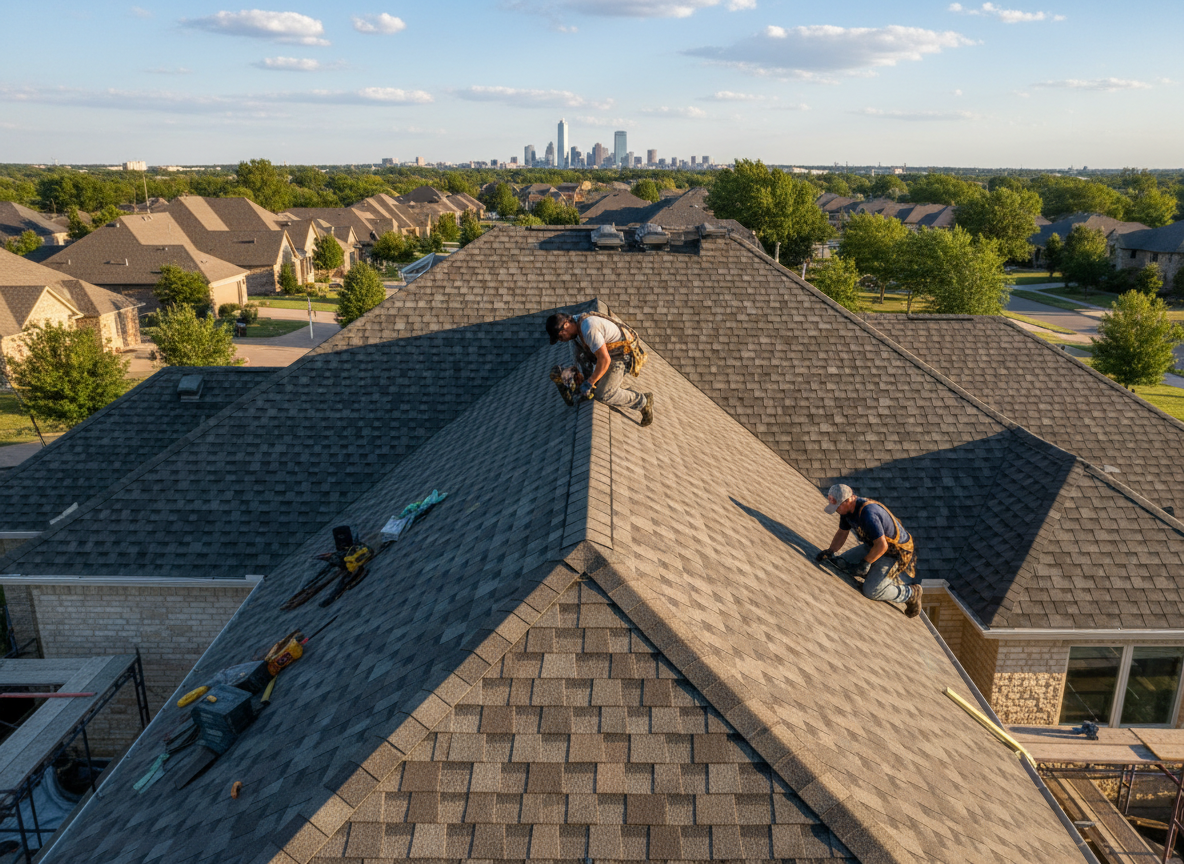
Asphalt shingle covers most of the residential stock, and a great deal of it sits on hipped roofs with deep eaves — a shape that sheds well in wind-driven rain because it presents no large gable end to the weather. The trade-off is junctions: four hips, four valleys and a ridge, each of which is a place to fail, and the valley is where most of them eventually do.
Metal on barns and rural buildings
Metal covers the state's agricultural buildings — tobacco barns, equipment sheds, pole buildings — and an increasing number of rural houses. On the older barns the roof is often the last original element still working, and the failures are the familiar ones: fasteners backing out, washers perished, cut edges undressed and flashings that were never detailed for movement.
Clay tile on the historic stock
A small number of older commercial and institutional buildings still carry clay tile, usually over a membrane that has long since passed its service life. The tile is the wear layer and the membrane is the waterproofing, so a sound tile field over a failed underlayment is a lift-and-relay rather than a new roof.
Low-slope commercial
Downtown Louisville, Lexington and the smaller county seats hold flat-roofed commercial buildings that drain through interior leaders and parapet scuppers. The failures are at the parapet base, the seams and the penetrations, and the water usually enters the masonry before it reaches a ceiling.
Where water enters a Kentucky roof
Behind a chimney. Masonry moves, the counter-flashing was set into a joint that has opened, and water enters the wall rather than the room.
At a valley in a squall. Both planes feed one line, and wind-driven rain pushes water sideways into a detail that sheds ordinary rain perfectly well.
At a wall junction above a porch roof. The most common misread leak in the state — the covering above is sound and the failure is at the elevation where the two roofs meet the wall.
At the base of a parapet. Water stands against the wall, works behind the coping, and enters the masonry.
In the roof deck itself, from the inside. Condensation where an attic cannot ventilate, presenting as a leak with no entry above it.
Four of those five are wall failures rather than roof failures, which is the single most useful thing to understand about repairing a roof in this state. The covering is often the last place to look.
The services, in the order a job usually happens
The first visit is about stopping water. Emergency roof repair after a limb strike or a wind event: make the ceiling below safe, clear the room, record the opening before anything is moved. Emergency roof tarping covers a roof that cannot be worked safely or is waiting on material, battened in place because an adhesive sheet will not last in this weather.
The second is about proof. Roof leak repair traces the water from the interior mark through the attic and the wall junctions rather than assuming the nearest damage is the cause, using moisture readings and a controlled water test where conditions allow. Storm and hail damage repair records the event plane by plane, keeping impact, wind and age apart so the account can be read by someone who was not there.
The third is about the covering. Shingle roofing handles re-cover, tear-off and failed edges on the state's dominant material. Metal roofing covers the farm and rural stock — fasteners, washers, seams and flashings detailed for movement. Tile roofing is the lift, strip, re-membrane and re-lay work on the historic buildings. Flat roof repair is the downtown trade of seams, parapets, drains and penetrations. Roof coating is considered on a sound low-slope assembly once moisture testing has shown it is dry, and not before.
The fourth is a decision. Roof repair handles the isolated failure at a chimney, a valley, a boot or a parapet. Roof replacement is weighed on layers, age, patch history and what the tear-off shows, and it is the point where ventilation and underlayment can be corrected together. Roof installation sets that specification, which in this climate means an assembly that can dry as well as shed.
The last is the record. Roof inspection documents covering, flashing, drainage, wall junctions and the attic side with photographs — the document that makes a later repair-or-replace decision reviewable.
What's included in a Kentucky scope
- Wall junctions examined as closely as the roof, because a large share of leaks here enter at a chimney, a parapet or the meeting of a lower roof with a wall.
- The water's route traced from the interior mark to the detail responsible, photographed before work begins.
- Flashing rebuilt rather than sealed, with counter-flashing set into a sound joint rather than a bead laid over a cracked one.
- Ventilation assessed, since a roof that cannot dry inward will keep producing damp ceilings regardless of how well it sheds.
- Layers stated and the deck inspected once the old covering is off, particularly where the roof has leaked slowly for a season.
- Drainage addressed on every low-slope section — leaders, scuppers, parapets and ponding.
- A written sequence for ice-season work, with temporary protection wherever a plane cannot be closed the same day.
From the first call to handover
A call establishes what the building is doing and what the weather did. The inspection walks the roof where it can be walked, enters the attic, and looks at the chimneys, parapets and wall junctions rather than the field alone. A written scope follows, naming the failure, the work and anything that will only be known once the covering is open. Permit and inspection requirements vary by city and county, and the local building department confirms what a particular address needs. Work is sequenced around the forecast, temporary protection goes on where a plane cannot be closed in one visit, and the finished details are photographed at handover.
Where the work is carried out in Kentucky
Coverage runs across the state: Louisville, Lexington, Bowling Green, Owensboro, Covington, Frankfort, Hopkinsville, Elizabethtown, Richmond, Paducah, Ashland and the communities between them. The exposure changes with the terrain — ice and wind-driven rain through the central and western counties, steep ground and fast runoff in the east, and the densest older brick housing around Louisville and the Bluegrass.
Kentucky within the wider coverage
Kentucky is the southern edge of the eight Midwest states covered here, with Illinois, Ohio, Indiana, Michigan, Wisconsin, Minnesota and Iowa. The full list of forty states by region is on the states page.
Starting a conversation about a Kentucky roof
What helps most at the start is the timing and the position: when the water appears, where it shows indoors, and what the building is made of. On this state's housing that usually points to a wall junction before it points to a shingle. Call (833) 406-0167 and describe what the roof is doing.
Around Kentucky
We regularly work near:
- 📍Mammoth Cave National Park
- 📍Red River Gorge
- 📍Cumberland Falls State Resort Park
- 📍Land Between the Lakes
- 📍Bernheim Arboretum and Research Forest
Roof Repair in Kentucky — Local Notes
- •Ice arrives as glaze from rain freezing on contact, and the damage that follows is usually at limb strikes and at gutters rather than on the field of the roof.
- •Brick is porous and moves with temperature, so a flashing has to shed water past the wall rather than seal against it.
- •A hipped roof sheds wind-driven rain well but presents four hips, four valleys and a ridge, each a junction to fail.
- •An attic that cannot exchange air produces a ceiling stain with no entry point above it.