Indiana is flat in a way that changes what a roof has to survive. Wind crossing open farmland reaches a town with nothing taken out of it — no ridge line, no treeline breaking the flow — and it arrives at a building as pressure rather than as gusts. That is why a roof on the edge of a small Indiana town can lose its ridge caps while an identical roof forty miles away stays intact, and why the first question after a wind event here is not how strong the storm was, but what the building was standing in front of.
The state also holds two very different roof inventories: the farm buildings and small-town housing that carry metal and shingle, and the industrial and commercial stock around Indianapolis, Gary, South Bend and Evansville that carries low-slope membrane and built-up roofing. Repairing one is not like repairing the other. This page works through the wind, the hail and the winter, then what is on the buildings, then where the failures begin and how the work is carried out. If a storm has opened the roof, call (833) 406-0167 and describe the opening and where the water is going.
Wind that arrives with nothing in the way
Pressure, not just speed
A roof fails in wind for two reasons at once. Air moving across the surface pulls upward, and air that has found its way under an edge pushes up from below; the two effects add together at the edges of the roof. On an exposed site the flow is steady and the load sits on the same edge for a long time instead of passing in a gust. That is why the failures cluster at the rake, the eave, the ridge and the corners, and why a roof can look untouched from the driveway while a whole run of ridge caps has lifted.
Once a cap or a tab lifts, the sealant strip that held it has usually cracked, and re-sealing will not hold it again. That single missing cap is often the visible end of a fastening run that has worked loose along its length, so a repair that replaces one piece and stops is a repair that comes back after the next blow.
Spring hail
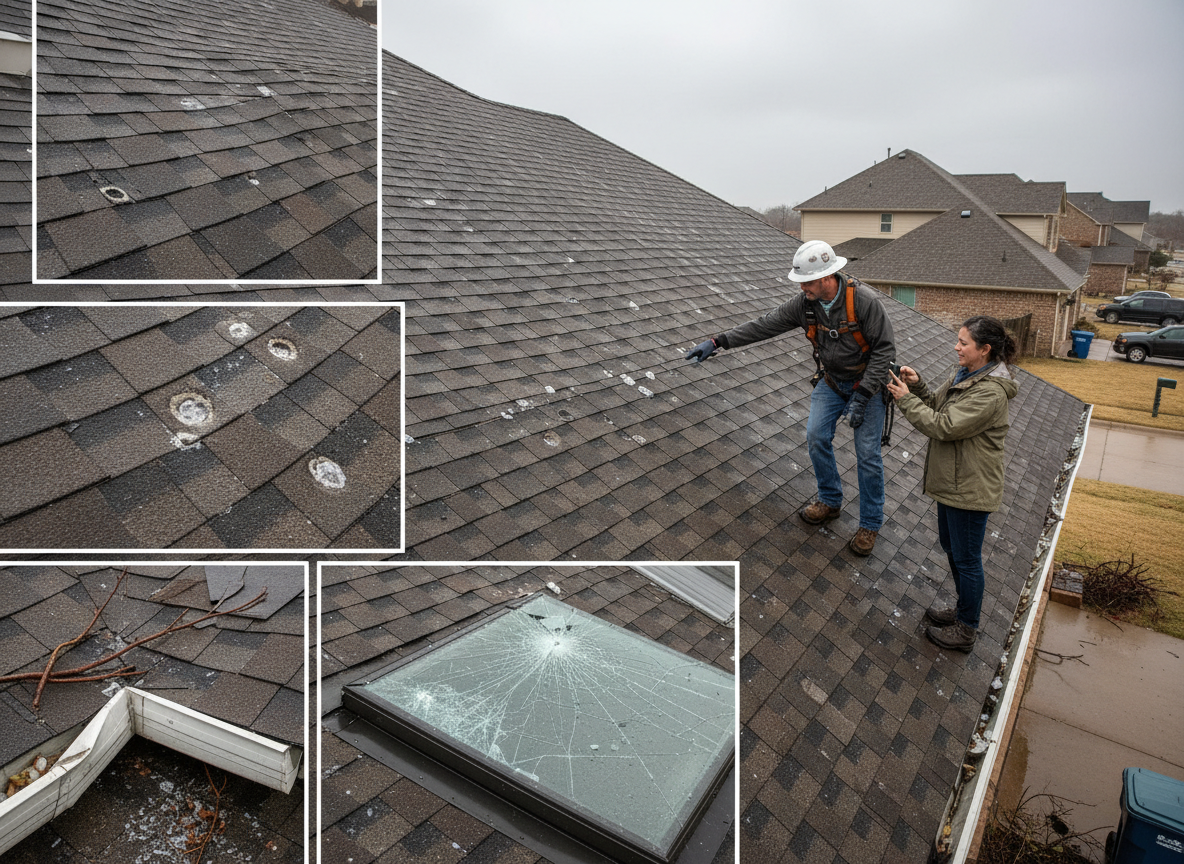
Hail in Indiana arrives with the same thunderstorms that produce the wind, and it damages a roof in a way that is hard to see from the ground. A stone that does not break the shingle surface still bruises the mat beneath it, loosening the granules above and shortening the life of that area. The damage reads on the slope as soft spots with a ring of displaced granules, and on the soft metals at vents, valleys and caps as dents. Those two records together are what distinguish a hailstorm from ordinary wear.
Hail is also uneven. A storm that tracks across one county can strike a single neighbourhood hard and leave the next town untouched, so the question is always what happened at that address rather than what happened in the region.
Tornado and straight-line wind
Indiana has a long record of tornadoes and of the straight-line wind events that do more total damage across a wider area. The distinction matters less to a homeowner than the pattern: a tornado leaves a narrow path of severe damage and a wide area of debris strikes, while straight-line wind peels edges across a whole neighbourhood. Both leave punctures from flying material, and a puncture is small on the surface and open underneath.
Winter, which is quieter but longer
Indiana winters are cold enough to hold snow for weeks in the northern counties and mild enough in the south that the same snow repeatedly melts and refreezes. That freeze-thaw cycle is what opens flashing joints and works at the eave. The state rarely takes the depths of the upper Midwest, so the more common winter problem is ice at the gutter line rather than structural load — though a wet snow followed by rain can load a shallow roof far beyond what the depth suggests.
The northern counties and the lake's reach
The far north of Indiana sits close enough to Lake Michigan to share some of its weather. Cold air crossing the water in winter reaches the northern counties as heavier snow than the rest of the state sees, and the same proximity moderates summer heat near the shore. For a roof that means a longer period under snow at the top of the state and a shorter one in the south, with the freeze-thaw cycle doing the work in both — at the eave in the north, and at every flashing joint in the south where the melt and refreeze repeats more often.
What is on Indiana roofs
Farm buildings, machine sheds and rural metal
The rural counties carry a great deal of ribbed metal on barns, machine sheds, pole buildings and an increasing number of houses. Metal is well suited to the exposure, but it fails at its details rather than its panels: fastener washers that have perished, screws that have backed out of purlins, cut edges that were never sealed, and the flashing where a panel meets a masonry wall or a concrete silo. On older barns the roof is often the last original element standing, and the question is whether the structure beneath it can carry a new covering.
Small-town shingle and the steep gable
Most of the state's houses carry asphalt shingle on a gable roof, often steep enough to shed snow quickly, and much of it now in a second layer. The steep pitch is an advantage in winter and a liability in wind, because a steep plane catches more of the flow and the eave overhang presents a bigger edge. Where the original roof had a ridge vent and the replacement did not, the attic tells the story in the first summer.
Industrial and commercial low-slope
The corridor from Gary through South Bend, Indianapolis and Evansville carries a large stock of industrial buildings, warehouses and mid-century commercial blocks with low-slope membrane, modified bitumen or built-up roofing. These roofs fail at seams, at parapet bases, at penetrations and at drains, and ponding is common where the original slope has settled. A membrane that stays under water fails at its laps regardless of how well they were closed, so drainage is examined before the sheet is judged.
Indianapolis and the inner suburbs
The capital and its inner-ring suburbs hold a wide mix: pre-war houses with hipped roofs and interior chimneys, mid-century ranches, and a large volume of 1990s and 2000s subdivision housing now reaching the age where the first replacement is decided. Hail history is usually the deciding factor there, which is why documentation matters as much as the covering.
Where an Indiana roof fails first
At the ridge and the rake. Wind damage on exposed sites starts at the edges, and the ridge is the highest and most exposed line on the building.
At a penetration. A vent collar, a pipe boot or a chimney flashing that has cracked shows as a stain well away from the penetration itself, because water runs along the deck before it finds a way through the ceiling.
At a shallow valley. Where a porch or an addition meets the main roof, the valley takes the combined flow of both planes and is the first detail to give.
At a seam on a flat roof. Laps and parapet bases, usually with ponding behind a blocked drain.
At the eave after a freeze. Gutter ice backing water under the first courses, most common in the northern counties.
The useful habit in all five cases is the same: find the water's route rather than the nearest visible damage. Indiana roofs are large and the stain is a poor guide to the opening.
The thirteen services, in Indiana terms
Securing the building. Emergency roof repair after a wind event or a debris strike means containing the ceiling, isolating the room and recording the opening before anything is moved. Emergency roof tarping is temporary protection for a roof that cannot be worked safely or is waiting on material, fixed with battens in this wind rather than relying on an adhesive sheet.
Finding the entry. Roof leak repair traces from the interior mark outward through the attic, using moisture readings and, where conditions allow, a controlled water test. Storm and hail damage repair records each slope separately so wind, impact and age are not blended into one verdict — which is what a claim or a repair decision later depends on.
Repairing the covering. Shingle roofing covers repair, replacement and correcting failed detail on a sound roof, including the ridge and edge details that wind punishes. Metal roofing is the rural and agricultural trade: fastener and washer replacement, seam work, and re-flashing where a panel meets masonry. Tile roofing is occasional here, mostly on older commercial fronts and porch roofs, and is handled as lift, strip, re-membrane and re-lay. Flat roof repair covers the industrial and commercial stock plus the flat additions on houses — seams, drains, scuppers and penetrations. Roof coating is considered on a dry, sound low-slope assembly after moisture testing, never as a substitute for one.
Deciding scope. Roof repair covers the ordinary failures — lifted ridge caps, split boots, corroded valley metal, a parapet detail that has opened. Roof replacement is usually decided by hail history, the number of layers and how much of the roof has already been patched. Roof installation sets the specification: underlayment, ice barrier at the eave where required, ventilation, and a fastening pattern appropriate to the wind exposure of the site.
Records. Roof inspection produces a written condition record with photographs of the covering, flashings, drainage and the attic side, which is the document that makes a later decision reviewable.
What's included in an Indiana scope
- The wind exposure of the site, noted rather than assumed, because an exposed edge on open ground is detailed differently from a roof sheltered by trees.
- The route the water took, traced from the interior mark to the failed detail and photographed before work begins.
- The scope split into covering, underlayment, deck and flashing, so a membrane repair is never invoiced as a shingle repair and nothing appears at the end that was not agreed at the start.
- Edge and ridge details rebuilt with the fastening and sealing appropriate to the covering, since these are where Indiana wind does its damage.
- The deck opened and inspected wherever a covering has leaked slowly or hail has been recorded, because soft sheathing is not visible from above.
- Drainage addressed on every low-slope roof — drains, scuppers and ponding — before the membrane is judged.
- A written sequence for anything weather-dependent, with temporary protection specified wherever a plane cannot be closed in one visit.
From the first call to the handover
A call establishes what the building is doing and what the weather did. The inspection then walks the roof where it can be walked, enters the attic, and looks closely at the edges, the penetrations and the valleys rather than the field alone. From that comes a written scope naming what failed and what will be opened, with anything uncertain listed as a possibility rather than added later. Permits and inspections are local matters, and requirements vary by city and county, so the building department for the address confirms what applies before work is scheduled. Work is sequenced around the forecast, temporary protection goes on where a plane cannot be closed in a single visit, and the finished details are photographed at handover.
Where the work is carried out in Indiana
Coverage runs across the state: Indianapolis, Fort Wayne, Evansville, South Bend, Carmel, Fishers, Bloomington, Lafayette, Muncie, Terre Haute, Anderson, Kokomo, Columbus and the towns between them. The exposure changes with the terrain — open farmland wind and metal roofs through the north and west, hail-driven shingle replacement around the capital and its suburbs, and industrial low-slope work through the northern corridor.
Indiana within the wider coverage
Indiana sits among the eight Midwest states covered here, with Illinois, Ohio, Michigan, Wisconsin, Minnesota, Iowa and Kentucky. The complete list of forty states by region is on the states page.
Talking about a roof in Indiana
What matters in the first conversation is the site and the covering: what is the building standing next to, what is on the roof, how many layers, and where the water shows. Call (833) 406-0167, describe the roof and what the weather did to it, and the inspection follows from that rather than from a list.
Around Indiana
We regularly work near:
- 📍Indiana Dunes National Park
- 📍Turkey Run State Park
- 📍Brown County State Park
- 📍Conner Prairie
- 📍Angel Mounds State Historic Site
Roof Repair in Indiana — Local Notes
- •On open farmland the wind arrives with nothing taken out of it, so exposed edges fail before the field of the roof.
- •A hailstone that leaves the shingle surface intact can still bruise the mat beneath and shorten the life of that area.
- •Rural metal roofs fail at fastener washers, backed-out screws and cut edges rather than in the middle of a panel.
- •Industrial low-slope roofs fail at seams, parapet bases and drains, usually with ponding behind a blocked outlet.