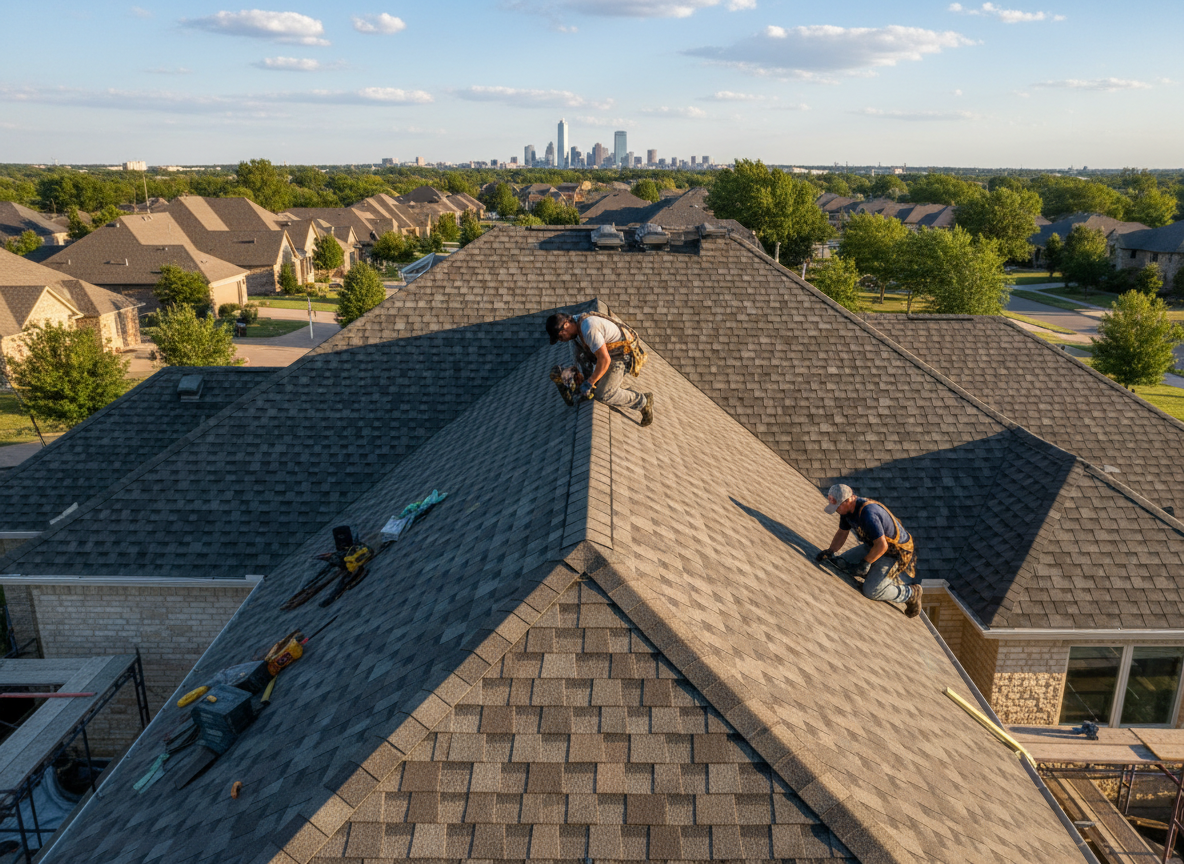
Wisconsin gives a roof a long time to fail. Winter here is not a storm that passes; it is a season that starts in November and is still holding snow in March, and through that stretch the roof is asked to carry weight, shed meltwater and stay watertight while every joint in it freezes and thaws a few dozen times. The damage that results is rarely dramatic. It is a stain at the eave that appears in January, a damp patch on a wall below a chimney that comes back every thaw, a fascia that has gone soft behind a gutter nobody looked at.
The state also has one of the more distinctive older housing stocks in the region: Milwaukee's cream-city brick, the Polish flats built into the slope of the near south side, and a great many shallow roofs on buildings put up before the middle of the last century. This page covers the winter first, then the buildings, then where water waits on a Wisconsin roof, followed by the services and how the work is carried out. If the ceiling is wet now, call (833) 406-0167 and describe where it shows and whether it appeared during a thaw.
The winter, in the order it happens
Frost, and what it does below the roof
Ground frost in Wisconsin can go deep enough to move foundations and heave flatwork, and the same cold that does that to the ground also holds the eave of a roof below freezing for weeks. The consequence is that meltwater from the upper slope arrives at a cold edge, refreezes, and forms the ridge of ice that starts the whole sequence. A roof can be perfectly sound and still leak in January for that reason alone.
Snow load and the wet-snow problem
A Wisconsin roof carries snow for months rather than days, and the design of the structure reflects the load expected where it stands. The variable is density: dry lake snow can be light, and the same depth after rain, sleet or a thaw that refreezes becomes several times heavier. Where a roof has already been layered, the covering's own weight is added to that. The signs of trouble are always in the building — doors out of alignment, a new ceiling crack, a ridge that has dipped — and they call for a structural answer rather than another layer of shingles.
The January thaw
Most winters produce at least one stretch of mild air in the middle of the season, and that is when most interior water arrives. Snow that has sat for weeks melts within a day or two, the gutters are still full of ice, and the water has to go somewhere. A roof that survived the cold can fail in the thaw, which is why the timing of a stain is such a useful diagnostic.
Spring, hail and wind
Once the snow clears, the state moves into its storm season. Hail arrives with spring thunderstorms and bruises shingle mats, dents soft metals and shortens the life of the plane it lands on. Wind lifts edges and ridge caps. Summer humidity then keeps shaded slopes damp enough for moss and algae to establish, which is a slower form of the same problem: water held against the covering.
The buildings, and what they were designed for
Cream-city brick and the shallow roof
Milwaukee's older neighbourhoods carry a great deal of cream-coloured brick, a material that is soft, porous and dependent on details that let it dry. A roof meeting that wall needs a flashing that sheds water clear of the brick rather than a bead of sealant against it, and the parapets on the commercial buildings are the same story in larger form — a wall carried above the roof with a coping that decides whether water enters the masonry.
Polish flats and the roofs that sit into a slope
A Polish flat is a duplex built into a hillside, with the lower unit at garden level and the upper unit at the higher level. The roofs on these buildings are usually shallow, often with a rear section over a porch, and the junction between the main roof and the lower roof is where water collects. Because the building steps down a slope, drainage runs toward the back rather than to the front of the building, so a blocked leader at the rear floods the section nobody looks at.
Shingle everywhere, and metal on the farms
Asphalt shingle covers the suburban housing and most of the small-town stock, often in a second layer by now. Metal covers farm buildings and outbuildings across the state, and standing seam appears on newer rural houses. On a barn the failure is at the fastener and the cut edge; on a house it is at the flashing and the eave, where snow sits and slides.
Flat roofs on the commercial stock
Milwaukee, Madison, Green Bay and the paper-mill towns all carry low-slope commercial and industrial roofs that drain through interior leaders and scuppers. These fail at seams, at the parapet base and around roof-mounted equipment, and they carry the added burden of a freeze: any water left standing at a lap in November is ice inside that lap by December.
The five places water waits on a Wisconsin roof
At the eave, behind an ice ridge. The most common January leak, and the one most often treated as a shingle problem when it is a ventilation and insulation problem.
In a valley, under snow. A valley holds snow longer than the planes that feed it, and when it melts the flow from both sides is concentrated on one line of metal.
Behind a chimney on the uphill side. Snow drifts against the masonry, meltwater sits there, and the flashing is under water for as long as the drift lasts.
At the base of a parapet. Water stands against the wall, works behind the coping, and enters the masonry rather than the room.
At a blocked leader on a rear section. The porch roof nobody inspects, holding a pond because the outlet has silted up.
Every one of these is a place where water is held rather than a place where water runs, and that is the whole principle of finding a leak on a roof in this climate.
What the ice leaves behind by spring
The end of a Wisconsin winter is the most useful inspection window of the year, because the roof is finally visible and everything the season did to it is still in place. There are four things worth looking at before the first spring storm adds to the list.
The gutter line. A run that has pulled away from the fascia, or a hanger that has stretched, is usually the first physical evidence that ice was sitting there for months. Behind that gutter is a fascia board, and behind the fascia is the end of a rafter — the order in which timber rots.
The attic side of the roof. Staining on the underside of the deck, damp insulation at the perimeter, or frost on the sheathing during a cold snap all point to warm air reaching the assembly. That is the condition that made the ice in the first place, and it is cheaper to correct in May than to replace a ceiling in February.
The flashing at masonry. A joint that was sound in autumn will often show a hairline opening after a winter of freeze and thaw. Catching it before the spring rain is the difference between a flashing repair and a wall repair.
The valleys. Snow sat in them longest, water concentrated there, and the metal beneath took the exposure. A valley that has begun to corrode is a repair now rather than a leak later.
What the work consists of
First, stopping the water. Wind and limb damage gets emergency roof repair: the ceiling contained, the room isolated, the opening photographed before anything moves. Where the roof cannot be worked safely or is waiting on material, emergency roof tarping puts a mechanically fixed cover over it — battened, because a cold adhesive sheet lifts at the first gust.
Second, locating the detail. Roof leak repair follows the water from the interior mark back through the attic to the junction holding it, with moisture readings and, where conditions permit, a controlled water test so the entry is proved before anything is opened. Storm and hail damage repair separates impact from wind from age, plane by plane, so the record stands up later.
Third, putting the covering right. Shingle roofing covers the state's dominant material, including the edges and ridges that wind attacks. Metal roofing handles panels, fasteners, washers and the flashings that must allow thermal movement. Tile roofing appears on older commercial fronts and a few churches, and is done by lifting, numbering and re-laying over new membrane. Flat roof repair is the low-slope trade — laps, parapets, drains and penetrations. Roof coating extends a sound assembly's life when testing shows it is dry; it is not a treatment for a wet one.
Fourth, deciding how far to go. Roof repair handles the isolated failure: a cap, a boot, a valley, a parapet detail. Roof replacement is weighed on layers, age and patch history, and it is the point at which the eave and attic detail behind the ice can finally be corrected. Roof installation specifies that work: ice barrier at the eave, underlayment, ventilation, and fastening for the exposure.
Finally, the record. Roof inspection documents covering, flashings, drainage, eave detail and the attic side with photographs, which is what a later decision — repair, replace, or a claim — rests on.
What's included in a Wisconsin scope
- The eave, the attic and the ventilation described as one item, since the ice will return in the first cold snap if only the covering is replaced.
- The route the water took, traced from the interior mark to the detail that held it, photographed before work begins.
- Snow-holding details reviewed — valleys, the uphill side of chimneys and dormers, the base of parapets — because those are where the melt sits longest.
- Layers stated plainly where more than one covering is up, with the deck inspected once they are removed.
- Drainage restored on every low-slope section, including the rear and porch roofs that are rarely inspected.
- Deck repairs listed as a possibility, confirmed on opening rather than added at the end.
- A written sequence for winter work: what is closed the same day, what is protected temporarily, and when the permanent work is finished.
From the call to the handover
A call establishes the building, the covering and the behaviour of the leak — cold weather or rain, one spot or several. The inspection walks the roof where it can be walked, enters the attic, and examines the eave, the valleys, the chimney and any parapet rather than the middle of the plane. That produces a written scope: what failed, what will be done, what will be opened, and what changes if the opening is worse than expected. Permit and inspection requirements vary by city and county, and the local building department confirms what a particular address needs. Winter work is sequenced around the forecast with temporary protection wherever a plane cannot be closed the same day, and the finished details are photographed at handover.
Where the work is carried out in Wisconsin
Coverage runs across the state: Milwaukee and its suburbs, Madison, Green Bay, Kenosha, Racine, Appleton, Oshkosh, Eau Claire, La Crosse, Wausau, Janesville, Sheboygan and the communities between them. The exposure shifts as the map moves north — a longer snow season and more ice at the eave upstate, older brick and flat commercial roofs around Milwaukee.
Wisconsin within the wider coverage
Wisconsin belongs to the eight Midwest states on this site, together with Illinois, Ohio, Indiana, Michigan, Minnesota, Iowa and Kentucky. The forty covered states, grouped by region, are listed on the states page.
A conversation about a Wisconsin roof
Tell us the city or county, the covering, whether the roof has been layered, and when the water appears — during a thaw, during rain, or after both. That timing does most of the diagnostic work in this climate. Call (833) 406-0167 and describe what the roof is doing.
Around Wisconsin
We regularly work near:
- 📍Apostle Islands National Lakeshore
- 📍Devil's Lake State Park
- 📍Door County
- 📍Horicon Marsh
- 📍Taliesin
Roof Repair in Wisconsin — Local Notes
- •A roof can be sound and still leak in January, because meltwater reaches a cold eave and refreezes into a ridge that backs water up.
- •Snow that has been rained on and refrozen can weigh several times what the same depth of dry snow weighs.
- •Cream-city brick is soft and porous, so a flashing has to shed water clear of the wall rather than seal against it.
- •On a Polish flat the building steps down a slope, so drainage runs to the rear roof rather than to the front of the building.