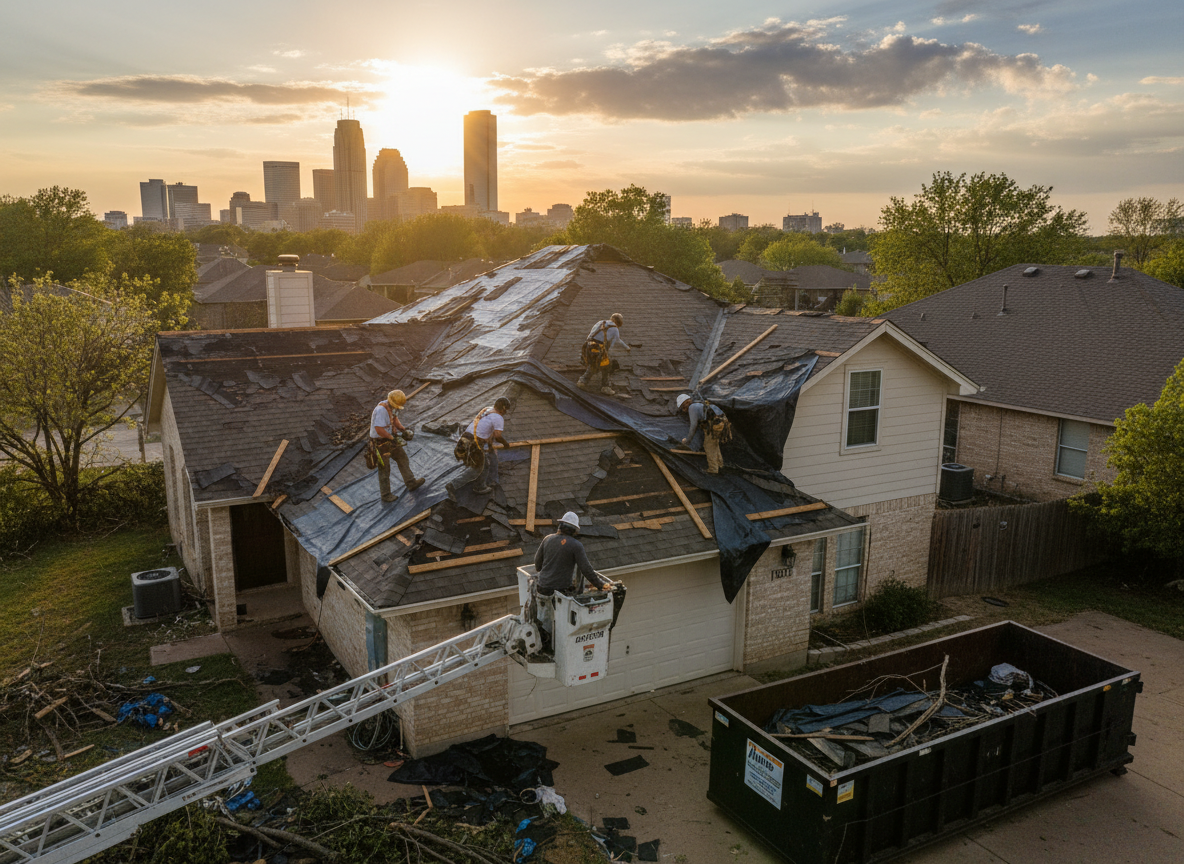
Minnesota builds its roofs for winter, and the rest of the year is spent living with what that decision costs. Pitches are steeper here than in most of the country because a roof has to shed snow, not carry it, and the ventilation and insulation detail matters more because the temperature difference between a heated attic and an outdoor eave is larger and lasts longer than almost anywhere else. A roof that would be acceptable in a milder state is a liability here, and a roof built properly for this climate is a different animal from the one on the house next door that was re-covered quickly.
That single fact explains most of the repair work in the state. Ice at the eave, water in the attic, a valley that has rusted from standing meltwater, a fascia gone soft behind a gutter full of ice — all of them trace back to the same two questions: how much heat is reaching the roof assembly, and where does the meltwater go when it gets there. This page works through snow and ice first, then the housing stock, then the failures, then the services. If water is coming in now, call (833) 406-0167 and say where it shows and when it started.
Snow, ice and the long cold
Design snow load, in plain terms
Every roof is designed for a snow load that reflects the climate where it stands, and Minnesota's is among the highest in the country. That load is not a fixed weight — it depends on depth, density and whether the snow has been rained on or has thawed and refrozen. A dry Minnesota snowfall can be light; the same depth after a January rain or a brief thaw becomes several times heavier. Older roofs, roofs that carry two or three layers of shingle, and roofs with long unsupported spans have less margin than their original design assumed.
Where the load is exceeding what the structure can carry, the evidence appears in the building rather than on the roof: a door that no longer latches, a new crack across a ceiling, a ridge line that has visibly dipped. Those are structural signals and they are handled as such, not with another layer of covering.
The ice season, which is long
Ice on a Minnesota roof is not an event; it is a condition that persists. Snow on the upper slope melts from the heat below, the water runs to an eave that stays below freezing for weeks, and a ridge forms. Water backed up behind that ridge enters the assembly and appears at the ceiling near an exterior wall. Each refreeze widens the joints it reached.
The reason it happens on some houses and not others on the same block is the roof assembly, not the weather. Air leaking from the rooms below into the attic, thin or displaced insulation, blocked soffit vents and an unbalanced ridge vent all produce the same result: a warm deck and a cold eave. Correcting the covering without correcting that is a decision to have the same conversation next January.
The thaw, and where the water goes
Spring arrives in stages here, and the first stage is the dangerous one: days above freezing with nights still below. Snow melts on the roof and refreezes in the gutters and at the ground, so the water has no path away. That is when a roof that survived the winter shows its damage — a stain that spreads over a week, a wall that goes damp, a flat section that ponds because the outlet is still frozen.
Hail, wind and summer storms
Once the snow is gone, the state moves into a storm season that produces hail, damaging straight-line wind and tornadoes, with the strongest activity generally through the southern and central counties. Hail is the quiet one: a stone that leaves the surface intact still bruises the mat beneath a shingle and shortens the life of that plane. Wind lifts caps and edges. Summer also brings the humidity that lets moss and algae establish on shaded slopes, which is the slow version of the same problem — water held against the covering.
When a retrofit changes what the roof does
One pattern shows up often enough in Minnesota to be worth naming. A house has carried snow on its roof for decades without trouble, the attic is then re-insulated — often well, often with the vents left as they were — and the first cold snap afterwards produces ice at the eave that the owner has never seen before.
The reason is that insulation changes where the heat goes. Adding insulation at the ceiling line without keeping a clear path for air from the soffit to the ridge can block the ventilation that was quietly keeping the deck cold. Sealing a house more tightly without thinking about the attic can push warm, moist air into the roof assembly instead of out of it. Either way the deck warms, the snow above it melts, and the meltwater arrives at an eave that is still below freezing.
That is why a roofing scope in this state asks about the attic before it asks about the shingles. Insulation, vapour control, soffit venting and ridge venting are one system, and a roof replacement that does not respect the system is a covering change rather than a repair. It is also the reason a new roof on an old house can perform worse than the roof it replaced, which is not what most homeowners expect to hear.
What Minnesota roofs are made of
Steep pitches and the reason for them
The dominant shape is a steep gable, often with a pitch chosen to shed snow rather than to look a particular way. On those roofs the snow slides, which is good for load and hard on everything at the bottom of the slope: gutters, downspouts, the plants below, and any lower roof the snow lands on. Snow retention and gutter protection are practical decisions here rather than accessories.
Shingle, and the layering problem
Asphalt shingle covers the great majority of the housing, from the 1920s duplexes of the Twin Cities to the newest exurban subdivisions. A large share of it is now a second or third layer, and layering is a poor fit for this climate: it traps heat, hides the deck, adds weight to a structure already carrying snow, and leaves no clean surface to detail an ice barrier against.
Brick, stucco and the inner-ring housing
The inner neighbourhoods of Minneapolis and St. Paul carry a great deal of brick and stucco housing from the early twentieth century, including many duplexes and small apartment buildings with shallow rear sections and porches. Stucco is unforgiving of a roof that sheds water onto it: a flashing that directs water behind the stucco instead of in front of it will not show until the wall has been wet for a season.
Metal, especially in the north
Ribbed metal and standing seam cover farm buildings across the state and a growing number of rural houses, particularly where snow sliding is an advantage. Metal handles the cold well; what fails is the fastener and the flashing, and the movement that a panel undergoes between a summer afternoon and a January night.
Low-slope commercial
The Twin Cities, Duluth, Rochester and St. Cloud all carry commercial and industrial low-slope roofs that drain through interior leaders and scuppers. In this climate the failure mode is seasonal: water standing at a seam in November is ice inside that seam by December, and the opening it leaves is found in March.
Where the water gets in
At the eave behind the ice ridge. The most common winter leak in the state, and the one most often misdiagnosed as a shingle failure.
At a valley. Snow sits there longest, the melt from both planes concentrates on one line of metal, and freeze-thaw works the seams.
Behind a chimney or a dormer cheek. Drifted snow sits against the masonry or the wall, and the flashing is under water for as long as the drift lasts.
Under a stucco wall junction. Water directed behind the stucco rather than in front of it shows indoors long after the flashing failed.
At a porch or rear roof. The shallow section nobody looks at, holding water because the outlet is blocked or frozen.
The diagnostic value of asking when the water appears is high in Minnesota: in cold weather it is meltwater and the answer is at the eave or the attic; in a driving rain it is a flashing or a wall junction; in spring it is often both.
Which trade a Minnesota roof needs
Most roofing services are the same words everywhere; what changes here is which of them a building actually calls for. Reading the work by building type is more useful than a list, so that is how it is set out.
On a shingle house with a steep gable. The common jobs are shingle roofing for re-cover or tear-off, roof repair for a localised failure at a valley or a pipe boot, and roof replacement once layers and patching have reached the point where another season is a gamble. Where snow sliding has taken the gutter and the bottom course with it, that edge detail is rebuilt as part of the work rather than patched afterwards. A roof inspection is what makes the tear-off-versus-re-cover decision on evidence instead of on the age of the shingle.
On a building with a flat or low-slope section. Flat roof repair does the seam, parapet and drain work, and in this climate it also has to solve the freeze: water left standing at a lap in autumn is ice inside that lap by midwinter. Roof coating is worth considering where the assembly is proved dry and the goal is another stretch of service rather than a new roof. Where the section is over a porch or a rear addition, it is usually the least-inspected part of the building and the first to pond.
On a rural or agricultural building. Metal roofing covers the panels, the fasteners and the flashings, and it is the trade that has to allow for a temperature swing from a July afternoon to a January night. Where a barn roof is being replaced rather than repaired, the structure beneath is part of the conversation, since a metal plane is only as good as the purlins carrying it.
On an older masonry or stucco building. Tile roofing applies where original clay or concrete tile is still up and the membrane beneath has finished; the tile is lifted, numbered, the membrane replaced, and the field re-laid. Flashing at a stucco or brick wall is the detail that decides whether these buildings stay dry, and it is rebuilt rather than sealed.
When the roof has just been opened. Emergency roof repair is containment: the ceiling below made safe, the room cleared, the opening recorded before anything is moved. Emergency roof tarping holds the building until permanent work is possible, battened in place because a cold adhesive sheet will not stay. Roof leak repair then finds the actual entry rather than the nearest stain, and storm and hail damage repair records what the storm did, plane by plane, so the account survives being read by someone else.
When the roof is being installed new. Roof installation is the specification stage — ice barrier at the eave, underlayment, ventilation balanced to the attic, fastening for the exposure — and in Minnesota it is the single most consequential decision in the whole job, because everything that goes wrong in January is decided there.
What's included in a Minnesota scope
- The ice problem treated as an assembly problem, with the attic, insulation, ventilation and eave detail described alongside the covering rather than left out of it.
- The water's route traced from the interior mark to the detail that held it, photographed before work starts.
- Snow-shedding details reviewed — valleys, the uphill face of chimneys and dormers, and whatever sits below the slope the snow lands on.
- Layers stated, deck inspected once the old coverings are off, since weight and heat both matter more here than in a milder climate.
- Drainage and freeze protection addressed on every low-slope section, including rear and porch roofs.
- Stucco and masonry junctions re-flashed so water is shed clear of the wall rather than sealed against it.
- A written sequence for winter: what is closed today, what is protected temporarily, and when the permanent work is completed.
From the first call to the handover
One call establishes the building, the covering, the age and the behaviour of the leak. The inspection walks the roof where it can be walked, enters the attic, and examines the eave, the valleys, the chimney and any wall junction rather than the middle of the plane. A written scope follows, naming the failure, the work and what will be opened. Requirements for permits and inspections vary by city and county, and the building department for the address confirms what applies. Winter work is sequenced around the forecast, with temporary protection on any plane that cannot be closed the same day, and the finished details are photographed at handover.
Where the work is carried out in Minnesota
Coverage runs across the state: Minneapolis, St. Paul, Duluth, Rochester, St. Cloud, Bloomington, Brooklyn Park, Plymouth, Woodbury, Mankato, Moorhead and the communities between them. The exposure changes as the map moves north and west — a longer snow season, more drifting and more ice upstate, the densest older housing and the most hail history around the Twin Cities.
Minnesota within the wider coverage
Minnesota is one of the eight Midwest states on this site, together with Illinois, Ohio, Indiana, Michigan, Wisconsin, Iowa and Kentucky. The complete list of forty states by region is on the states page.
Talking about a Minnesota roof
What is useful in the first conversation is the building and the timing: what covering is up, how many layers, whether the attic has been re-insulated, and whether the water appears in cold weather or in rain. Call (833) 406-0167 and describe what the roof is doing — the answer here usually starts at the eave.
Around Minnesota
We regularly work near:
- 📍Voyageurs National Park
- 📍Boundary Waters Canoe Area Wilderness
- 📍Itasca State Park
- 📍Split Rock Lighthouse
- 📍Gooseberry Falls State Park
Roof Repair in Minnesota — Local Notes
- •Minnesota roofs are built steep so snow sheds rather than sits; what falls off lands on gutters, lower roofs and whatever is below.
- •Ice forms on some houses on a block and not others because of attic heat, not the weather.
- •A dry snowfall can be light; the same depth after rain or a thaw and refreeze can be several times heavier.
- •Stucco is unforgiving of a flashing that directs water behind it instead of in front of it.