Ohio is easier to understand as two roof climates sharing a state line. In the north-east, Cleveland and the counties east of it take lake-effect snow in bands, and a roof there is judged on how it carries weight and how it handles meltwater at the eave for four months. Along the Ohio River, Cincinnati and the southern counties get a shorter winter but a wetter one: rain on frozen ground, ice rather than powder, and spring storms that arrive earlier. Columbus and the centre sit between the two, with enough of each to need both answers.
That difference is not academic when a roof is leaking. A stain that appears in Cleveland in February is usually an ice-dam symptom and belongs at the eave and the attic. The same stain in Cincinnati in March is more often wind-driven rain at a wall or a valley. The sections below move from the weather to the housing stock to the way failures present, then to the services and how a job runs. If the ceiling is wet now, call (833) 406-0167 and say where the water is and what the weather was doing when it started.
The two winters
Snow belt, and what a band actually means
Lake-effect snow arrives in narrow bands that can sit over one corridor for hours while a neighbouring county stays clear. That produces two problems at once: an unusual load on a small number of roofs, and a great deal of meltwater when the band finally moves and the temperature climbs. Snow that has been rained on and refrozen is heavy, and the weight sits on the same plane for weeks rather than days.
The load question is a structural one and shows up first in the building rather than the roof — a door that will not close, a hairline crack across a ceiling, a ridge that has begun to dip. Where that is happening, the roof is not the place to start.
Ice at the eave, and the freeze that follows
Most Ohio winters produce the same sequence: snow on the roof, heat escaping from the rooms below, meltwater running to a cold overhang, and a ridge of ice forming at the gutter line. Water backed up behind it enters the roof assembly and shows on the ceiling close to an exterior wall. Every subsequent freeze widens whatever joint it reached, which is why the damage from a single winter can be more than the snow suggests.
The repair that lasts is made at the ceiling line and in the attic — air sealing, insulation, ventilation — with the eave detailed so water can escape rather than sit. Replacing the shingles without that work changes the surface and leaves the cause in place.
The southern ice, which is a different event
Southern Ohio's ice arrives as glaze from a shallow layer of warm air above freezing ground. It weights limbs over roofs, brings them down onto planes that were sound the day before, takes gutters off the fascia, and leaves a smooth surface that hides a puncture until the thaw. Where a limb has rested on a roof, the damage is usually at the point of contact plus the run of shingles it scraped on the way down.
Spring and summer storms
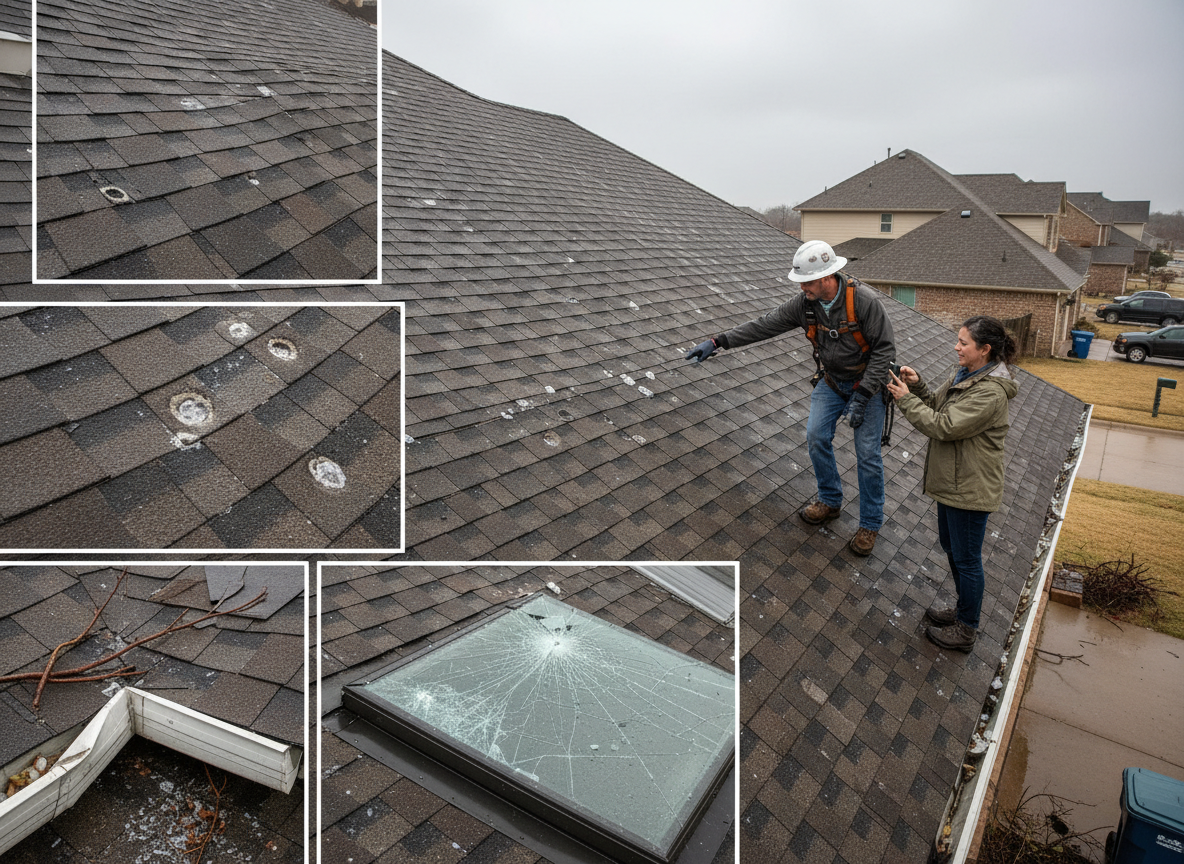
The state sees severe thunderstorms and tornadoes in most years, with the strongest activity generally through spring and again in early summer. Wind damage has a signature: lifted tabs along a rake or eave, missing ridge caps, edges peeled back where the sealant strip failed, and debris punctures that are small on the surface and open underneath. Hail is less frequent than on the plains but still produces the bruising that reads clearly from above and not at all from the driveway.
What is on Ohio roofs
Pre-war housing and the hipped roof
A large share of the state's housing was built before the middle of the last century, and the roofs on those buildings share a shape: hips rather than gables, moderate pitches, deep eaves, and a chimney on an interior wall or through the ridge. Hipped roofs shed water in four directions, which puts four valleys and four hips on a roof that a modern gable would resolve with two planes. More junctions means more places to fail, and the valley is where most of Ohio's older roofs eventually leak.
Slate, and what it means to repair one
Cleveland, Cincinnati and Columbus all have historic districts where the original slate is still up, usually on churches, schools and the larger houses. Slate is a lifetime material when it is left alone, but it is unforgiving of foot traffic, and the flashings around it — valleys, chimney aprons, ridge iron — are usually the same age as the roof. Repairing one is a matter of matching the source and size of the slate, lifting the surrounding courses without breaking them, and replacing the metal rather than sealing over it.
Shingle, mostly, and often in layers
Asphalt shingle covers the great majority of the state's houses, from mid-century ranches to recent subdivisions, and a lot of it now carries two or three layers. Layering hides the deck, adds weight, and makes the next repair harder, because there is no clean surface to tie into and the fasteners have less to hold. Where a roof has been layered twice, the honest question is whether another patch is worth doing at all.
Low-slope commercial and the older downtown buildings
Ohio's downtowns and industrial corridors carry a lot of low-slope membrane and built-up roofing, mostly on buildings whose roofs drain through interior leaders, scuppers and parapet openings. Those roofs fail at seams, at the base of the parapet and around penetrations rather than in the field, and the water usually enters the wall before it enters a room.
Porch roofs, additions and the planes added later
A great many Ohio houses have grown a rear addition, an enclosed porch or a dormer since they were built, and those additions are where a roof becomes difficult. The junction between an old plane and a new one is a change of pitch and usually a change of covering, and the flashing that bridges the two was often done quickly because it is out of sight from the ground. Additions also tend to carry shallower pitches and poorer ventilation than the original roof, which makes them the first place ice forms and the last place anyone looks.
Where an addition meets a wall, the roof has to be counter-flashed into the masonry or the siding rather than run up against it and sealed. That detail is the difference between a junction that stays dry for two decades and one that is re-caulked every second autumn.
Gutters, fascia and water that never leaves
Ohio's rainfall is spread across the year rather than concentrated into a season, so gutters work constantly and fail gradually. A run that has pulled away from the fascia, a hanger that has rusted through, or a downspout discharging against the foundation all end up indoors long after the cause was visible from the ground. On older houses the fascia board behind the gutter is often the first timber to go, and by the time the run is hanging loose the rot has travelled into the rafter ends.
Clearing a gutter does not fix a roof, but a blocked one changes what the roof is asked to do. Water that should leave the building is instead held against the eave, which is exactly where the ice forms in January and where the fascia rots by the following winter.
How an Ohio leak announces itself
A stain that grows during a thaw, not during rain. That is meltwater backing up at the eave, and it points to the ice-dam sequence rather than to a hole in the field.
A damp patch on an interior wall below a chimney. Masonry moves differently from the roof, and the flashing at that joint is where the two part company.
Water at a valley during heavy rain only. Valleys take twice the volume of the planes that feed them, and a valley that was cut short or has corroded metal only shows in a downpour.
A ceiling stain under a flat section of an older downtown building. Seam and parapet work, often with ponding behind a blocked leader.
Granules in the gutter and a slope that looks grey. Age rather than damage — the shingle has lost its surface and its ability to shed, and no repair changes that.
Services in Ohio terms
Getting the building dry. Emergency roof repair comes first after a limb strike or a wind event: contain the ceiling, isolate the room, photograph the opening before anything is moved. Emergency roof tarping is the temporary cover for a roof that cannot be worked safely or is waiting on material, fixed mechanically with battens because adhesive sheets do not survive Ohio wind.
Tracing the entry. Roof leak repair works from the interior stain outward, since water travels along rafters and top plates and the opening is seldom above the mark. Storm and hail damage repair surveys slope by slope and keeps wind, impact and wear separate, which is what makes the scope defensible later.
Working with the covering. Shingle roofing covers repair, replacement and correcting failed detail on a sound roof; where layers have to come off, the deck is inspected at the same time. Tile roofing covers clay and concrete tile where it exists on older buildings and porch roofs, lifted and re-laid over new underlayment. Metal roofing handles ribbed panels on outbuildings and agricultural buildings, standing seam on newer houses, and the fastener and washer failures that come with both. Flat roof repair is the downtown and commercial work — seams, parapet bases, drains and penetrations. Roof coating is considered only on a dry, sound low-slope assembly after moisture testing.
Repair or replace. Roof repair covers the ordinary failures: a slipped slate, a split boot, a lifted ridge cap, a valley pan rusted through, counter-flashing pulled from a mortar joint. Roof replacement is decided by the number of layers, the age of the covering, how often the same plane has been patched, and what the tear-off shows. Roof installation fixes the specification — ice barrier at the eave, underlayment, ventilation, fastening — which is what determines how the roof behaves in its tenth winter.
Documentation. Roof inspection records the covering, flashing, valleys, drainage and the attic side with photographs, so a decision between repair and replacement rests on something a homeowner can revisit.
What's included in an Ohio scope
- The failure located, not assumed — the leak traced from the interior mark to the junction that let it in, photographed before work begins.
- The eave and the attic treated as one item where ice is involved, since a scope that replaces shingles and leaves the ventilation alone is a repeat visit waiting to happen.
- Layers accounted for. Where two or three coverings are already up, the scope states whether the new work ties into them or removes them, and what that means for the deck.
- Valleys and flashings rebuilt rather than coated, in metal appropriate to the covering and the pitch.
- Deck repairs priced as a possibility, opened and confirmed rather than discovered at the end.
- Drainage checked on every low-slope section — leaders, scuppers, drains, and where the water actually goes.
- A sequence in writing for anything weather-dependent: temporary protection, permanent work, and the point at which the roof is closed.
How the work runs
A call, then an inspection that reaches the detail rather than the field: the roof walked where it is safe, the attic entered, the valleys and chimneys looked at close range. From that comes a written scope naming what failed, what will be opened, and what happens if the opening reveals more than expected.
Permits and inspections are handled locally, and requirements vary by city and county, so the building department for the address confirms what applies before scheduling. In winter, work is sequenced around the forecast and temporary protection goes on wherever a plane cannot be closed in a single visit. At handover the finished details are photographed and handed over, because the next person to look at that roof — a buyer's inspector, an adjuster, another roofer — will be looking at the same junctions.
Where the work is carried out in Ohio
Coverage runs statewide: Columbus, Cleveland, Cincinnati, Toledo, Akron, Dayton, Youngstown, Canton, Lorain, Springfield, Hamilton, Lima, Mansfield and the smaller cities between them. The exposure changes with the map — lake-effect snow and older slate in the north-east, river ice and wind-driven rain in the south-west, and a mix of both through the centre.
Ohio within the wider coverage
Ohio is one of the eight Midwest states on this site, alongside Illinois, Indiana, Michigan, Wisconsin, Minnesota, Iowa and Kentucky. The full set of forty states, grouped by region, sits on the states page.
Starting the conversation
Describe the roof rather than the symptom: what covering is on it, roughly how old it is, whether it has been layered, where the water shows, and when it appears. Those five answers point to the right inspection before anyone climbs. Call (833) 406-0167 and the first part of the conversation is working out which of Ohio's two winters your roof has been through.
Around Ohio
We regularly work near:
- 📍Cuyahoga Valley National Park
- 📍Hocking Hills State Park
- 📍Serpent Mound
- 📍Perry's Victory and International Peace Memorial
- 📍Hopewell Culture National Historical Park
Roof Repair in Ohio — Local Notes
- •Lake-effect snow arrives in narrow bands, so two roofs a few miles apart can carry very different loads in the same week.
- •Water backed up behind ice at the eave enters the roof assembly and shows on the ceiling near an exterior wall, not at the ridge.
- •Southern Ohio's ice is glaze rather than powder, and it brings limbs down onto planes that were sound the day before.
- •A hipped roof puts four valleys and four hips on a building that a gable roof would resolve with two planes.