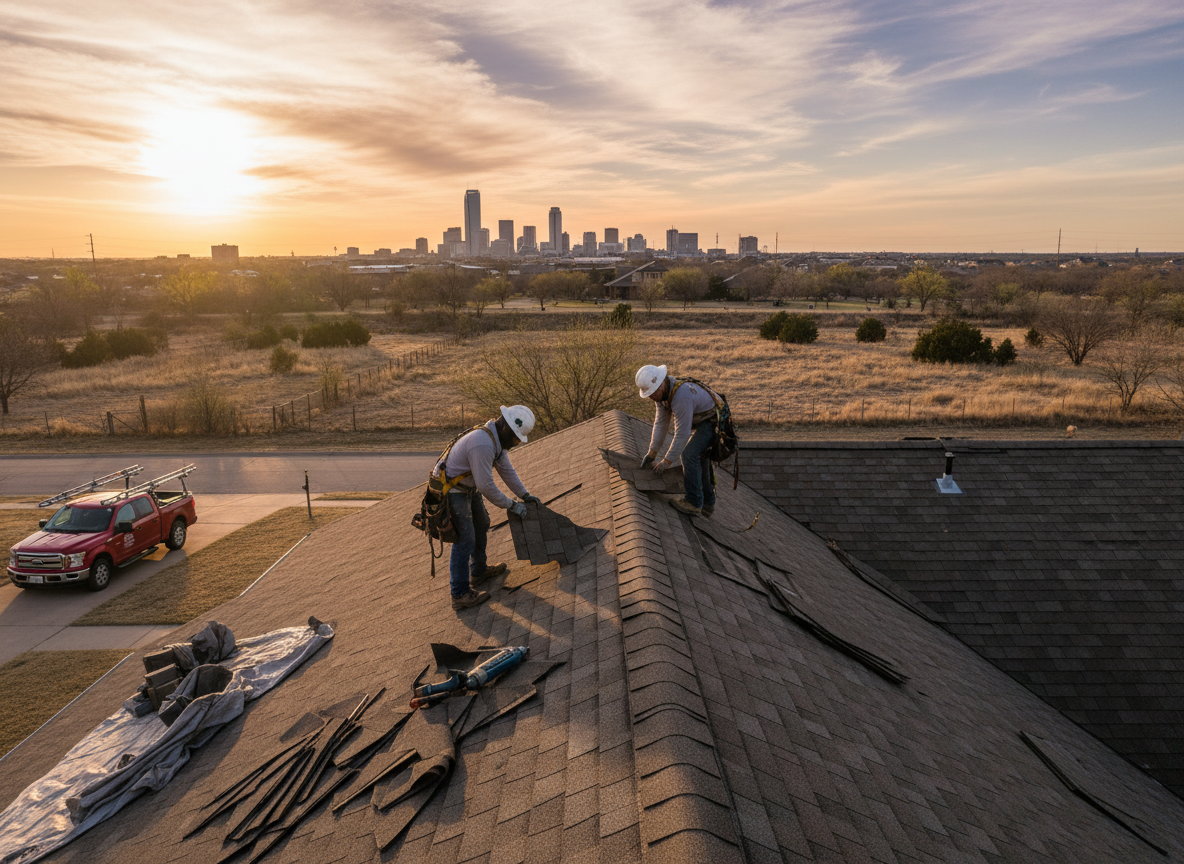
In Michigan the roof you have depends on which side of the state you are standing on. The lake-effect belts that run down the western counties and across the Upper Peninsula can put several feet of snow on one town in a week while the south-east stays comparatively clear, and the difference is measured in miles rather than in counties. A roofing problem in Grand Rapids is a snow-load and ice-dam problem; the same symptom in Detroit is more often freeze-thaw at the eave on a hundred-year-old brick house or a flat commercial roof that has been patched for two decades.
Both halves of the state share one thing: the ground freezes and thaws repeatedly through the winter, so water is repeatedly given the chance to get into a joint and then expand inside it. That cycle, more than any single storm, is what ends a Michigan roof. The sections below set out the belts and what they mean, the housing stock, the details that fail, and how the work is carried out. If water is coming in now, call (833) 406-0167 and say which side of the state the building is on and what the roof is doing.
The belts, and what snow actually does
Lake-effect snow in narrow bands
Cold air crossing Lake Michigan picks up moisture and releases it as snow over the first high ground it meets, which is why the western counties and the northern Lower Peninsula carry some of the deepest seasonal accumulations in the region. A band can stall over one corridor and drop a large depth in hours, then shift, leaving a neighbouring town with a fraction of it. Two consequences follow. The first is load, concentrated on a small number of roofs. The second is melt: when the band moves and milder air arrives, all of that snow turns to water in a short window and has to leave the roof through the eave, the gutter and the ground.
What load tells you, and where
A roof is designed for an expected ground snow load that varies with location, and the load it actually carries depends on depth, density and whether the snow has been rained on and refrozen. Wet snow can weigh several times what the same depth of dry powder weighs. The signs of an overload are rarely on the roof: a door that stops latching, a new crack across a ceiling, a ridge that has begun to dip. Where those appear, the structure is the conversation and the covering is secondary.
Ice dams and the freeze-thaw cycle
The classic Michigan sequence is snow on the roof, heat escaping from the rooms below, meltwater running to a cold overhang, and refreezing at the gutter line. The ice ridge that forms holds water against the eave until it backs up under the courses and enters the assembly, showing indoors as a stain near an exterior wall. Every freeze that follows widens whatever joint the water reached — which is why one bad winter can do more damage than several mild ones.
Freeze-thaw is also the reason flashing details fail here faster than elsewhere. Water enters a lap, a mortar joint or a seal, freezes, expands, and opens it a little further. Repeat that through a winter and a detail that was sound in October is passing water by February.
Summer, hail and wind
Michigan summers are moderated by the lakes but still produce severe thunderstorms, hail and occasional tornadoes, mostly through the southern half. The damage pattern is familiar: hail bruising the mat beneath a shingle, wind lifting tabs at the rake and ridge, and debris puncturing a plane. The lakes also raise humidity, and a roof that stays damp in shade grows moss and lichen, which hold water against the covering long after the surface has dried.
The Upper Peninsula and the far north
The far north runs a different calendar. Winter arrives earlier and leaves later, and the snow that falls is drier and more mobile, so it drifts against anything that interrupts the wind — a chimney, a dormer, a vent stack, the uphill side of a valley. Drifting is its own problem: a drift sits against a penetration for weeks, the meltwater from it works at the collar, and the leak appears at the first mild spell rather than during the storm.
On the metal roofs common there, snow also slides. A slide takes gutters, downspouts and anything loose at the eave with it, which is why snow retention and gutter protection are practical questions in the north in a way they are not in the south-east. The same slide is why the eave detail on a northern metal roof is built to be hit.
What is on Michigan roofs
The brick house and the shallow roof
Southeast Michigan holds a very large stock of brick and masonry houses built in the first half of the last century, and many of them were given shallow roofs — low hips, wide eaves and a pitch that sheds slowly. Brick walls move with temperature, and a roof that meets a masonry wall has to allow for that movement at the flashing. When the counter-flashing was set into a mortar joint that has since cracked, water enters the wall and appears indoors well below the roof line.
Flat and low-slope on the commercial stock
Detroit, Flint, Saginaw and Grand Rapids all carry low-slope commercial and industrial buildings whose roofs drain through interior leaders, scuppers and parapet openings. These fail at seams, at the base of the parapet and around penetrations, and ponding is common where the original slope has settled. In a freeze-thaw climate, water that stands at a seam in November is ice inside that seam by January.
Shingle through the suburbs, metal in the north
Asphalt shingle covers most suburban and small-town housing, and much of it is now in a second or third layer. Metal — ribbed panels and standing seam — covers farm buildings, outbuildings and an increasing share of rural houses, and it is the covering most exposed to the northern belts, where snow slides rather than sits and the fasteners take the movement.
Cedar, moss and the shaded slope
Older houses in the northern counties and along the lakeshore sometimes carry cedar shakes or shingles. Cedar handles snow well and rain badly once it has dried out and cupped, and in Michigan's humidity a shaded north slope will hold moss that keeps the wood wet. Moss is not a cosmetic issue on cedar; it is the mechanism by which the covering stays damp and the fasteners corrode.
The details that fail here
The eave, every winter. Ice backing water under the first courses, showing as a stain near an exterior wall.
The masonry joint above a flashing. Counter-flashing that was set into mortar and has since opened, letting water into the wall rather than the room.
A seam on a flat roof after a freeze. Water standing at a lap in autumn becomes ice inside the lap by midwinter.
A valley on a shallow roof. Snow sits in the valley longer than anywhere else, and the melt from both planes is concentrated there.
A vent or a chimney on the windward slope. Drifting snow packs against it and meltwater works at the collar.
The pattern behind all five is the same: the failure happens where water is held rather than where water runs. Finding the place where it is being held is the whole of the diagnosis.
The work, grouped by what it has to achieve
Keeping the house dry this week. When a plane has been opened by wind or a limb, emergency roof repair is about containment first: the ceiling below made safe, the room isolated, the opening recorded before a hand touches it. Emergency roof tarping buys the time — mechanically battened, because nothing adhesive survives a Michigan gale or a February night.
Finding which detail is holding water. Roof leak repair begins at the interior mark and works back along the rafters and top plates to the junction responsible, using the attic and moisture readings rather than guesswork. Storm and hail damage repair is a plane-by-plane record that keeps impact, wind and age apart, so a scope can be read by someone who was not on the roof.
Restoring the covering. Shingle roofing handles tear-off, re-cover and the correction of failed edges on the state's dominant covering. Metal roofing deals with the movement a metal plane has to live with — fasteners, washers, seams and the flashings that allow a panel to grow in the sun and shrink at night. Tile roofing is the older-building trade of lifting, numbering, re-membraning and re-laying. Flat roof repair is seam and drainage work on the commercial stock, where the failure is almost always at a lap, a parapet base or an outlet. Roof coating is a decision taken after the assembly has been proved dry, never a way of avoiding that test.
Deciding how much roof to spend on. Roof repair addresses isolated failures — a cap that has lifted, a boot that has split, valley metal that has rusted, a parapet that has opened. Roof replacement comes down to how many coverings are already there, how the plane has been patched, and what the deck looks like once it is bare; in this climate it is also the one opportunity to correct the eave and the attic that produced the ice. Roof installation is where that is specified: ice barrier, underlayment, balanced ventilation, and fastening matched to the exposure.
Putting it on paper. Roof inspection delivers a condition record — covering, flashings, drainage, eave detail, attic side, photographed — that a homeowner, a buyer's inspector or an adjuster can all read the same way.
What's included in a Michigan scope
- The eave and the attic treated together, because a scope that replaces shingles and leaves the ventilation untouched brings the ice back in the first cold snap.
- The water's route, traced from the interior mark to the detail holding it, with photographs taken before work starts.
- Masonry junctions re-flashed rather than sealed, with counter-flashing set into a sound joint instead of a bead over a cracked one.
- Layers accounted for where two or three coverings are already up, with the deck inspected once they are off.
- Drainage corrected on every low-slope roof, since standing water at a seam is the mechanism that opens it in a freeze.
- Deck repairs listed as a possibility and confirmed on opening rather than discovered at the end.
- A sequence in writing for weather-dependent work, with temporary protection wherever a plane cannot be closed in one visit.
How a Michigan job runs
A call establishes the building, the side of the state it is on, and what the roof is doing. The inspection then walks the roof where it can be walked, enters the attic, and looks at the eave, the masonry junctions and the valleys rather than the field alone. A written scope follows, naming the failure, the work, and what will be opened. Permits and inspections are handled locally — requirements vary by city and county — and the building department for the address confirms what applies. In winter the sequence is built around the forecast, with temporary protection on any plane that cannot be closed the same day, and the finished details photographed at handover.
Where the work is carried out in Michigan
Coverage runs across the state: Detroit and its suburbs, Grand Rapids, Lansing, Ann Arbor, Flint, Kalamazoo, Saginaw, Muskegon, Traverse City, Marquette and the towns between them. The exposure changes with the map — lake-effect belts and metal coverings on the west and north, older brick housing and flat commercial roofs in the south-east.
Michigan within the wider coverage
Michigan is one of eight Midwest states on this site, with Illinois, Ohio, Indiana, Wisconsin, Minnesota, Iowa and Kentucky. All forty states are grouped by region on the states page.
Starting with the roof you have
Tell us the county, the covering, roughly how old it is, whether the ceiling stains appear in cold weather or in rain, and whether the roof has been layered. Those answers separate an ice problem from a flashing problem before anyone climbs. Call (833) 406-0167 and the conversation begins with what the Michigan winter has already done.
Around Michigan
We regularly work near:
- 📍Sleeping Bear Dunes National Lakeshore
- 📍Pictured Rocks National Lakeshore
- 📍Isle Royale National Park
- 📍Mackinac Island
- 📍Tahquamenon Falls State Park
Roof Repair in Michigan — Local Notes
- •Lake-effect snow falls in narrow bands, so the depth on a roof can differ sharply between towns a few miles apart.
- •Water held at a seam in autumn is ice inside that seam by midwinter, which is why flat roofs open in a freeze.
- •Masonry walls and roofs move at different rates, so counter-flashing set into a cracked mortar joint is a slow leak into the wall.
- •On a shallow roof, snow sits longest in the valley, where the melt from both planes is concentrated.