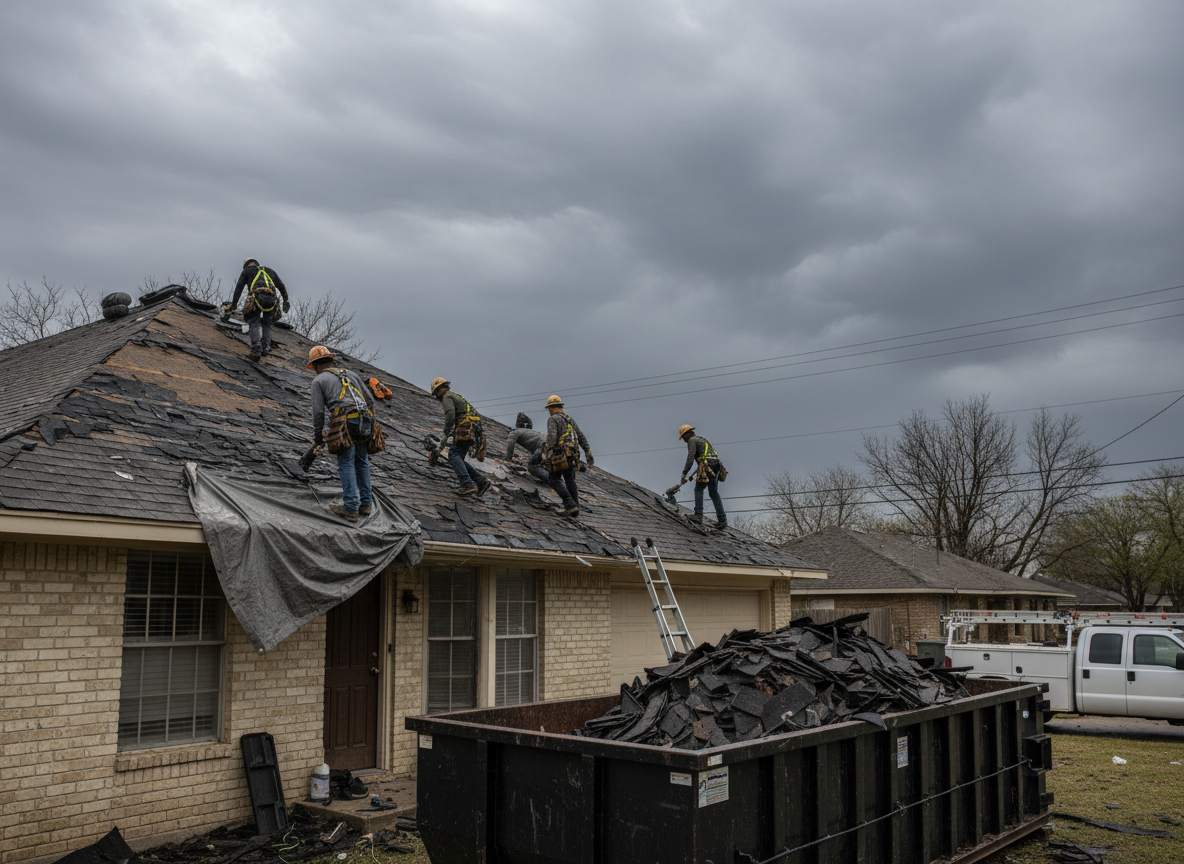
Wind is the first fact about an Iowa roof, and it is not the wind of a summer afternoon. The state sits in the corridor where thunderstorm complexes organise into long lines and cross hundreds of miles without breaking up, and the result is sustained straight-line wind that loads a roof for minutes rather than seconds. The most damaging of these events are remembered by name, and the pattern they leave is consistent: edges peeled, ridge caps gone, shingles lifted in runs rather than patches, and debris punctures scattered across whole neighbourhoods.
Hail follows in the same storms, and winter follows the storms. Between the three, an Iowa roof is asked to resist impact, pressure and weight in the same year, on a housing stock that runs from farmsteads with metal roofs to small-town shingle and the newer suburbs around Des Moines. This page takes the wind first because it shapes everything else, then the hail, then the winter, then the buildings and the work. If the roof has been opened, call (833) 406-0167 and say what happened and where the water is going.
Wind, and the shape of the damage
Straight-line wind is not a lesser storm
A tornado is narrow and violent; a derecho is wide and sustained. Both remove roofs, but the second does it across a swath tens of miles wide, which is why a single event can require work in several counties at once. For a single building, the mechanism is the one that governs every wind failure: air moving over the surface pulls up, air that has entered under an edge pushes up, and the two add together at the perimeter. A roof under sustained flow sits under that load for minutes, and a tab that would have held in a gust lifts and stays lifted.
Once the sealant strip has cracked, the tab will not re-bond convincingly, and a repair that presses it back down is a repair that fails in the next event. The reliable fix is replacement of the affected course and the fastening behind it, which is why wind damage is usually counted in runs and edges rather than in single shingles.
What a wind-damaged roof looks like from the ground
Very little. A lifted ridge cap, a missing piece at a hip end, a gutter that has been pulled forward, a downspout hanging loose. The damage that matters is often on the far slope, at the rake, or under the debris that came to rest on the roof. That is why a wind survey walks the perimeter and both faces rather than looking at the plane that faces the road.
Hail in the same storms
Iowa hail is the quiet half of the same weather. A stone that does not break the shingle surface still bruises the mat, loosens the granules above it and shortens the life of that area. On the slope it reads as a soft spot with a ring of displaced granules; on vents, valleys and caps it reads as dents. Those two records together are what separate hail damage from age, and the distinction matters because the same storm arriving on a twenty-year-old roof produces a different scope from a new one.
Winter on the open plain
Iowa snow is often accompanied by wind, which means drifting rather than an even layer. Drifts pack against chimneys, dormers and vent stacks, and they sit there for weeks. The meltwater from a drift works at the flashing behind it, and the leak appears during the first mild spell rather than during the storm. Where snow is not drifted, the freeze-thaw cycle at the eave does the same work as anywhere else in the region: melt, refreeze, back up, stain the ceiling near an exterior wall.
Windbreaks, shade and the roof behind them
Iowa farmsteads were planted with shelterbelts for a reason, and the reason still shows on the roof. A building inside a windbreak takes a different load from one standing alone in a field: the trees break the flow, the pressure at the edges drops, and a roof that would peel on open ground can survive the same storm. It is one of the few places where the landscape is on the roof's side.
Two consequences follow. The first is that removing trees — for age, storm damage or a change of use — changes the wind exposure of the building behind them, and a roof that has been sheltered for decades may not perform the same way once it is not. The second is shade. A roof under trees sits cool, keeps moisture longer and grows moss on the northern planes, and the debris that falls into the valleys and gutters is the most common cause of the ponding that ends a low-slope section.
That is worth knowing before a roof is judged on its appearance. A shaded plane with moss and debris is not necessarily a worn plane, and a bright open plane is not necessarily sound — the two have been exposed to different things, and a scope that treats them the same is guessing.
The buildings, and what is on them
Farmsteads, pole barns and metal
Away from the cities, the roofscape is metal. Ribbed panels cover machine sheds, pole barns and a growing share of farmhouses, and the exposure suits the material — wind passes over a metal plane better than almost anything else, and snow slides. What fails is the detail: fastener washers that have perished, screws backing out of purlins, cut edges that were never dressed, and the flashing where a panel meets a masonry wall or a silo. On an older barn the roof is often the last original part of the structure still doing its job, and the question is whether the frame can carry new sheets.
Small-town shingle and the older downtown
Most Iowa towns have a core of late-nineteenth and early-twentieth-century brick commercial buildings with flat roofs behind a parapet, and a surrounding grid of houses in shingle. The downtown buildings fail at the parapet and the seams, and water enters the masonry rather than the room. The houses fail at the edges in wind and at the valleys in rain.
The suburbs and hail history
Des Moines and its suburbs, Cedar Rapids, the Quad Cities and Iowa City all hold large volumes of post-war and late-twentieth-century housing in asphalt shingle, much of it already re-covered. Hail history is the deciding factor on those roofs, and it is the reason documentation matters: a plane that has taken two hail events and a re-cover is at a different point from an identical-looking plane next door.
Areas that flooded, and the roofs above them
Where a town has been through a river flood, the roofs above the waterline are often the part of the building that was never examined. Long exposure to damp air from below, followed by a hot summer, is hard on decking and on the attic side of the assembly, and staining that appears a year after the water receded is usually connected to it.
Where an Iowa roof fails first
The ridge and the rake. The highest and most exposed lines, and the first to lose caps and tabs in sustained wind.
The wall junction on the windward face. Water driven at a wall gets in without any opening in the field, and the stain appears well below the roof line.
A valley after heavy rain. Both planes feed one line, and a valley that was cut short or has corroded metal only shows in a downpour.
A parapet on a downtown building. Coping lifts, water enters the masonry, and the ceiling below is the last place it shows.
Behind a drifted chimney or dormer. Meltwater from a drift, working at a flashing for weeks.
The pattern is consistent: on this roofscape the failures are at edges and junctions, and reading the middle of a plane tells you almost nothing.
The services, by what the building needs
After a wind event. Emergency roof repair is containment — make the ceiling below safe, clear the room, record the opening before anything is moved. Emergency roof tarping holds the building until permanent work can be scheduled, battened in place rather than relying on an adhesive in Iowa wind. Storm and hail damage repair then documents the event plane by plane, keeping impact, wind and age apart so the account survives scrutiny.
Finding the entry. Roof leak repair works from the interior mark outward through the attic, using moisture readings and a controlled water test where conditions permit, so the detail is proved before it is opened.
On a shingle roof. Shingle roofing covers re-cover, tear-off and the edge and ridge details that take the wind. Roof repair handles the single failure — a lifted cap, a split boot, a valley, a wall junction — and roof inspection supplies the written condition record that makes the next decision a considered one rather than a reaction to the last storm.
On a farm or metal building. Metal roofing is the trade for panels, fasteners, washers, cut edges and flashings, including the re-flashing where a sheet meets masonry.
On a flat or low-slope roof. Flat roof repair covers seams, parapets, drains and penetrations on the downtown and commercial stock, and roof coating is considered where the assembly is proved dry and the aim is service life rather than replacement.
On an older building with tile. Tile roofing applies where original clay or concrete tile is still in place and the waterproofing beneath it has finished; the field is lifted, numbered, re-membraned and re-laid.
For a roof that has reached the end. Roof replacement is decided on layers, age and hail history, with the deck inspected once the old covering is off. Roof installation sets the specification that decides how the new roof behaves in the next wind event — underlayment, fastening pattern, edge metal and ventilation.
What's included in an Iowa scope
- The wind exposure of the site, noted rather than assumed, because an edge on open ground is detailed differently from one sheltered by a windbreak.
- The route the water took, traced from the interior mark to the failed junction and photographed before work starts.
- Edges, ridges and perimeter metal rebuilt with the fastening the covering requires, since these are where Iowa wind does its work.
- The storm separated from the wear — impact, wind and age recorded in their own columns, so the scope is defensible months later.
- Layers stated and the deck opened where the covering has leaked or taken repeated hail.
- Drainage and parapets addressed on every low-slope and downtown roof, with ponding treated as a drainage question first.
- A written sequence for weather-dependent work, with temporary protection wherever a plane cannot be closed in one visit.
How the work runs
The first call establishes the building, the covering and what the weather did. The inspection then walks the perimeter and both faces, enters the attic, and looks at the wall junctions, valleys and parapets rather than the middle of the roof. A written scope follows with the failure, the work and what will be opened named in it. Permits and inspections are local, and requirements vary by city and county, so the building department for the address confirms what applies. Work is sequenced around the forecast, temporary protection goes on wherever a plane cannot be closed the same day, and the finished details are photographed at handover.
Where the work is carried out in Iowa
Coverage runs across the state: Des Moines and its suburbs, Cedar Rapids, Davenport and the Quad Cities, Sioux City, Iowa City, Waterloo, Council Bluffs, Ames, Dubuque, Ankeny, West Des Moines and the towns between them. The exposure changes with the map — open-plain wind and farmstead metal through the west and north, denser shingle housing and a longer hail history around the capital and the eastern cities.
Iowa within the wider coverage
Iowa belongs to the eight Midwest states covered here, alongside Illinois, Ohio, Indiana, Michigan, Wisconsin, Minnesota and Kentucky. The forty states, grouped by region, are on the states page.
A conversation about an Iowa roof
What is useful to know first is the site and the history: what the building stands in front of, what the covering is, how many layers, when it was last through a hail event, and where the water shows. Call (833) 406-0167 and describe what the roof has been through.
Around Iowa
We regularly work near:
- 📍Effigy Mounds National Monument
- 📍Loess Hills
- 📍Maquoketa Caves State Park
- 📍Pikes Peak State Park
- 📍Amana Colonies
Roof Repair in Iowa — Local Notes
- •Sustained straight-line wind loads a roof for minutes, which is why damage appears in runs along edges rather than in single shingles.
- •Iowa snow usually arrives with wind, so it drifts against chimneys and dormers and the leak appears during the thaw.
- •Farmstead metal fails at washers, backed-out screws and cut edges, not in the middle of a panel.
- •A downtown brick building leaks into the wall at the parapet before it ever shows on a ceiling.